
REITs vs Property Investment in Singapore: Which Fits You?
In Singapore, a REIT lets you own a slice of a property portfolio for a few hundred dollars, collect regular distributions and sell on the stock exchange. Buying physical property means a much larger cheque, stamp duties and hands-on ownership, in return for a tangible asset you control. The right choice depends on your capital, your time horizon and how much control you want.
This guide compares the two on the points that decide the matter: entry cost, taxes and stamp duty, income, liquidity, borrowing, risk and portfolio fit.
TL;DR
- A REIT is a pooled, professionally managed fund of income-producing property that trades like a share. Direct property is a single asset you own, finance and manage.
- Entry capital differs sharply: REITs need as little as a few hundred dollars, while a second private home can need roughly 25% of the price in upfront costs.
- S-REITs must distribute at least 90% of taxable income, and published average yields have run above typical net yields on direct property.
- Direct property gives control, tangible ownership and the option of leverage. REITs give liquidity and diversification.
- Many investors hold both, and the sequence matters because ABSD depends on how many properties you already own.
Table of Contents
- What each option actually is
- Capital and entry costs
- Income and returns
- Side-by-side comparison
- Liquidity, diversification and borrowing
- Risks to manage on each route
- Which one fits you
- Our perspective
- Start with a free valuation or a conversation
- FAQ
- Sources
What each option actually is
When you invest in a REIT, your money is pooled with other investors’ in a collective investment scheme. It holds a portfolio of income-generating real estate such as shopping malls, offices, hotels or serviced apartments. The assets are professionally managed, and the revenue, mostly rent, is normally distributed at regular intervals after management and property fees, according to MoneySense. You buy units through a broker, the same way you buy shares.
The market is substantial. Singapore has 41 REITs and property trusts with a combined market capitalisation of S$104 billion, about 10% of all listed stocks, according to the REIT Association of Singapore’s chartbook (data as of 31 December 2025). The same data shows an average distribution yield of 5.9% and an average gearing ratio of 39%.
Direct property is different in kind. You hold title to a specific unit, whether a condominium, a shophouse or a commercial office. You decide the tenant, the rent and the sale timing, and you carry the costs. Our residential listings and commercial listings show the range of assets available.
Capital and entry costs
This is where the two routes differ most.
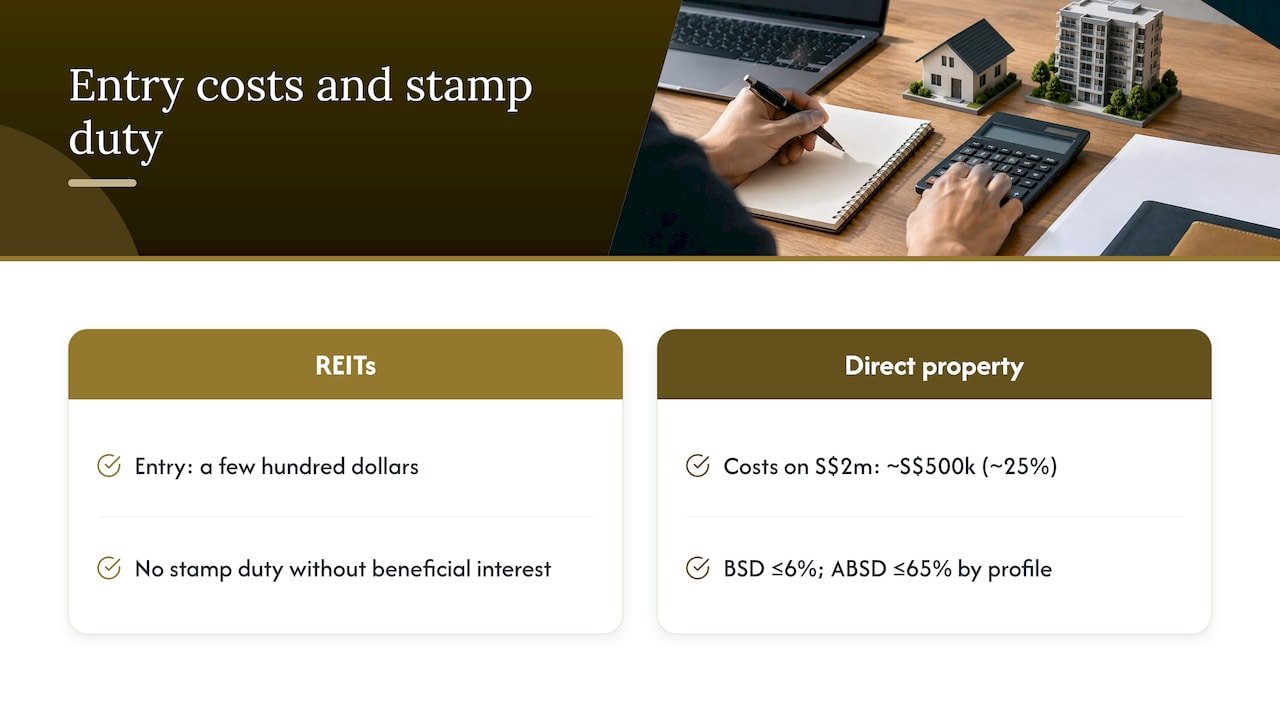
REITs. Little capital is needed. REITs can be bought with as little as a few hundred dollars, and units can be sold on the stock market almost instantly, according to the Engage commentary cited by MoneySense. Because REIT units are securities, an investor who holds no beneficial interest in the underlying property is not liable for stamp duty, according to the Ministry of Finance.
Direct property. The Ministry of Finance states that buyers of residential property pay Buyer’s Stamp Duty of up to 6% and Additional Buyer’s Stamp Duty (ABSD) of up to 65%, depending on their ABSD profile (MOF). DBS notes that ABSD is currently 20% for Singapore citizens buying a second home, and that all-in initial costs for a second property can be roughly 25% of the price. On a S$2 million property, that could reach around S$500,000 (DBS).
For a closer look at budgeting, see our guides to second property costs and sequencing, ABSD rates and cash examples and, for non-residents, what foreign buyers must budget for ABSD.
Planning ABSD in the property route
ABSD is a planning variable, not just a cost. The way purchases are sequenced and structured changes what you owe. Register Today’s approach is built around enabling clients to invest in property without carrying the ABSD burden, and we explain the method in our guide to avoiding ABSD on a second Singapore property. That is the main reason many investors who want to own physical property talk to us before they sign anything.
Income and returns
How each one pays you
S-REITs are legally required to distribute at least 90% of their taxable income to unitholders, mainly from rent plus profits from any asset sales (DBS). Those distributions are tax exempt for individual investors, as DBS notes. The structure is described as double tax transparency: income at source and income passed to retail investors are exempt, with conditions. A REIT must pay out 90% or more of its income and cannot borrow more than 50% of total asset value (The Business Times).
Direct property returns come from two places: rental yield and capital appreciation. DBS explains that the net result depends on rent, price growth and costs such as maintenance, stamp duties and taxes (DBS). Our Singapore rental yield snapshot shows how gross and net yields differ in practice.
What the numbers look like
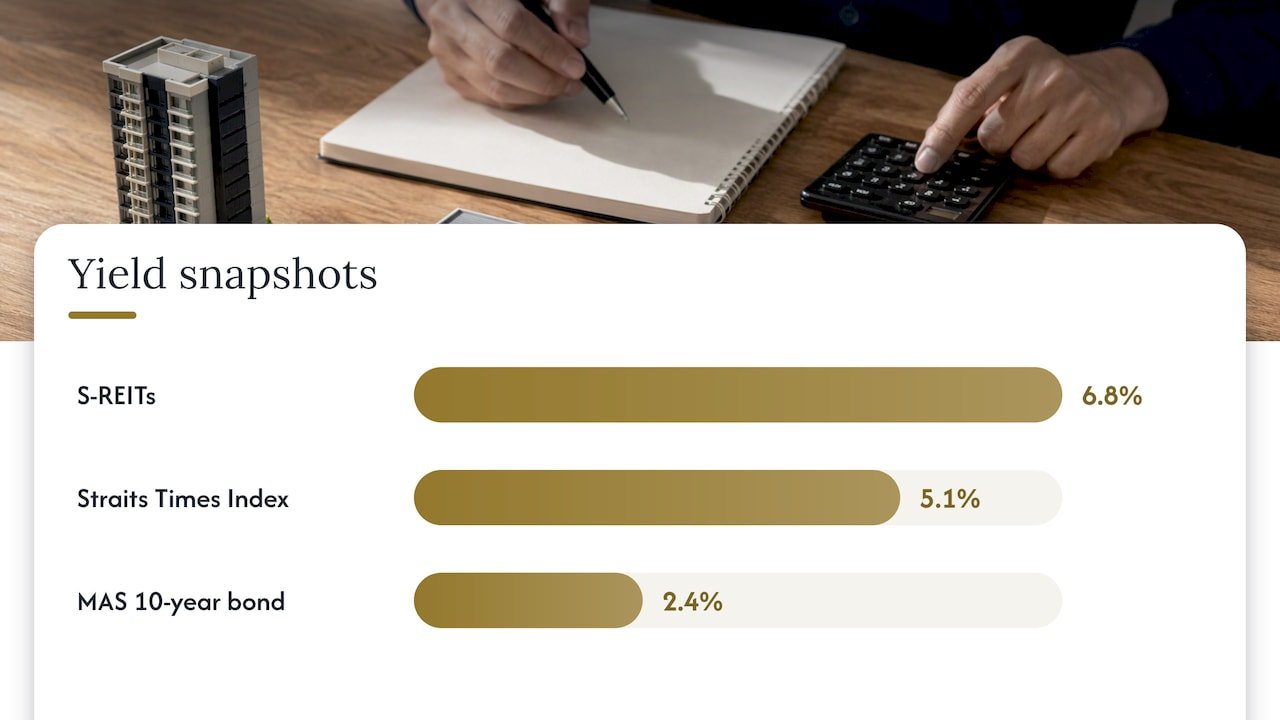
As of 30 May 2025, S-REITs offered an average dividend yield of 6.8%, against 5.1% for the Straits Times Index and 2.4% for the MAS 10-year government bond (DBS). An older paper from 2021 put large REIT yields at 4 to 5% and net yields on private residential property at around 2% a year (Ministry of Investments). Yields move with prices, so treat each figure as a snapshot of its date.
Yield is not the whole return, though. A yield measures income only. Direct property also offers capital appreciation, and an owner may use borrowing to magnify it. Over the long run, First Sentier Investors says listed and direct property have historically delivered similar returns, which is a case for owning both (First Sentier Investors).
GIC’s Nabil Chammas makes a related point. REITs are real estate and behave like it over longer periods, but in the short term the returns can diverge. Private property is valued by backward-looking appraisals, while REIT prices react quickly to market sentiment (GIC). A property’s value looks steadier on paper partly because it is priced less often.
To see how income compares with price, our price-to-rent ratio guide explains what a ratio of 35 means for a buyer. Lenders in some markets also size investment loans by how well rent covers the repayments, a method laid out in guides to DSCR lenders for investors.
Side-by-side comparison
| Factor | S-REITs | Direct property |
|---|---|---|
| Minimum capital | A few hundred dollars | A downpayment (typically 25%), plus legal fees and costs |
| Stamp duty on purchase | None on units when you hold no beneficial interest in the property | BSD up to 6%, ABSD up to 65% depending on profile |
| Income source | Distributions from a pool of rental assets | Rent from your own tenant |
| Required payout | At least 90% of taxable income | Your choice |
| Control | None over assets or management | Full control of tenant, rent, renovation and sale |
| Diversification | Built in across properties and tenants | One asset unless you buy more |
| Management effort | None | Tenants and maintenance, or an agent |
| Borrowing | Gearing is set inside the REIT | Mortgage in your own name |
Capital and downpayment points follow MoneySense; the stamp duty rows follow the Ministry of Finance.
Liquidity, diversification and borrowing
Liquidity
REIT units trade on the exchange, so DBS Vickers describes REIT investment as much more liquid than direct property. A private sale takes longer. GIC notes that a large direct real estate deal might take months from the point a sale is contemplated to the deal being executed (GIC). The Business Times authors add that institutional investors often plan to hold physical property far longer than REIT units (The Business Times).
For a property owner, that longer horizon is a feature as well as a constraint. It suits investors who want to hold an asset through a cycle and who have the funds to do so. If you plan to sell, a free property valuation is a sensible first step to understand timing and pricing.
Diversification
A REIT spreads your money across many properties and tenants. A single condominium unit concentrates it in one. GIC’s research suggests an optimal allocation to REITs of at least 10% of real estate investments (GIC). The finding comes from a global dataset, so treat it as a reference point rather than a rule for Singapore.
Borrowing
With direct property you take a mortgage in your own name, so your equity controls a larger asset. With REITs, the leverage sits inside the trust. The average gearing across S-REITs was 39% at the end of 2025 (REITAS), within the 50% cap mentioned above.
Risks to manage on each route
MoneySense lists the main REIT risks: market risk, income risk (distributions are not guaranteed), concentration risk, liquidity risk, leverage risk and refinancing risk (MoneySense). Its guidance is to read the Investment Approach and Risks sections of the prospectus and to choose a REIT whose structure matches your risk appetite and time horizon.
DBS cautions that a high yield does not make a REIT more attractive, because it may signal less stable distributions. For long-term investors, it suggests quality S-REITs with a record of resilient recurring earnings (DBS).
Direct property carries its own risk set, which good preparation handles well:
- Price risk. Check the asking price against recent transactions. Our guide to screening for undervalued properties shows how URA and HDB data can reveal a gap.
- Vacancy and rent risk. Review realistic net yield before buying, not just the headline rent.
- Rule risk. Short-term letting is regulated, so read our four checks for short-term rentals before planning that income.
- Zoning risk. For commercial assets, our five zoning checks cover the points that can change the ABSD treatment.
Which one fits you
Use these questions to decide.
- How much can you commit? If you have a few thousand dollars, REITs are the practical route today. If you have a downpayment and cash buffer for a purchase, property is open to you.
- How long can you hold? Direct property rewards patience through the cycle. REIT units suit people who may want access to cash.
- Do you want control? Choosing the tenant, the renovation and the exit date is only possible with direct ownership.
- How many properties do you already own? Your ABSD profile shapes the cost of the next purchase, so plan the sequence first.
- Do you want to be hands-on? REITs are passive. Property can be passive too if you use an agent, but it needs decisions.
A first-time investor often starts with a small REIT holding, then moves to a property purchase once savings allow. An established owner often adds REITs for diversification and liquidity. A commercial investor may weigh a shophouse, whose profile we describe in our shophouse investment guide, against a REIT holding of similar assets. If you are deciding whether to buy a home to live in rather than invest, our rent vs buy model is a better starting point.
Our perspective
We see the REIT versus property question most often from investors who have been told it is one or the other. In our experience it is a question of sequence and structure.
A REIT is a convenient way to hold property exposure in small amounts. But a physical property is an asset you choose, negotiate and control. You pick the location, the tenant mix and the exit. For investors with capital, that control is the reason to buy.
The obstacle is usually ABSD, and that is where we focus. Register Today is designed to let clients invest in property without the ABSD burden, which changes the arithmetic when you compare property with a REIT. Add detailed market evaluations to find gaps between price and value, and personalised negotiation on the purchase, and direct property becomes a more affordable and better-informed decision.
Our team has handled over $1 billion in sales, and we start every conversation with the numbers: your capital, your ABSD position and the yield you can realistically expect.
Anderson
Start with a free valuation or a conversation
If you already own property, our free property valuation shows what it is worth today, which helps you decide whether to hold, sell or reinvest. If you are looking to buy, browse residential and commercial listings, or speak to us through Register Today about your budget and ABSD position.

We also help sellers, landlords and expats with rentals, so one team can cover each stage of your plan.
FAQ
Are REIT distributions taxable in Singapore?
For individual investors, S-REIT distributions are tax exempt, according to DBS. The trust itself must distribute at least 90% of its taxable income to qualify for its tax treatment (The Business Times). Confirm your own situation with IRAS or a tax adviser.
Do you pay stamp duty when buying REIT units?
No stamp duty applies to REIT units when the investor does not receive beneficial interest or ownership of the underlying property, the Ministry of Finance explains (MOF). Buying physical residential property attracts BSD and, depending on your profile, ABSD.
How much money do I need to start with each?
REITs can be started with a few hundred dollars (MoneySense). Property typically needs a downpayment of around 25%, plus legal fees and other costs. Plan ABSD separately if you already own a home.
Can I hold both REITs and property?
Yes, and many investors do. First Sentier Investors notes that listed and direct property have delivered similar long-term returns and complement each other (First Sentier Investors). Buy the property first or the REIT first depending on your ABSD position and capital.
Sources
- MoneySense: Understanding real estate investment trusts
- REITAS: S-REITs and Property Trusts Chartbook, Q4 2025
- Ministry of Finance: Liability of investors for ABSD
- DBS: Calculating the returns on your property investments
- DBS: REITs explained
- DBS: How to evaluate and analyse S-REITs
- The Business Times: Are REITs really real estate?
- Ministry of Investments: Investing in REITs vs residential property
- First Sentier Investors: Listed property v direct property
- GIC: The role of REITs in real estate allocations
- DBS Vickers: Real estate investment trusts
- Best DSCR lenders for real estate investors