

Interest Rate Outlook for Singapore in 2026: What Borrowers Can Expect
Singapore interest rates are drifting up from a low point, not falling further. Forecasters see 3-month compounded SORA edging higher through late 2026 and into 2027, and October reporting showed some fixed home-loan rates already above 2%. For buyers and homeowners, the practical task is to budget for slightly higher repayments and to choose a loan structure that fits how much payment uncertainty the household can absorb.
This guide sets out the latest forecasts, what moves them, what they mean for monthly repayments, and how to decide between fixed and floating loans.
TL;DR
- MUFG projected 3-month compounded SORA at 1.30% in Q3 2026, 1.36% in Q4 2026 and 1.40% in Q1 2027. UOB’s forecast is similar, at 1.35% in Q4 2026.
- The early-2026 view that rates would bottom near 1.00% has been overtaken: October reporting said some fixed home-loan rates had crossed 2%, and floating rates were rising too.
- MAS policy works through the exchange rate, and imported inflation is the main reason forecasters expect rates to stay firm.
- Fixed loans suit households that need predictable payments. Floating loans suit those who can tolerate swings or plan to sell soon.
- Banks’ affordability tests already use an interest-rate floor, so check your borrowing limit before you commit.
Table of Contents
- What forecasters expect for SORA in 2026 and 2027
- What home-loan rates look like now
- What drives the outlook
- What the outlook means for your monthly repayment
- Fixed or floating: how to decide
- Refinancing when rates move
- What higher rates mean for property decisions
- Our perspective
- Plan your next step with Register Today
- FAQ
- Sources
What forecasters expect for SORA in 2026 and 2027
Most home loans in Singapore are priced off compounded SORA, so the SORA path is the best single guide to the rate outlook.
In its 27 July 2026 note, MUFG Research projected 3-month compounded SORA at 1.30% in Q3 2026 and 1.36% in Q4 2026, rising to 1.40% in Q1 2027. It tied that upward drift to MAS tightening, imported-inflation risks and a widening output gap.
UOB’s 4Q26 research arrives at a very similar place. It forecasts 3-month compounded SORA at 1.35% in Q4 2026, 1.41% in Q1 2027, 1.44% in Q2 2027 and 1.48% in Q3 2027, and expects MAS’s S$NEER appreciation slope of 1.25% to stay unchanged through 2026 and 2027.
| Forecaster | Q3 2026 | Q4 2026 | Q1 2027 | Q2 2027 | Q3 2027 |
|---|---|---|---|---|---|
| MUFG (July 2026) | 1.30% | 1.36% | 1.40% | n/a | n/a |
| UOB (4Q26) | n/a | 1.35% | 1.41% | 1.44% | 1.48% |
Both houses describe a gentle upward slope, not a sharp climb. The difference between the two sets of numbers is a few basis points, which matters far less than the direction.
How the view changed during the year
The year began with a different mood. In January, UOB expected SORA to bottom around 1.00% in the second quarter of 2026 and rise to 1.39% by year-end. It reasoned that Singapore rates would bottom before US rates because much of the transmission of Fed cuts had already happened.
The year-end figure from that January call (1.39%) is close to what the later forecasts show for Q4. What changed is the shape of the path: the later forecasts have SORA rising steadily from mid-year, and the housing-loan market has reacted accordingly. Borrowers who planned around a long period of cheap money should update that assumption.
What home-loan rates look like now
The Straits Times reported on 2 October 2026 that some fixed home-loan rates had risen above 2%, while floating rates were also increasing. Banks were responding to higher wholesale funding costs and expectations of US rate increases. The same report noted that Singapore’s managed-currency framework and abundant liquidity could limit sharp rises.
That last point matters. Singapore does not copy the Fed move for move. CNA explained that floating-rate loans are commonly priced as compounded SORA plus a bank margin, and that a Fed move does not automatically produce an equivalent move in SORA or mortgage rates. SORA also reflects Singapore interbank transactions, domestic liquidity and broader funding conditions.
Packages differ by bank, loan size, property type and lock-in, so treat any quoted figure as a snapshot and confirm the current rate sheet with the lender before you decide.
What drives the outlook
Three forces matter most for Singapore borrowers.
MAS and the exchange rate
Unlike most central banks, MAS does not set a policy interest rate. It manages the Singapore dollar against a basket of currencies (the S$NEER) and adjusts the slope of that band. Interest rates then follow from the exchange-rate policy and from global funding conditions. MUFG identified global funding conditions, the S$NEER-based policy and persistent imported inflation as the main influences on the outlook.
After the July tightening, CIMB Securities expected MAS to deliver another modest tightening in October, citing imported cost pressures and a widening positive output gap. Check MAS’s own announcement for the current stance, as it is the starting point for the next set of forecasts.
Imported inflation
MAS anticipates that core inflation will stay elevated through early 2027, with rising electricity tariffs, imported goods costs and possible food price volatility from adverse weather among the factors. Persistent inflation is the main argument for rates staying firm rather than easing.
Global yields and funding costs
MUFG said imported energy and food inflation and global yields could keep Singapore rates high for longer. When banks pay more for wholesale funding, floating margins and fixed-rate packages tend to reprice upward, which is the pattern the October reporting described.
What the outlook means for your monthly repayment
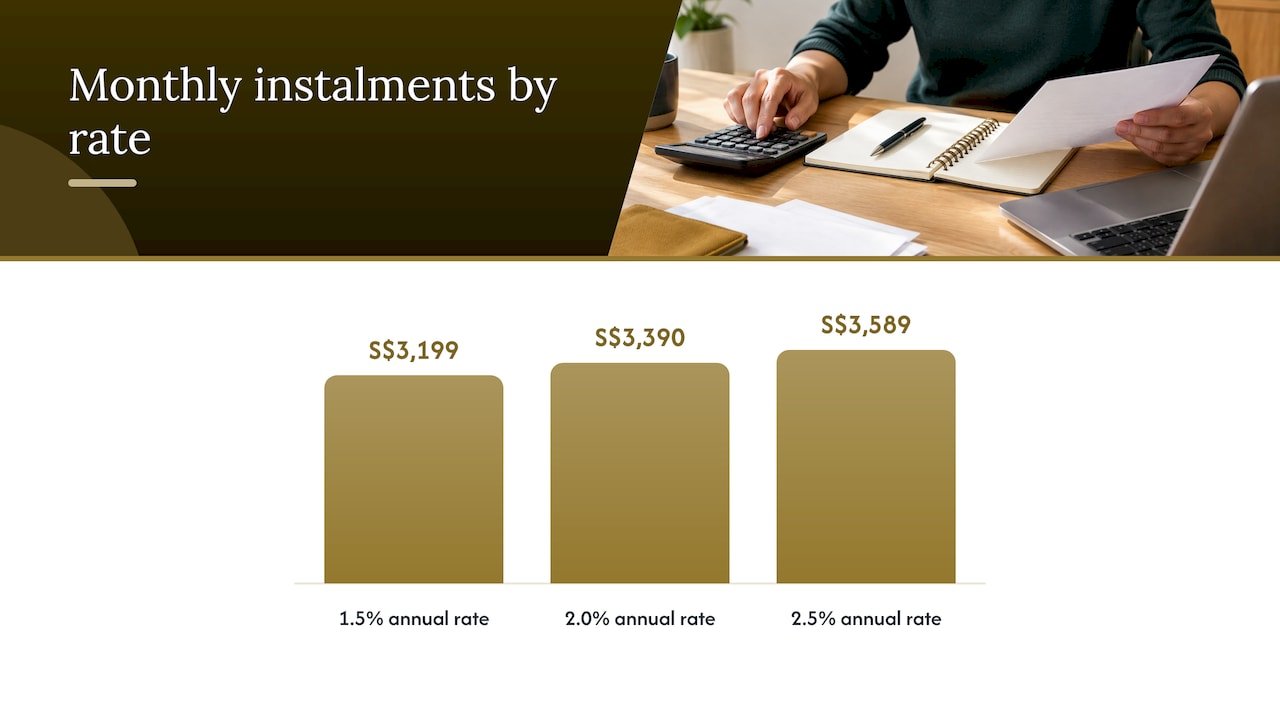
For a floating loan, the repayment moves with compounded SORA plus the bank’s margin. The scale of the change is easier to see in numbers. The figures below are our own illustration for a S$800,000 loan over 25 years with equal monthly instalments. They are not quotes from any bank.
| All-in annual rate | Approximate monthly instalment | Difference from 1.5% |
|---|---|---|
| 1.5% | S$3,199 | n/a |
| 2.0% | S$3,390 | about S$191 more |
| 2.5% | S$3,589 | about S$390 more |
A half-point rise on this loan adds roughly S$190 a month, or around S$2,300 a year. That is manageable for most households with a buffer, and it is a real strain for those already close to their limit.
To test your own numbers, a full amortization schedule for your mortgage shows how each instalment splits between interest and principal, and how a rate change alters the balance over time.
The stress test banks already apply
MAS stated in an 8 April 2026 parliamentary reply that banks’ Total Debt Servicing Ratio calculations include an interest-rate floor for private-property and HDB mortgage loans. The same reply noted that HDB’s concessionary loan is linked to the CPF Ordinary Account interest rate, which helps mitigate the effect of market-rate increases on HDB borrowers.
In practice, your borrowing limit is set against a conservative rate, not today’s headline rate. Our guide to how TDSR rules set your price band walks through the 55% limit, and the page on LTV limits for first and second loans covers how much you can borrow against the property.
Fixed or floating: how to decide
The rate outlook does not give one answer for everyone. CNA’s reporting frames the choice by borrower profile: fixed loans suit borrowers who prioritise payment certainty, while floating loans may suit those who can tolerate volatility, expect rates to fall or plan to sell soon. Higher-for-longer rates keep servicing costs elevated mainly for SORA-linked floating borrowers, while fixed-rate borrowers are protected during the fixed period.
DBS’s home-loan guidance puts the same trade-off simply: fixed loans give payment stability during the lock-in period, while floating loans can be cheaper but pass on changes in the reference rate.
| Your situation | Structure that tends to fit |
|---|---|
| Tight monthly budget, little spare cash | Fixed, for a known repayment |
| Planning to sell within a few years | Floating, or a short fixed period |
| Comfortable buffer, can absorb a higher instalment | Floating |
| Expect rates to ease and accept the risk | Floating |
| Buying a first home and want to plan around a single number | Fixed |
A few questions help settle it:
- How much could your instalment rise before it hurts? Use the table above and add a further half-point as a margin.
- How long will you hold the property? A short holding period reduces your exposure to rate changes later.
- What are the lock-in and penalty terms? Each package has its own. Read them before you sign, as they decide the cost of switching later.
- Is your income steady? Variable income favours predictable payments.
Our SORA fact sheet checks for choosing fixed or floating go through these steps in more detail.
Refinancing when rates move
With forecasts pointing up, homeowners whose lock-in is ending often ask whether to move early. The answer depends on the gap between your current rate and the new package, the legal and valuation costs, and any penalty. Our break-even checklist for refinancing shows how to work out how many months it takes for the saving to cover the switching cost. If you are still choosing between loan types, mortgage types in Singapore explains MSR, TDSR and LTV before you apply.
What higher rates mean for property decisions
Rates are one input among several. Cooling measures, supply and rental demand also shape prices and returns. For the wider picture, see our Singapore property outlook with three scenarios and the overview of cooling measures in 2026. Landlords and tenants can also check the rental market data and vacancy rate, since financing costs can feed into rents.
Our perspective
We read the rate outlook as a planning input, not a reason to wait. Forecasts for SORA in late 2026 and 2027 differ by only a few basis points, so the more useful question is whether your finances can carry a repayment half a point to a point above today’s.
Where we see buyers go wrong is in treating the loan and the property as separate decisions. The price you can pay is set by your borrowing limit, the borrowing limit is set against a conservative rate, and your comfort with that rate depends on how long you intend to hold. We start with that sequence, then look at the property.
Our approach is to pair a detailed market evaluation with personalised negotiation, so that clients know where a price sits relative to the market before they commit. We also help clients structure purchases to avoid the burden of Additional Buyer’s Stamp Duty, which keeps more capital available to service a loan when rates are firm. Lower upfront cost and a realistic rate assumption together make a transaction more resilient.
Anderson
Plan your next step with Register Today
If you are buying, selling or renting in Singapore, start with a clear view of what your property is worth and what you can afford to borrow. Register Today offers a free property valuation, and our team supports buyers, sellers and tenants with market evaluations and personalised negotiation.

Request your free property valuation to see where your home sits in the market, or browse residential listings if you are ready to look at homes. You can also start from the Register Today homepage to buy, sell or rent.
FAQ
Where are interest rates expected to be in 2026?
Forecasts point to a modest rise in SORA through the end of the year. MUFG projected 3-month compounded SORA at 1.30% in Q3 and 1.36% in Q4 2026, and UOB forecast 1.35% in Q4. Actual home-loan rates are higher, because banks add a margin to SORA.
Is the interest rate going up in Singapore?
The direction is gently upward. Forecasters expect 3-month compounded SORA to rise into 2027, and the Straits Times reported in October 2026 that some fixed home-loan rates had passed 2% and floating rates were rising. Singapore’s managed-currency framework and ample liquidity could limit sharp moves.
What is the current housing loan interest rate in Singapore?
It depends on the bank, loan type and package. Floating loans are commonly priced as compounded SORA plus a bank margin, and October 2026 reporting said some fixed rates had gone above 2%. Check the lender’s current rate sheet, because packages are repriced often.
Should I choose a fixed or floating loan now?
Choose fixed if you need a predictable repayment during the lock-in period. Floating may suit you if you plan to sell soon, can absorb a higher instalment or expect rates to ease. Whichever you pick, make sure your budget works at a rate a little above today’s.
Sources
- MUFG Research: Singapore, MAS tightens modestly, reinforcing SGD resilience
- UOB Global Economics and Markets Research: Singapore, 4Q26
- The Straits Times: Singapore interest rates could bottom out in Q2 2026, says UOB
- The Straits Times: Singapore home loan rates rise
- CNA Explains: Should Singapore home owners review their home loans
- Business Today: Policy outlook on Singapore revised after MAS tightening
- MAS: Written reply to parliamentary question on rising interest rates and mortgage repayments
- DBS: Fixed or floating home loan, which is better
- Mortgage amortization schedule tool