
Singapore Cooling Measures 2026: What Changed and What Still Applies
The main 2026 change is the removal of the 15-month wait-out period for private home owners buying non-subsidised HDB resale flats, effective 28 July 2026. The core cooling tools, ABSD, Seller’s Stamp Duty (SSD), loan-to-value (LTV) limits and the total debt servicing ratio (TDSR), remain in force. This guide sets out which rules apply today, how they change your upfront cash and borrowing, and what to check before you commit.
TL;DR
- On 28 July 2026, the government lifted the 15-month wait-out period for private home owners buying non-subsidised HDB resale flats, with immediate effect.
- ABSD still depends on your residency and how many homes you own: Singapore Citizens pay 0% on a first home, 20% on a second and 30% on a third or later.
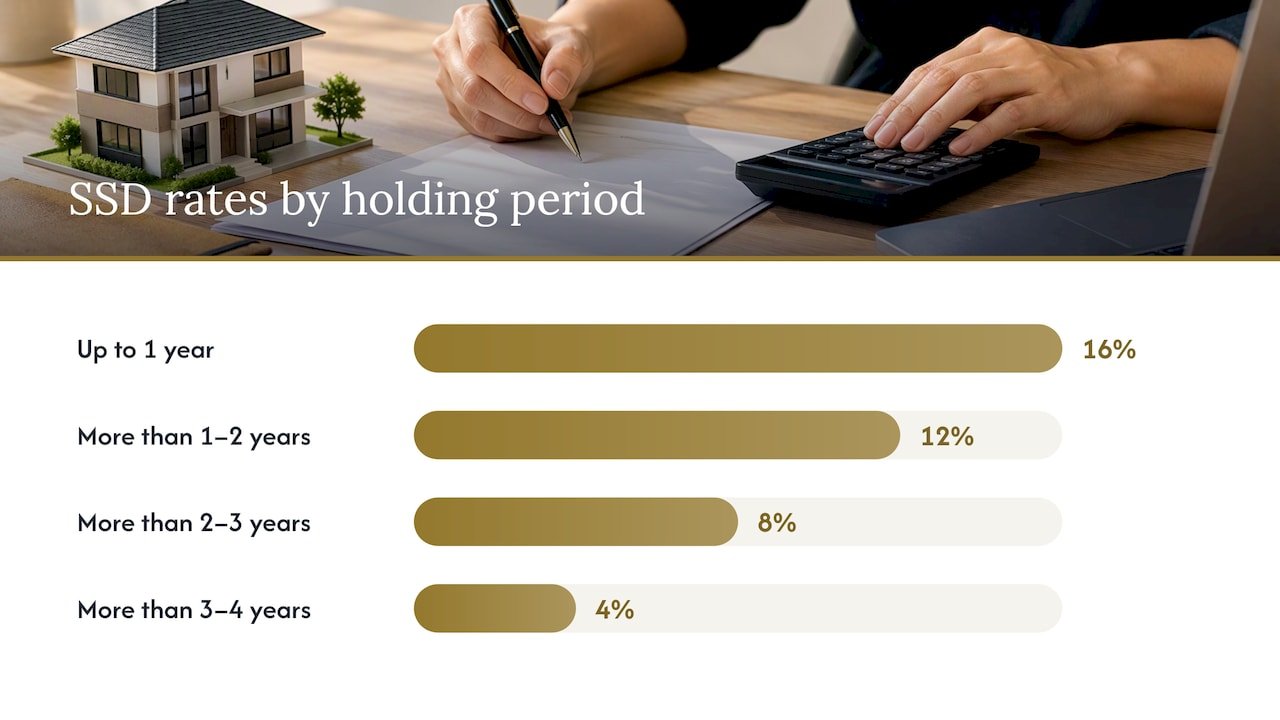
- SSD still applies to residential property sold within four years of purchase, at 16%, 12%, 8% and 4% for each successive year.
- Bank LTV limits (75%, 45%, 35%) and the TDSR cap of 55% of monthly income decide how much you can borrow.
Table of Contents
- What changed in 2026
- ABSD in 2026: who pays what
- Seller’s Stamp Duty after the July 2025 change
- Borrowing limits: LTV, TDSR and MSR
- What the measures mean for each type of reader
- A pre-purchase checklist for 2026
- Perspective: planning around the rules, not around the headlines
- Talk to us before you sign an OTP
- FAQ
- Sources
What changed in 2026
The headline move came on 28 July 2026. The government removed the 15-month wait-out period that had applied to private property owners who wanted to buy a non-subsidised HDB resale flat. The change took effect immediately. National Development Minister Chee Hong Tat described it as a pragmatic adjustment, pointing to moderated conditions: HDB resale price growth slowed to 2.9% in 2025 from 10.4% in 2022. He also said the government would keep reviewing policies, including the eligibility age for singles to buy HDB flats.
This is a relaxation, not a new restriction. Other than this adjustment, the rules most buyers deal with every day did not move: ABSD rates, LTV limits and TDSR are the same frameworks you used to plan a purchase before July.
The second thing to know is the market reaction. On 6 October 2026, the Ministry of National Development reported no discernible impact on HDB resale and rental prices, including Cash-Over-Valuation, after the wait-out was removed. The same reply noted HDB’s flash estimate for the third quarter of 2026 showed resale prices 0.2% lower than in the second quarter.
For readers searching for “new cooling measures”, the practical reading is this: 2026 so far has been a year of fine-tuning, not of fresh tightening. Policy can still change, so confirm the current position on the official pages linked below before you sign an option to purchase (OTP).
ABSD in 2026: who pays what
Additional Buyer’s Stamp Duty is the measure that most affects investors and upgraders. IRAS sets the rates by buyer profile. For Singapore Citizens, ABSD is 0% on a first residential property, 20% on a second and 30% on a third or subsequent property. Other buyer categories, including foreigners, pay higher rates; our guide on what foreign buyers must budget for ABSD covers the 60% tier in detail.
Two features of the rules matter in planning:
- Remission and refunds. IRAS notes that qualifying married couples with at least one Singapore Citizen spouse may receive remissions or refunds, and that a concession may apply to single Singapore Citizen seniors aged 55 or older, subject to conditions. The conditions are strict and time-bound, so read the IRAS page for your own case.
- Timing of the duty. ABSD is due on top of Buyer’s Stamp Duty, and the deadlines are short. Our stamp duty timeline explains the 14 and 30 day windows.
If you want worked cash examples, see our ABSD planning guide with myTax steps. If you are buying while selling an existing home, the ABSD remission guide shows how the six-month window works in practice.
Commercial and mixed-use purchases
Investors often assume ABSD is a residential-only question. It is not always so clear: the zoning and use of a property decide how it is treated. Before you bid on a shophouse, an office unit or a mixed-use building, run the zoning checks in our guide to commercial property and ABSD surprises.
Seller’s Stamp Duty after the July 2025 change
SSD targets short-term resale. The Ministry of Finance extended the holding period and raised the rates, noting that short-holding-period private residential transactions had increased sharply, particularly sub-sales of uncompleted units. The holding period went from three years to four, and each tier rose by four percentage points.
For a residential property acquired on or after 4 July 2025, IRAS sets the following schedule:
| Holding period | SSD rate |
|---|---|
| Up to 1 year | 16% |
| More than 1 to 2 years | 12% |
| More than 2 to 3 years | 8% |
| More than 3 to 4 years | 4% |
| More than 4 years | None |
The holding period begins when the OTP is accepted, and the rate is applied to the higher of the sale price or the market value. Where different interests in a property were acquired at different times, IRAS computes the holding period separately from each acquisition date.
A worked example
Suppose you sell a residential unit at S$2,000,000 and your OTP was accepted two years and four months earlier. That falls in the more-than-two-to-three-year band, so the rate is 8%. The duty is S$160,000. Had you waited until the holding period passed three years, the rate would be 4%, or S$80,000. Waiting beyond four years removes it entirely. This is a simple illustration of the schedule, not a quote for any specific sale.
Planning a sale close to a band boundary is worth a conversation with your lawyer. Our guide to avoiding a surprise SSD bill after July 2026 goes through the timing questions sellers raise most.
Borrowing limits: LTV, TDSR and MSR
Stamp duties raise the cash you need on day one. Credit rules limit how much you can borrow. The Monetary Authority of Singapore publishes the framework in Macroprudential Policies in Singapore:
- LTV limits are tiered by the number of outstanding housing loans: 75% for a first loan, 45% for a second and 35% for a third. They are 20 percentage points lower when specified tenure or age conditions apply.
- TDSR caps total monthly debt obligations at 55% of monthly income.
- MSR caps housing loan repayments at 30% of monthly income for HDB flats and new ECs.
A quick illustration: a household earning S$12,000 a month has a TDSR ceiling of S$6,600 for all debt repayments combined. A car loan of S$1,200 a month leaves S$5,400 for a mortgage under that ceiling, before other limits apply. Banks calculate the figures using their own assumptions, so treat this as a rough check, not an approval.
On rates, MAS and HDB use safeguards such as the TDSR interest rate floor and concessionary HDB loans. In an April 2026 parliamentary reply, MAS said it urges home buyers to exercise financial prudence while global conditions remain uncertain, even though domestic interest rates have been relatively stable.
Our LTV limits guide shows how the cash and CPF split changes for a second or third loan.
What the measures mean for each type of reader
First-time buyers
You face 0% ABSD on a first property as a Citizen, so your main constraints are BSD, the 25% minimum down payment implied by the 75% LTV cap, and the TDSR or MSR ceiling. Buyer’s Stamp Duty is calculated on the higher of price or market value, which is why valuation matters. Our note on why valuation risk raises BSD explains the mechanism. Start from a realistic monthly budget and work backwards to a price range.
Private home owners considering an HDB resale flat
The lifting of the wait-out on 28 July 2026 widens your choices if you are downsizing from private property to a non-subsidised resale flat. Rules for subsidised flats and loans can differ, so check the HDB conditions for the specific scheme before relying on the change.
Investors
For investors, ABSD and SSD shape the holding strategy. A second or third residential purchase attracts a higher ABSD, and a quick exit within four years triggers SSD. Commercial assets follow different logic, which is why zoning and use checks come first. Our outlook with three scenarios and a buyer checklist helps you stress-test a purchase against different market paths.
Sellers
Count the holding period from the OTP acceptance date, not the completion date. Then price the sale against what the buyer’s own stamp duty and loan limits allow. A realistic asking price is easier to defend when you know what a buyer can borrow.
A pre-purchase checklist for 2026
- Confirm your ABSD profile. Residency, marital status and number of properties owned determine the rate. Check it on the IRAS page before you view homes.
- Count your loans. The number of outstanding housing loans sets your LTV tier.
- Run TDSR with your real debts. Include car loans, credit cards and any other commitments.
- Check the property’s use. Residential, commercial and mixed-use treatment differ.
- Plan the cash and CPF split. Stamp duties are due within short windows after the OTP.
- Check the seller’s SSD position. If a seller is inside the four-year period, expect firm pricing.
- Compare the price with recent transactions. Our URA and HDB screening guide explains how a price gap against comparable sales is identified.
Perspective: planning around the rules, not around the headlines
We see the same pattern each time a policy headline appears. Buyers ask whether prices will fall. The better question is what the rules do to your own cash, your borrowing and your holding period.
The 2026 changes are a good example. The wait-out removal helps a specific group of private owners. It does not change ABSD, SSD, LTV or TDSR, and the Ministry’s own October figures show no discernible effect on HDB resale and rental prices. A buyer who waits for a policy-driven dip may find that the numbers that matter have not moved.
Our approach is designed around the transaction. We start with a valuation and a market evaluation to find the gap between asking price and likely value, then negotiate with that evidence in hand. For investors, we structure purchases with ABSD in mind and work within the remission and exemption rules set by IRAS, so that tax planning is done before you commit, not after. We are transparent about costs at each step, because a sound decision needs the full figure.
Every case differs, and the rules carry conditions. Confirm your own position with IRAS and your conveyancing lawyer, and bring us the numbers early.
Anderson
Talk to us before you sign an OTP
If you are comparing options under the 2026 rules, we can start with a free property valuation. It gives you a grounded view of value before stamp duty and loan limits are applied. You can also browse residential listings or commercial listings, or contact us through our main page to discuss buying, selling or renting.
If you are an investor weighing a second property, read how to approach ABSD on a second Singapore property first, and bring your questions to the call.
FAQ
Are there new property cooling measures in Singapore in 2026?
The main announced change is the removal of the 15-month wait-out period for private home owners buying non-subsidised HDB resale flats, effective 28 July 2026. ABSD, SSD, LTV and TDSR continue to apply. The minister said the government will keep reviewing policies, so check official pages for updates.
Did the wait-out removal push HDB prices up?
As of 6 October 2026, the Ministry of National Development reported no discernible impact on HDB resale and rental prices, including Cash-Over-Valuation. HDB’s flash estimate for the third quarter of 2026 showed a 0.2% fall from the second quarter.
How long does Seller’s Stamp Duty apply?
For residential property acquired on or after 4 July 2025, SSD applies if you sell within four years, at 16%, 12%, 8% and 4% by year. After four years, no SSD applies. The holding period starts when the OTP is accepted.
How much can I borrow for a second home?
The bank LTV limit for a second housing loan is 45%, against 75% for a first. TDSR also caps all debt repayments at 55% of monthly income. Your bank will apply its own assumptions, so ask for an in-principle assessment before you make an offer.
Sources
- Straits Times: 15-month wait-out period lifted
- Parliament record: impact of removing the wait-out period, 6 October 2026
- IRAS: Additional Buyer’s Stamp Duty
- IRAS: Seller’s Stamp Duty for residential property
- MOF: Extension of the SSD holding period
- MAS: Macroprudential Policies in Singapore
- MAS: Written reply on rising interest rates and mortgage repayments