
How to Sell a Condo in Singapore: Steps, SSD and Costs
To sell a condo in Singapore, first check whether Seller’s Stamp Duty (SSD) applies to your holding period, then confirm your loan and CPF refund figures, price the unit against recent transactions, appoint an agent or prepare to sell on your own, and move through the Option to Purchase (OTP), sale agreement and completion. The order matters because the first three steps decide how much money you actually take home.
This guide walks through each stage for private condominium owners, with the official rules and the points where sellers most often lose money.
TL;DR
- SSD applies if you sell within 4 years of buying (for purchases on or after 4 July 2025) or within 3 years (for purchases between 11 March 2017 and 3 July 2025). Hold beyond that and there is no SSD.
- Your sale proceeds are not your cash. The outstanding housing loan and the CPF principal plus accrued interest are settled first, and your lawyer coordinates this at completion.
- Price using URA transaction data, and get a valuation before you list.
- Read the agency agreement, especially the commission clause, before you sign it.
- Standard OTP and sale and purchase agreement templates exist, so do not accept informal terms.
Table of Contents
- Start with the numbers: what you will actually keep
- Step 1: Check Seller’s Stamp Duty
- Step 2: Review your mortgage and CPF position
- Step 3: Price the condo with real transaction data
- Step 4: Choose how you will sell
- Step 5: Prepare the unit for viewings
- Step 6: From offer to Option to Purchase
- Step 7: Completion and handover
- How long does it take to sell a condo?
- Our perspective
- Get a figure to plan around
- Common mistakes to avoid
- FAQ
- Sources
Start with the numbers: what you will actually keep
Most sellers begin with the question “what will it sell for?” The better first question is “what will be left after everything is settled?” Three deductions come before any profit shows up in your bank account: SSD (if applicable), the outstanding mortgage, and the CPF refund. Agent commission and legal fees follow.
A simple way to frame it:
| Item | What to find out | Where to get it |
|---|---|---|
| Expected sale price | Realistic range from recent comparable sales | URA transaction data, a valuation |
| SSD | Whether your holding period triggers it, and at what rate | IRAS |
| Outstanding loan | Balance, any early redemption or prepayment fee | Your lender |
| CPF refund | Principal withdrawn plus accrued interest | CPF Board |
| Agent commission | Rate and who pays it | Your agency agreement |
| Legal fees | Quote for the sale | Your conveyancing lawyer |
Work this table out in a spreadsheet before you speak to any buyer. It tells you your floor price: the lowest figure at which selling still makes sense.
Step 1: Check Seller’s Stamp Duty
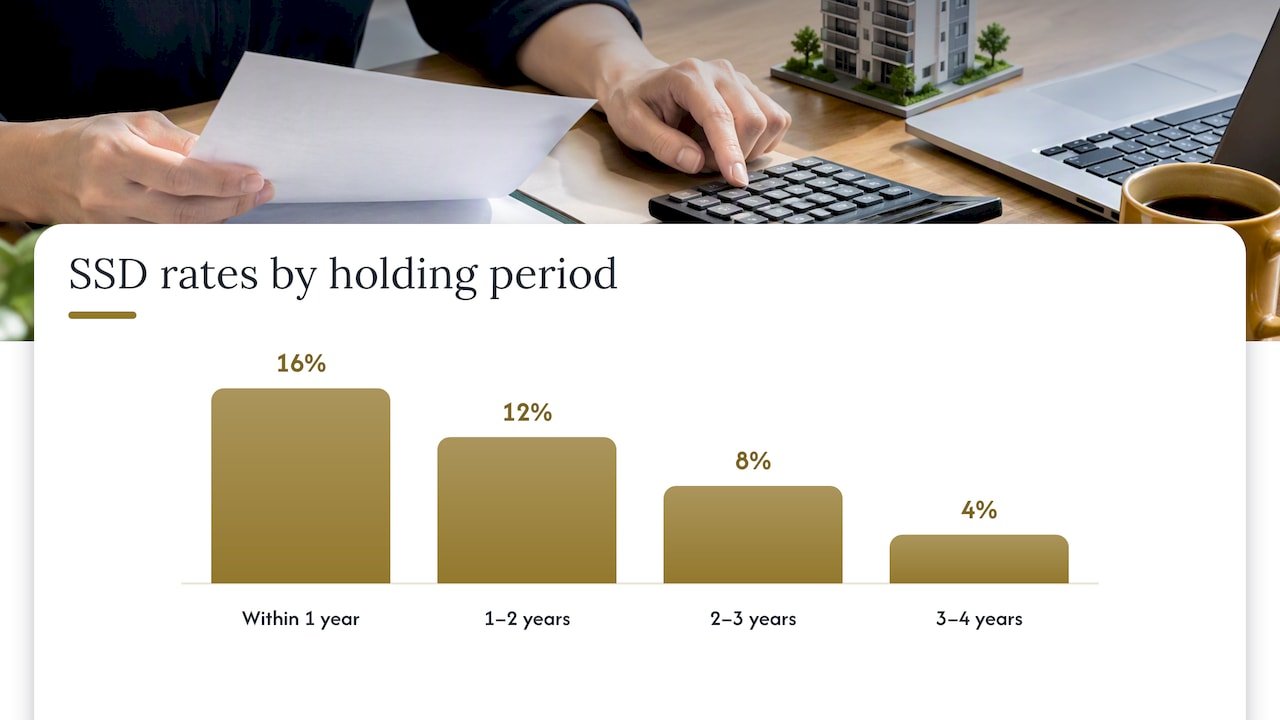
SSD is payable when you dispose of residential property within a set holding period. IRAS states that for properties purchased on or after 4 July 2025 the holding period is up to 4 years, and that the earlier 3-year period applies to properties bought between 11 March 2017 and 3 July 2025. The duty is calculated on the higher of the selling price or the market value at the time of disposal.
For purchases on or after 4 July 2025, the rates are, according to the same IRAS page:
| Holding period | SSD rate |
|---|---|
| Within 1 year | 16% |
| More than 1 to 2 years | 12% |
| More than 2 to 3 years | 8% |
| More than 3 to 4 years | 4% |
On a sale price of S$2,000,000, a 4% SSD is S$80,000, so waiting a few extra weeks to cross a holding-period boundary can be worth more than any negotiation. Count the holding period from the date you acquired the property, and confirm the exact cut-off with IRAS or your lawyer before you grant an OTP. Our guide on avoiding a surprise Seller’s Stamp Duty bill goes through the timing in more detail.
Step 2: Review your mortgage and CPF position
You do not normally need to find the full loan amount in cash before listing. Your conveyancing lawyer coordinates the redemption from the sale proceeds on completion. What you should do early is:
- Ask your bank for the outstanding balance and a redemption statement.
- Check whether you are still in a lock-in period and whether an early redemption or prepayment fee applies.
- Tell your lawyer about the loan so the redemption can be built into the completion timeline.
If you used CPF, you generally need to refund the principal withdrawn plus accrued interest to your CPF account when you sell. If the proceeds do not cover the loan and the required refund, the CPF Board says you are not required to top up the shortfall in cash, provided the property was sold at market value.
This matters if you are buying your next home. CPF Board points out that sale proceeds are not the same as cash available for the next purchase, because they are what remains after the loan and the CPF refund. Plan your next down payment from that residual figure, not from the headline price.
Step 3: Price the condo with real transaction data
An asking price pulled from listings tells you what other owners hope for. Transaction data tells you what buyers paid. URA’s property market information service lists private residential transactions, including resale and subsale caveats lodged with the Singapore Land Authority, covering the last 60 months. A caveat is a legal document a purchaser lodges to register their interest, usually after the OTP is exercised or a sale and purchase agreement is signed, so it reflects a deal that actually went ahead.
When you search, compare like with like:
- Same project first. Look at units in your own development before the neighbouring ones.
- Similar size and floor. A high-floor unit with an unblocked view is not priced like a low-floor unit facing a road.
- Recent dates. A transaction from two years ago reflects a different market.
- Tenure and remaining lease. Freehold and 99-year leasehold units trade differently, and so do leasehold units with different years left.
Then add a valuation. We offer a free property valuation that gives you a figure to test against the transaction data. If the two figures differ, find out why before listing. If you plan to buy another property afterwards, understanding how a valuation shortfall affects your costs helps you set your budget.
Setting the asking price
Pricing slightly above your floor leaves room to negotiate, but pricing far above recent transactions usually leaves a listing unseen by serious buyers and invites low offers later. Decide three numbers in advance: your ideal price, the price you would accept, and the price below which you will not sell. Share only the first with your agent’s marketing, and keep the last private.
Step 4: Choose how you will sell
You can sell through an agent or on your own. CEA’s guidance for owners who transact on their own sets out three steps: learn the rules, go through the relevant checklist, then negotiate and sign the contract. CEA also suggests engaging an agent if you are unfamiliar with the process.
Most condo owners use an agent because of the volume of viewings, negotiation and paperwork involved. If you do, keep these points in mind:
- CEA encourages a Prescribed Estate Agency Agreement, exclusive or non-exclusive, that sets out the scope of work and the commission.
- CEA advises reviewing the clauses, especially commission, before you sign.
- Our pages on agent commission in Singapore and exclusive agency agreements explain who pays, what is negotiable and which clauses deserve a second look.
Exclusive or non-exclusive is a real choice. An exclusive agreement gives one agent the incentive to invest in marketing your unit, while a non-exclusive one lets several agents work at once. Pick based on how competitive your project is and how quickly you need to sell.
Step 5: Prepare the unit for viewings
Preparation is cheap compared with the price movements it can influence. A sensible checklist:
- Declutter and clean. Buyers need to see space, not your belongings.
- Fix small defects. Dripping taps, loose door handles, stained grout and chipped paint suggest neglect elsewhere.
- Maximise light. Open curtains, replace dead bulbs and clean windows.
- Gather documents. Keep the floor plan, maintenance fee details, tenancy documents if tenanted, and any renovation approvals together.
- Plan viewing slots. Cluster viewings in a few time windows so offers arrive close together.
Buyers commonly walk through with their own checks, and our property inspection checklist shows what they look for, which lets you fix those points first. If the unit is tenanted, coordinate viewing access with the tenant in line with the tenancy terms.
Step 6: From offer to Option to Purchase
When a buyer’s offer is acceptable, the next document is the OTP. CEA notes that standard templates exist for the Option to Purchase and for the Agreement for the Sale and Purchase of private residential property. Use them, or have your lawyer or agent do so, rather than drafting terms from scratch.
Before granting the OTP, check:
- The agreed price and any option fee.
- The exercise period and what happens if the buyer does not exercise it.
- Whether the unit is sold with fittings and furnishings, and which ones.
- The completion period, which you should set with your own loan redemption and your next purchase in mind.
- Whether your SSD holding period has been crossed by the date the sale is concluded.
Our explainer on the Option to Purchase in Singapore covers what buyers and sellers each need to do, and the stamp duty timeline shows the deadlines your buyer faces after exercising, which tells you when to expect the next stage to move.
Step 7: Completion and handover
After the OTP is exercised, the sale and purchase agreement follows and the parties work towards completion. At completion your lawyer redeems the outstanding loan, arranges the CPF refund, and pays you the balance. You then hand over the keys, utility accounts and any agreed items.
Practical points for this stage:
- Give your lawyer the loan redemption details and CPF information as soon as the OTP is granted.
- Arrange a handover walk-through so the buyer confirms the condition and fittings.
- Settle outstanding maintenance fees and utilities up to the handover date.
- Keep copies of all signed documents.
If you are also buying, align your two completion dates. A gap forces you into temporary housing or bridging arrangements, so ask your lawyer how the completion periods can be set to fit together.
How long does it take to sell a condo?
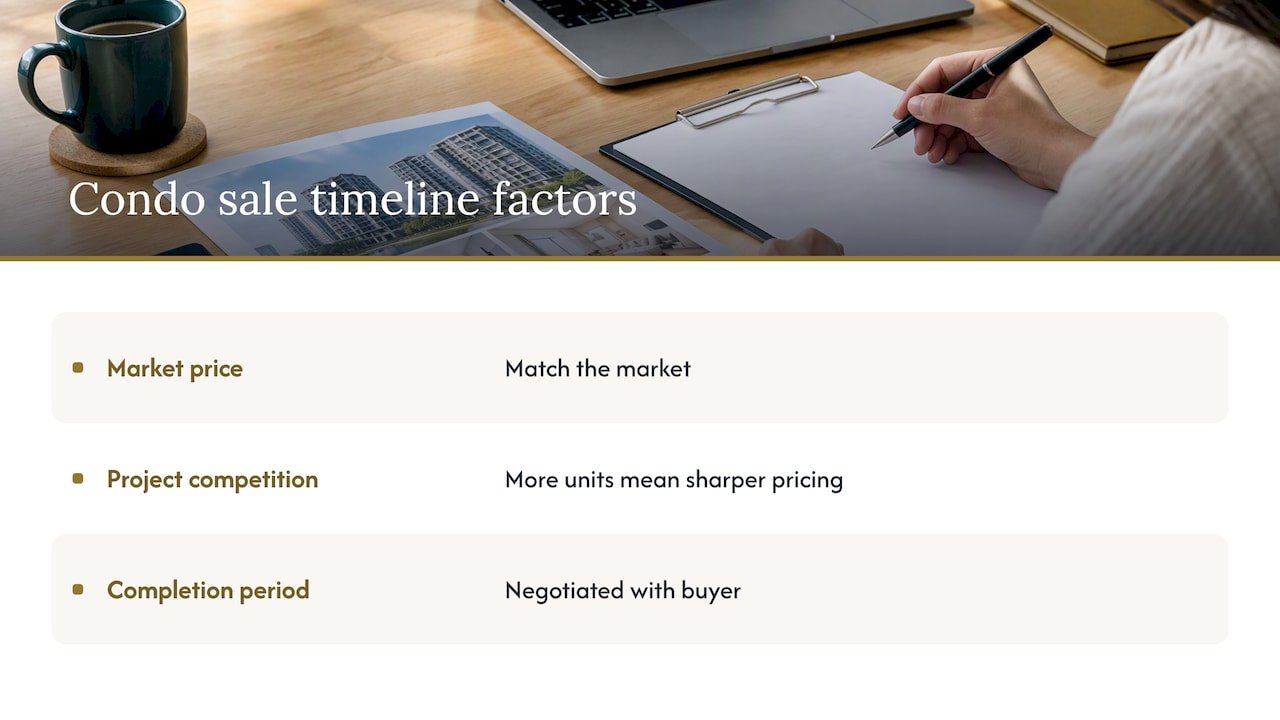
The time depends on three things: how well the price matches the market, how large and competitive your project is, and the completion period you agree with the buyer. There is no fixed figure that applies to every unit. A project with many units for sale gives buyers more alternatives, so a unit in a large development often needs sharper pricing to stand out. The completion period is a negotiated term in the contract, so you control part of the timeline.
If you need to sell fast, the practical levers are all within your control: price against recent transactions rather than aspirations, prepare the unit before the first viewing, make it easy to view, and be ready with your loan and CPF figures so that you can respond quickly to an offer.
Our perspective
In our experience of Singapore property transactions, sellers lose the most money before the unit is ever listed. They miss a holding-period boundary, accept a headline price without working out the net, or sign an agency agreement without reading the commission clause. These are all avoidable with a short checklist and a proper valuation.
We believe a seller should know their number before they meet a buyer. That is why we start with a free valuation and a market evaluation that looks at transaction data, nearby supply and where buyers are actually paying. Our team has handled over $1 billion in sales, and our approach is built on transparency: we explain the costs, the timing and the trade-offs so you can decide for yourself. Where the next move is a purchase, we also help you look at how to structure it with the stamp duty rules in mind, since selling and buying are usually one decision rather than two.
— Anderson
Get a figure to plan around
If you are thinking of selling, the first practical step is to know what your condo is worth today. We provide a free valuation with no fee, and our team can then talk through pricing, timing and negotiation with you.

Start with a free property valuation, or go to our page to sell your property with a team that handles both the sale and the next purchase.
Common mistakes to avoid
- Listing before checking SSD. A sale a few weeks too early can add thousands of dollars in duty.
- Treating sale price as take-home. Loan, CPF refund, commission and legal fees all come out first.
- Pricing from listings. Asking prices are wishes, transactions are facts.
- Skipping the agreement review. Commission, duration and exclusivity should be understood before signing.
- Misaligned completion dates. If you are buying again, the two timelines need to fit.
FAQ
Can I sell my condo at any time?
Yes, you can sell whenever you like, but if you sell within the SSD holding period you pay the duty. For purchases on or after 4 July 2025 that period is 4 years, and rates start at 16% in the first year and fall to 4% in the fourth year, according to IRAS. Check your purchase date before you list.
Do I need to pay off my mortgage before selling?
Not in cash. Your lawyer coordinates the redemption using the sale proceeds at completion. You should still ask your bank for the outstanding balance and any early redemption or prepayment fee, particularly if you are in a lock-in period.
What happens to my CPF when I sell?
You generally refund the CPF principal you withdrew plus the accrued interest. If the proceeds are not enough to cover the loan and the refund, the CPF Board says you do not need to top up the shortfall in cash, provided the property was sold at market value.
Should I use an agent to sell my condo?
You can sell on your own using the CEA checklists and standard templates, but CEA suggests considering an agent if you are unfamiliar with the process. If you appoint one, review the Prescribed Estate Agency Agreement, especially the commission clause, before signing.
How do I find out what my condo is worth?
Compare recent transactions in your project using URA’s property market information service, then confirm with a valuation. We offer a free property valuation if you want a second figure to test your price against.
Sources
- IRAS: Seller’s Stamp Duty (SSD) for Residential Property
- IRAS: SSD changes effective 4 July 2025
- CPF Board: CPF refund when selling or transferring property
- CPF Board: How much CPF OA savings can you use for your next home
- CEA: Buying or selling a private residential property
- CEA: Engaging a property agent, buying or selling
- URA: Private residential property transactions
- Redeeming your housing loan when selling property in Singapore