

Buying Property Under a Company in Singapore: Rules, Duties and Steps
A Singapore company can buy property in Singapore, and for most commercial and industrial assets the structure works well. Residential property is where it gets expensive: an entity that buys any residential property generally pays 65% Additional Buyer’s Stamp Duty (ABSD), on top of Buyer’s Stamp Duty (BSD). This guide explains what a company may buy, which duties apply, how an asset purchase differs from a share purchase, and the steps to follow before you sign.
TL;DR
- A Singapore company is not a “foreign person” under the Residential Property Act, so it does not need Land Dealings Approval Unit (LDAU) approval for ordinary purchases, but zoning and use still need checking.
- An entity buying residential property pays BSD plus ABSD of 65% (rate effective 27 April 2023), both calculated on the higher of price or market value.
- Commercial and industrial property carries no ABSD, but BSD, GST, property tax and agency approvals (for industrial land) still apply.
- Buying the shares of a property-owning company is taxed differently, and it can attract Additional Conveyance Duties where the assets are mainly residential.
- Stamp duty is due within 14 days of signing in Singapore, so structure and funding must be settled before the option is exercised.
Table of Contents
- Can a company buy property in Singapore?
- What duties does a company pay?
- Asset purchase or share purchase?
- Commercial and industrial property through a company
- Can a company rent out the property?
- Company or personal name: how to decide
- Our perspective
- Steps to buy through a company
- Looking at property through a company?
- FAQ
- Sources
Can a company buy property in Singapore?
Yes. The Singapore Land Authority (SLA) states that a Singapore company is not a “foreign person” under the Residential Property Act (RPA). The approval rules for restricted residential property therefore target foreign persons, not locally incorporated companies as such.
The answer still differs by property type:
| Property type | Can a company buy it? | Main watch-points |
|---|---|---|
| Private condominium or apartment | Yes | 65% ABSD for entities, BSD, financing |
| Landed residential | Yes for a Singapore company, but check the company’s ownership and RPA status first | ABSD, possible SLA approval for foreign persons |
| HDB flat | Separate HDB eligibility rules apply | Check HDB’s own rules |
| Commercial (shop, office, shophouse) | Yes | BSD up to 5%, GST, permitted use, tenancies |
| Industrial | Yes | BSD, GST, JTC or URA approvals for leases and transfers |
SLA lists condominium units, flat units, commercial and industrial property as generally purchasable by a foreign person without RPA approval. HDB property is the exception, because HDB eligibility rules apply separately.
Where approval can still be needed
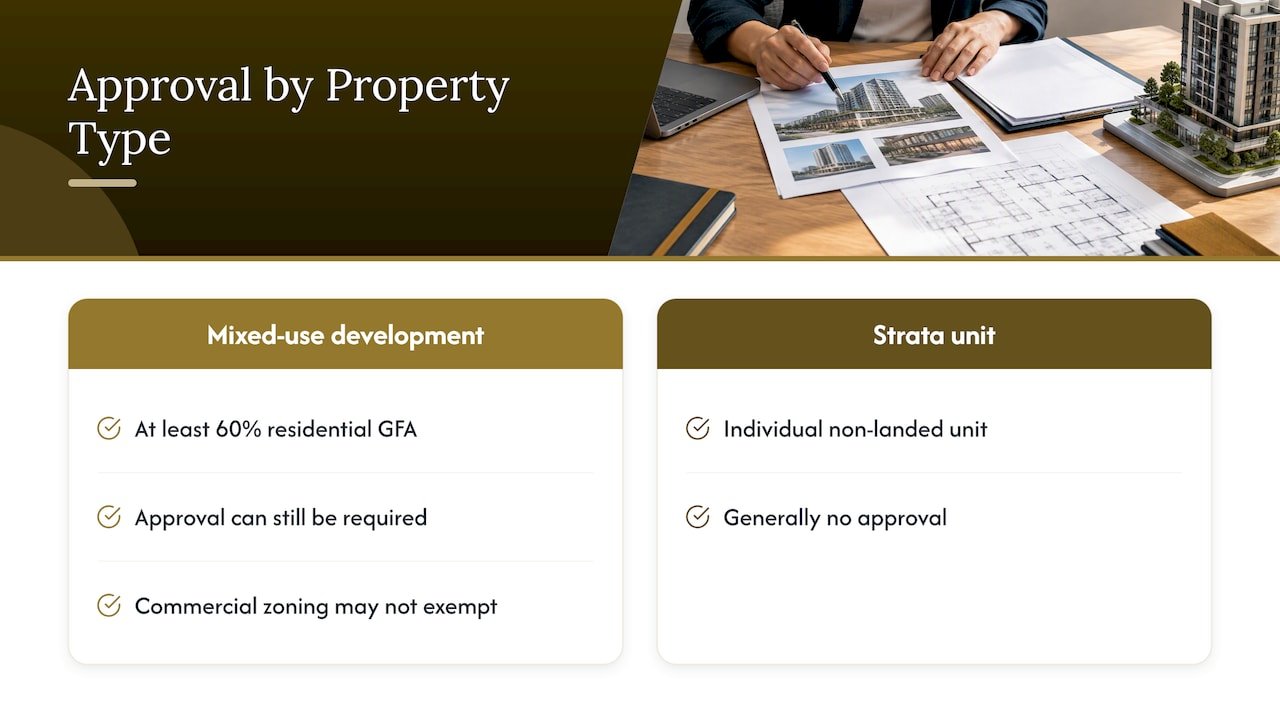
For foreign persons wanting restricted residential property, approval is assessed case by case and the LDAU takes about 30 working days to review an application. Zoning labels can mislead too. The Ministry of Law has explained that approval can still be required where land is zoned “Commercial” but its permanent approved use includes a restricted residential component. An entire mixed-use development with at least 60% residential gross floor area is the example given, while individual strata units in a non-landed development are generally not subject to approval.
If your company has foreign shareholders, confirm its status with a lawyer before you commit. Our guide on 60% ABSD and what foreign buyers must budget covers the personal-buyer side of that question.
What duties does a company pay?
Two stamp duties matter on a direct purchase.
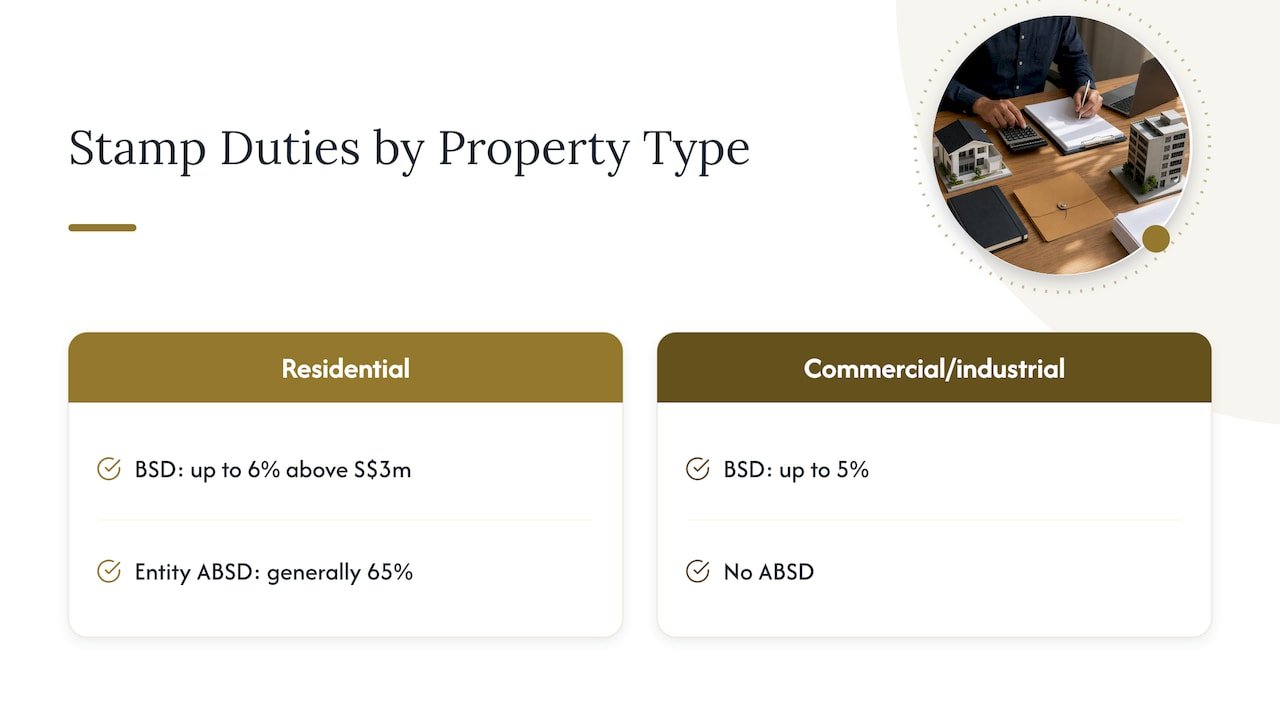
Buyer’s Stamp Duty (BSD) is tiered. According to one 2026 practitioner guide, rates climb to 5% for non-residential property and 6% for residential property, the latter on the portion above S$3,000,000. Both BSD and ABSD are computed on the higher of the purchase price or the market value. That detail matters when a price is agreed below valuation, and we explain it in why valuation risk raises BSD.
Additional Buyer’s Stamp Duty (ABSD) is the large one. IRAS states that from 27 April 2023 an entity buying any residential property is generally subject to ABSD of 65%. Commercial and industrial purchases do not attract ABSD.
A worked example
Take a residential property bought by a company at S$5,000,000, with market value at or below that price. ABSD at 65% is S$3,250,000, payable in addition to BSD. The ABSD alone is more than half again the price of the property’s cheapest comparable alternatives in many segments, which is why most operating companies avoid residential holdings unless a specific business case supports them, such as staff housing within an approved structure or a development project run under the proper rules.
A buyer liable for ABSD must also complete the ABSD Declaration Form and keep it for at least five years. For current rates and cash planning, see our page on ABSD rates in Singapore.
Timing
Stamp duty is due within 14 days after signing in Singapore, or within 30 days of receipt if signed overseas. The practical effect is that the company’s bank balance or facility must be ready before the option is exercised. Our stamp duty timeline sets out the sequence.
Asset purchase or share purchase?
There are two routes to owning property through a company.
- Asset purchase: your company buys the property directly from the seller. BSD applies, and ABSD applies if the property is residential.
- Share purchase: you buy the shares of a company that already owns the property. Share transfers are generally subject to 0.2% duty, and institutional deals involving commercial or industrial assets are often structured this way to benefit from the lower rate.
The share route is not a shortcut for homes. IRAS says that qualifying transfers of equity interests in property-holding entities that primarily own Singapore residential property can attract Additional Conveyance Duties (ACD): buyer-side BSD of 1% to 6% plus 65% ABSD, with Seller’s Stamp Duty possibly applying to the seller under the stated holding-period rules. Practitioners note that early tax and structuring advice matters, as the choice between asset and share structures can materially affect pricing and viability.
What a share purchase also brings
Buying a company means inheriting its history: liabilities, tenancies, tax position and any unrecorded obligations. That calls for full due diligence on the company, not only the title. It also raises a succession question, since the shares, not the building, are what pass on later. If that is part of your plan, read about how shares are handled in a will in Singapore and speak to a lawyer early.
Commercial and industrial property through a company
For commercial buyers, a company is the normal vehicle and ABSD is not the main concern. The checks that matter are different:
- Permitted use. Confirm the planning use matches your business. Zoning mistakes are what most often turn into surprises, and our guide to five zoning checks for commercial property lists them, including the mixed-use cases where a residential component changes the picture.
- Tenancies and encumbrances. Commercial deals can involve bespoke drafting and detailed checks of title, encumbrances and permitted use.
- Industrial approvals. Foreign entities generally face no legal restriction on buying commercial property, though industrial leases or transfers may need JTC or URA approval.
- GST. Commercial property sales and leases are generally subject to GST if the seller is GST-registered. For mixed-use property, GST applies to the non-residential parts while the residential parts stay exempt.
- Property tax. Annual property tax on non-residential property is 10% of the Annual Value, a recurring cost to put in your yield model.
- Financing. Lenders assess company borrowers differently from individuals. Our commercial property guide covers use, BSD and the Total Debt Servicing Ratio (TDSR) checks.
Can a company rent out the property?
Yes. A company may buy a private residential property and lease it out, and the ABSD is the cost that has to be justified by the rental case. Rental income is subject to income tax. The sale and lease of an unfurnished residential property are exempt from GST, whereas commercial leases by a GST-registered landlord are generally taxed. Short lets are a separate matter with their own rules; see our short-term rental checks.
Company or personal name: how to decide
Run the decision in this order.
- Property type. Residential for an entity means 65% ABSD. Commercial or industrial does not.
- Holding period. Residential holding periods should be part of the investment case, especially if you may need to sell early. Seller’s Stamp Duty and the four-year capital gains questions can change the outcome.
- Liability and tax. A company separates the asset from your personal balance sheet, but it adds accounts, filing and its own tax treatment. An accountant should model this.
- Exit. Selling the property and selling the company’s shares are taxed differently, so decide which exit you want before you buy.
- Financing. Compare what a bank will lend to the company against what it would lend to you personally.
If the aim is a second home or an investment flat, ask whether a company is truly the right vehicle. Our article on lawful ways to plan around ABSD explains what is permitted and what draws an IRAS audit.
Our perspective
Most enquiries we see about company purchases start from a wish to lower tax. In practice, the structure rarely changes the residential outcome: the duty follows the property and the buyer type, not the paperwork. The companies that do well pick the right asset class first, usually commercial or industrial, then match the structure to the exit. Where a client’s situation is genuinely different, we map the duties, valuation gap and holding period together before a purchase goes ahead, and we work through the market evidence on the specific building, since a duty bill calculated on market value can differ from the price in the option.
Our advice is simple: price the duties before you view the property, not after you fall for it.
— Anderson
Steps to buy through a company
- Confirm eligibility. Check the company’s shareholders, its objects and, for residential or landed property, whether SLA approval is relevant. URA advises checking eligibility, prices, financing, stamp duties, legal fees and, where relevant, SLA approval before buying.
- Pass a board resolution. The company should authorise the purchase and the signatories.
- Engage licensed professionals. URA also recommends confirming that any property agency and agent are licensed and registered with the Council for Estate Agencies.
- Obtain the Option to Purchase. Negotiate price, completion date and conditions.
- Do the due diligence. Title search, legal requisitions and zoning checks. Commercial deals need deeper review of permitted use and existing tenancies.
- Exercise the option and pay stamp duty. Remember the 14-day window.
- Arrange financing and complete. Completion ends with registration of the transfer with SLA.
Looking at property through a company?
We list commercial property, commercial offices and residential homes in Singapore, and our team supports negotiation and market evaluation on each purchase. If you already own a property and are weighing a sale or restructure, our free property valuation gives you a starting figure at no cost.
You can also start from our main page to buy, sell or rent.
FAQ
Does a Singapore company pay ABSD when it buys a house or condo?
Yes. IRAS applies ABSD of 65% to entities buying any residential property from 27 April 2023, on top of BSD. Both are calculated on the higher of the price or market value.
Is there ABSD on commercial or industrial property?
No ABSD applies to a purchase of purely commercial or industrial property. BSD, GST where the seller is registered, and annual property tax still apply. Check the zoning, because mixed-use sites with a residential component can change the treatment.
Is it cheaper to buy the shares of a company that owns the property?
It can be for commercial and industrial assets, since share transfers carry 0.2% duty. For companies whose assets are mainly residential, Additional Conveyance Duties can apply, including the 65% ABSD. Get tax advice before you choose the route.
Does my company need approval to buy property?
A Singapore company is not a foreign person under the RPA, so it generally does not need LDAU approval as such. Approval can still arise for restricted residential property involving foreign persons, and industrial property may need JTC or URA approval. A conveyancing lawyer can confirm your case.
How long do I have to pay stamp duty?
Within 14 days of signing in Singapore, or within 30 days of receipt in Singapore if the document is signed overseas.
Sources
- Foreign ownership of property, Singapore Land Authority
- Written Answer on foreigners buying properties under the RPA, Ministry of Law
- Stamp Duty rates, IRAS
- Additional Buyer’s Stamp Duty, IRAS
- Determining the Additional Conveyance Duties payable, IRAS
- IRAS e-Tax Guide for property owners
- Information for buyers of other types of properties, IRAS
- Buying Property, Urban Redevelopment Authority
- Real Estate 2026 Singapore, Chambers Practice Guides
- Property Acquisition in Singapore: Essential 2026 Guide
- Singapore Real Estate Guide, Withers
- Tax facts: Property taxes and stamp duties, Grant Thornton
- Commercial Conveyancing, JCP Law