
Office Investment in Singapore: Strata Offices, Costs and Yields
Investing in an office in Singapore usually means buying either a strata-titled office unit or a larger commercial asset, then earning rent and, over time, capital appreciation. A strata unit is the most accessible route for an individual investor. It carries Buyer’s Stamp Duty (BSD) of up to 5% and GST where the seller is registered, but no Additional Buyer’s Stamp Duty (ABSD), which is a residential-property duty. This guide covers how strata offices work, what they cost, what yields to expect, which checks to make before you commit, and what the latest market data show.
TL;DR
- A strata office is a single office unit in a multi-owner building, bought much like a condominium unit, so you do not need to buy a whole building.
- Purchase costs centre on BSD of up to 5%, GST of 9% where the seller is GST-registered, legal fees and registration. ABSD is a residential duty.
- DBS cites gross office yields of up to 8%, against 3.3% for residential. Net yields are lower once vacancy, tax and upkeep are counted.
- Check approved use, title, strata management records, the lease position and URA’s strata subdivision restrictions before you buy.
- In Q3 2026, Colliers reported Core CBD Premium and Grade A rents up 5.3% over nine months, with vacancy at 2.7%.
Table of Contents
- What office investment in Singapore involves
- Costs to budget before you buy
- Yields and income: what to expect
- Current market data
- Due diligence for a strata office
- Financing an office purchase
- Our perspective
- Browse offices and request a valuation
- FAQ
- Sources
What office investment in Singapore involves
Office investors in Singapore generally choose between three routes: a strata unit in a multi-tenanted building, a whole floor or building (typically for institutions and funds), or a stake in an office-owning vehicle. For most private investors the first is the realistic entry point.
In a strata-titled office building, the usable space is divided into individual units and sold by the developer to users or investors, much like condominiums. This lets small and medium-sized businesses own their workspace, and lets investors hold a smaller, more manageable asset than a full building.
The same Business Times report estimates that around 14.6 million sq ft, or 16.6% of total office stock, is strata-titled, with more than 55% of it in the CBD, Downtown Core and Orchard planning areas. So the segment is meaningful, and it is concentrated in the central locations most tenants look for.
Strata office versus a whole building
The main differences are scale and control.
| Factor | Strata office unit | Whole building |
|---|---|---|
| Capital needed | One unit, a fraction of the building | The entire asset |
| Who can realistically buy | Individuals, SMEs, small companies | Institutions, funds, large groups |
| Control over common areas | Shared, through the management corporation (MC) | Full |
| Tenant mix | Set by many owners | Set by one owner |
| Exit | Sell one unit to a user or investor | Sell the whole asset |
Strata ownership offers cost savings, flexibility and investment potential, but it also means you share decisions on upkeep with other owners. That is covered under due diligence below.
Costs to budget before you buy
The cost structure of an office purchase differs from a residential one. Here is what to plan for.
Buyer’s Stamp Duty
PwC’s Singapore tax summary states that non-residential property carries BSD of up to 5%, calculated on the purchase price or market value, whichever is higher. The tiered structure for non-residential property tops out at 5%, so on a higher-priced unit the effective rate climbs towards that ceiling.
Because the higher of price and market value is used, a price that sits well above valuation can raise your duty. Our note on valuation risk and BSD explains how that works, and the stamp duty timeline sets out the filing windows.
ABSD does not apply to office purchases
ABSD is charged on residential property. Purely commercial property such as an office unit sits outside it, whatever the buyer’s profile. Our guide to zoning checks and ABSD surprises covers the edge cases, for example where a property’s approved use includes a residential element. For comparison, our page on ABSD rates shows what residential buyers must plan for.
This is one reason investors, including foreign ones, look at offices when residential duties make a purchase expensive.
GST
IRAS’s e-Tax Guide states that sales and leases of property are subject to GST except for residential property. GST applies where the seller is GST-registered, at the prevailing rate (9% as the market currently stands). It is generally claimable by a buyer who uses the non-residential property for business activities that generate taxable supplies, so your accountant should confirm your position before you budget.
Property tax, legal and ongoing charges
PwC lists a property tax rate of 10% for non-residential property such as commercial and industrial buildings. Residential owner-occupier rates do not apply.
The ICLG real estate report adds that buyers also pay registration fees and legal costs. Once registered as proprietor, the buyer takes on the statutory and contractual liabilities of ownership, including compliance with planning, building and use restrictions, and payment of insurance, property tax and maintenance charges.
A simple checklist of cash outlays:
- Deposit and purchase price
- BSD, filed within the statutory window
- GST, if the seller is registered
- Legal fees and registration fees
- Valuation and, if borrowing, bank-related charges
- Fit-out or refurbishment before the first tenant
- Annual property tax, MC contributions and insurance
Yields and income: what to expect
DBS notes that gross rental yields for Singapore office property can be up to 8%, against 3.3% for residential. It also points out that commercial leases typically run three to five years or longer, which gives steadier income and reduces vacancy risk compared with shorter residential tenancies.
Gross yield is a starting point, not a result. Net yield is what is left after:
- void periods between tenants
- agent commissions on each new lease
- fit-out costs
- property tax at 10% of annual value
- MC contributions into the management and sinking funds
- insurance and repairs inside your unit
The same pattern appears in the residential market, where our rental yield snapshot shows net yield sitting below gross. For offices, the gap depends heavily on how long the unit is let and how well the building is maintained.
A worked example
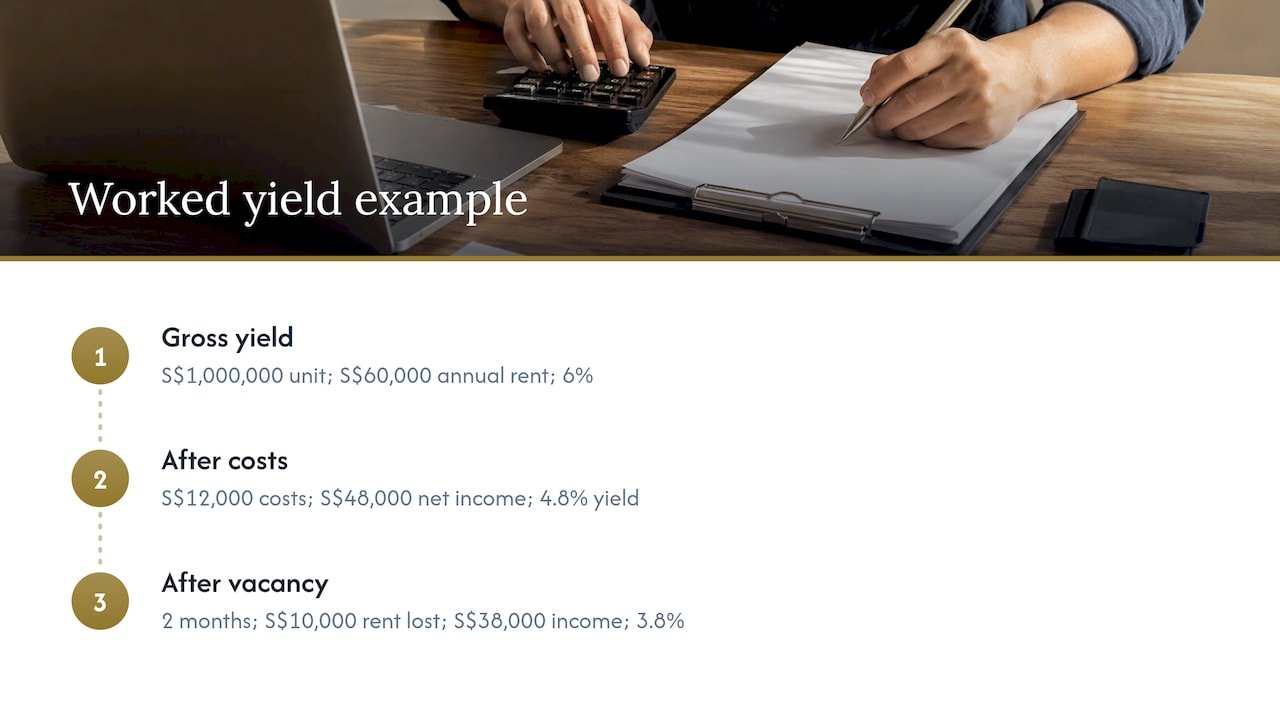
Suppose a unit is bought for S$1,000,000 and let at S$60,000 a year. The gross yield is 6%. If property tax, MC charges, insurance and an average agent commission total S$12,000 a year, net income is S$48,000 and the net yield is 4.8%. Add two months of vacancy in a year (S$10,000 of lost rent) and net income falls to S$38,000, or 3.8%. The figures are illustrative only, but the sequence is what you should model for any unit you consider.
How offices are valued
Three methods are used in practice:
- Comparable sales: compare the price per square foot with recent transactions in the same building or area.
- Income capitalisation: divide net operating income by the capitalisation rate you require. At a 4% required return, S$45,300 of net operating income implies a value of S$1,132,500.
- Discounted cash flow: forecast net income for each year you plan to hold, add the expected sale price, and discount at your required return.
A free property valuation is a useful anchor for the first of these before you make an offer.
Current market data
Office fundamentals strengthened through 2026. Figures below are for the period stated and will move, so read them as a snapshot.
- Core CBD rents and vacancy: Colliers reports that Core CBD Premium and Grade A rents rose 5.3% in the first nine months of 2026. Average rents rose 1.8% quarter on quarter to S$12.45 psf in Q3, vacancy fell to 2.7% from 3.3%, and net absorption rebounded to 419,000 sq ft. Net yields in that segment were 3.7%.
- Islandwide demand: The Business Times reports that net demand hit 182,986 sq ft in Q3 2026, up from 86,111 sq ft in Q2. Cushman & Wakefield’s Wong Xian Yang attributes the fall in islandwide vacancy to 10%, the lowest since Q1 2024, to positive net demand and shrinking supply.
Two points follow for investors. First, the prime CBD segment is tight and its net yield is modest, so prime buyers are paying for stability and capital value. Second, islandwide vacancy of 10% is far higher than the Core CBD figure, so location and building quality matter a great deal when you assess a unit outside the core.
DBS also notes that commercial property can diversify an investor who already holds residential assets, and that Singapore’s economic growth, infrastructure development and land scarcity support the potential for capital appreciation. Potential is not a promise, so underwrite on rent first.
Due diligence for a strata office
Approved use and title
Verify legal title and registered interests against the correct lot, and check the approved planning use separately. A clean title search does not establish approved use. Confirm that your intended tenant’s business is permitted in the unit, because an office unit can carry restrictions that surprise buyers who assume otherwise. Our commercial property guide on use, BSD and TDSR lists the checks in order.
URA restrictions on strata subdivision
From 15 March 2022, URA restricts strata subdivision of commercial components in specified Orchard Road and CBD corridors and near key national landmarks. Developments with strata subdivision approved or applied for before that date are affected on future redevelopment. The stated aim is to address concerns about fragmented ownership and keep prominent developments well maintained. If you are buying in a central building, ask whether redevelopment could be affected.
Management corporation and share value
Under the Building Maintenance and Strata Management Act, each lot is assigned a share value. The share value sets your proportion of contributions to the management and sinking funds, your voting rights and your share of common property. The MC manages common areas for all owners.
Request the following before you commit:
- Your unit’s share value and the current monthly or quarterly contributions
- The sinking fund balance and any planned major works
- Minutes of recent MC meetings and any pending disputes
- Arrears owed by other owners
- The existing lease terms, rent, deposit and expiry date, if the unit is let
Upkeep risk
The Business Times notes that strata-titled buildings can face upkeep challenges from fragmented ownership, sometimes leading to physical deterioration and a mismatched tenant mix, especially as buildings age. Owners with several buildings often compare property management and asset management approaches to keep income and condition on track. For a single unit, the practical step is to choose a well-run building with an active MC and a healthy sinking fund.
Financing an office purchase
Commercial loans are not priced or capped like residential mortgages, and each bank sets its own loan-to-value and rates according to the building, the lease and the borrower. If you borrow as an individual, your debt servicing is assessed under TDSR rules, which our commercial guide explains. A company borrower is assessed on the bank’s own criteria, and banks may ask directors for guarantees. Speak to your bank early, with the lease and building details in hand, and confirm in writing what it will lend against the specific unit.
Our perspective
We look at office investment the way we look at every Singapore property decision: the purchase price is only one line in the calculation.
Most first-time office buyers compare headline yields. We start with the duty position, because it shapes the whole return. A commercial office does not attract ABSD, and that is part of why we work with investors who want exposure to Singapore property without the residential duty burden. The BSD, GST and valuation questions still need careful handling, and that is where detailed market evaluation matters.
Our approach is to look for gaps: where the asking price sits against comparable sales, where a building’s rents sit against its neighbours, and where a lease profile supports the income. With over $1 billion in sales behind our team, we apply the same discipline to commercial offices as to residential homes, with transparent guidance and personalised negotiation on every deal.
Anderson
Browse offices and request a valuation
If you are ready to compare real units, our Commercial Office listings show what is currently available, and the wider Commercial category covers other non-residential property.
Already own an office or shop unit and thinking of selling? Ask for a free property valuation, then speak to us about pricing and negotiation. You can also start from our home page to buy, sell or rent.
FAQ
Can foreigners buy a strata office in Singapore?
Commercial property is not subject to ABSD, which is what makes residential purchases expensive for foreigners. See our guide on ABSD for foreigners for the residential comparison. Rules on specific buildings, such as the type of title and the approved use, still need to be checked with a lawyer before you commit.
What is a good yield for an office investment in Singapore?
DBS cites gross yields of up to 8% for offices, while Colliers reported net yields of 3.7% in the Core CBD premium segment in Q3 2026. What counts as good depends on location, lease length and condition. Compare the net yield after vacancy, tax and MC charges, not the gross figure.
Does GST apply when I buy an office?
GST applies to non-residential property where the seller is GST-registered, and IRAS notes that it is claimable where the property is used for business activities generating taxable supplies. Your accountant should confirm whether you can claim it, because that changes the cash you need at completion.
Why are some central strata offices restricted?
Since 15 March 2022, URA has restricted strata subdivision of commercial components in certain Orchard Road and CBD corridors and near key landmarks. The aim is to avoid fragmented ownership and keep prominent buildings well maintained. Existing strata buildings are affected when they are redeveloped.
Sources
- A niche investment window in strata-titled office space, The Business Times
- Singapore Corporate: Other taxes, PwC Tax Summaries
- IRAS e-Tax Guide on GST for property owners
- Real Estate Laws and Regulations Report 2026 Singapore, ICLG
- A Guide to Commercial Real Estate Investing in Singapore, DBS
- Singapore CBD office rents rise 5.3% in first nine months, Real Estate Asia
- Net demand for Singapore office space doubles in Q3, The Business Times
- Restrictions on the Strata Subdivision of Commercial Developments, URA circular DC22-02
- Strata Management Guide 1, BCA
- Property management vs asset management for office owners