

Gross vs Net Rent in Singapore: What Each Means and How to Compare
Gross rent is the full amount a tenant pays before anything is taken off. Net rent is what remains once the costs of owning and running the property are deducted. In Singapore the words are also used in a second, leasing sense: a commercial landlord may quote a “net” base rent with service charges and other outgoings billed on top, or a “gross” figure that bundles them in. The two meanings answer different questions, so the first step is to know which one a number refers to.
This guide covers both uses: the leasing meaning that tenants and landlords negotiate, and the investment meaning that buyers use when they work out yield. It also explains net effective rent, which matters whenever a landlord offers rent-free months.
TL;DR
- Gross rent is the total rent and related payments received. Net rent is that income after allowable expenses such as mortgage interest, property tax, insurance and maintenance.
- In a commercial lease, a gross quote usually bundles outgoings into one figure, while a net quote is a base rent with service charges and other items added separately. The two are not comparable until you put them on the same basis.
- Gross yield divides annual rent by the purchase price. Net yield subtracts running costs first, so it is always lower.
- Net effective rent spreads rent-free periods and other incentives across the lease, showing the real average cost per month.
- Compare offers on one basis: total monthly outlay per square foot or per month, after incentives, over the same lease term.
Table of Contents
- Gross rent and net rent: the basic difference
- The two meanings: tax and investment versus leasing
- How gross and net work in a Singapore commercial lease
- From rent to yield: gross yield and net yield
- Gross yield versus cap rate
- Net effective rent and rent-free periods
- How to compare rental figures consistently
- What this means for homeowners and renters
- Our perspective
- Put your numbers on a firm basis
- FAQ
- Sources
Gross rent and net rent: the basic difference
The simplest way to separate the two is to ask who bears the costs.
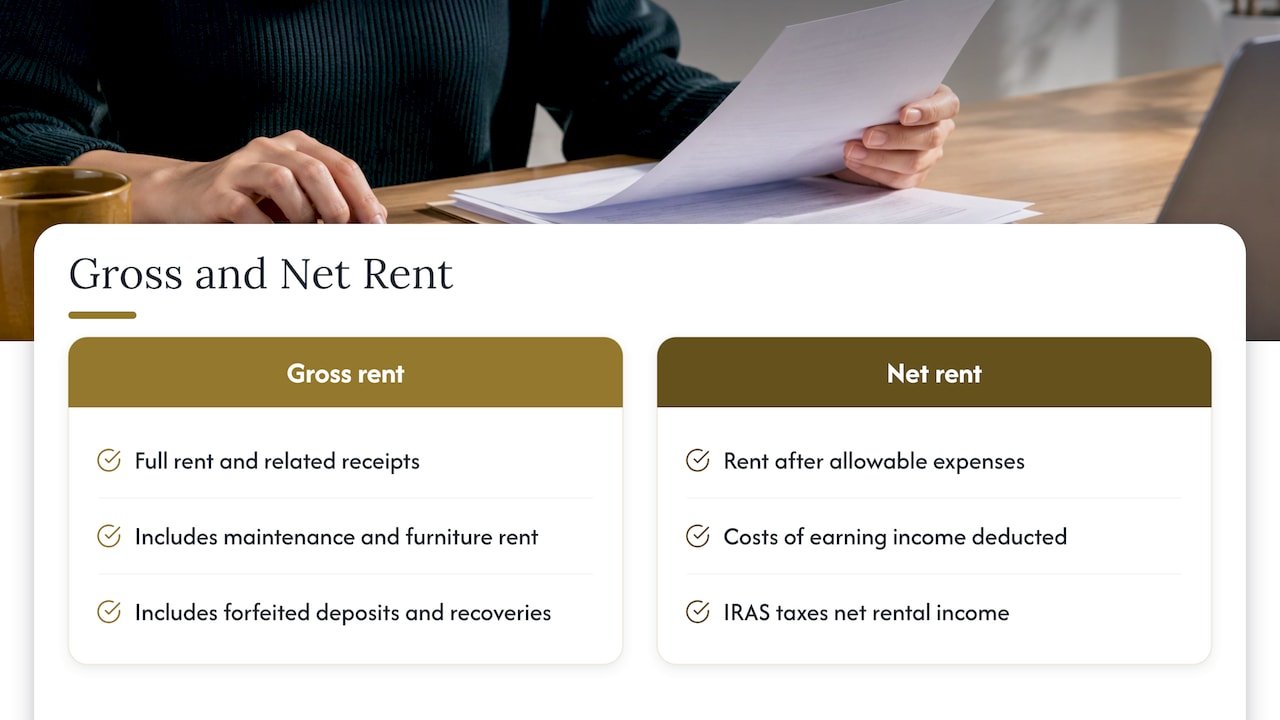
Gross rent is the headline amount that comes in. For tax purposes, IRAS describes rental income as the full amount of rent and related payments received, including maintenance payments, rent for furniture and fittings, forfeited rental deposits, subletting income and insurance recoveries. So gross rent is wider than the monthly rent line on a tenancy agreement.
Net rent is what is left after the allowable costs of earning that income. IRAS taxes net rental income, meaning the rent after allowable expenses, not the gross figure.
A worked example from IRAS
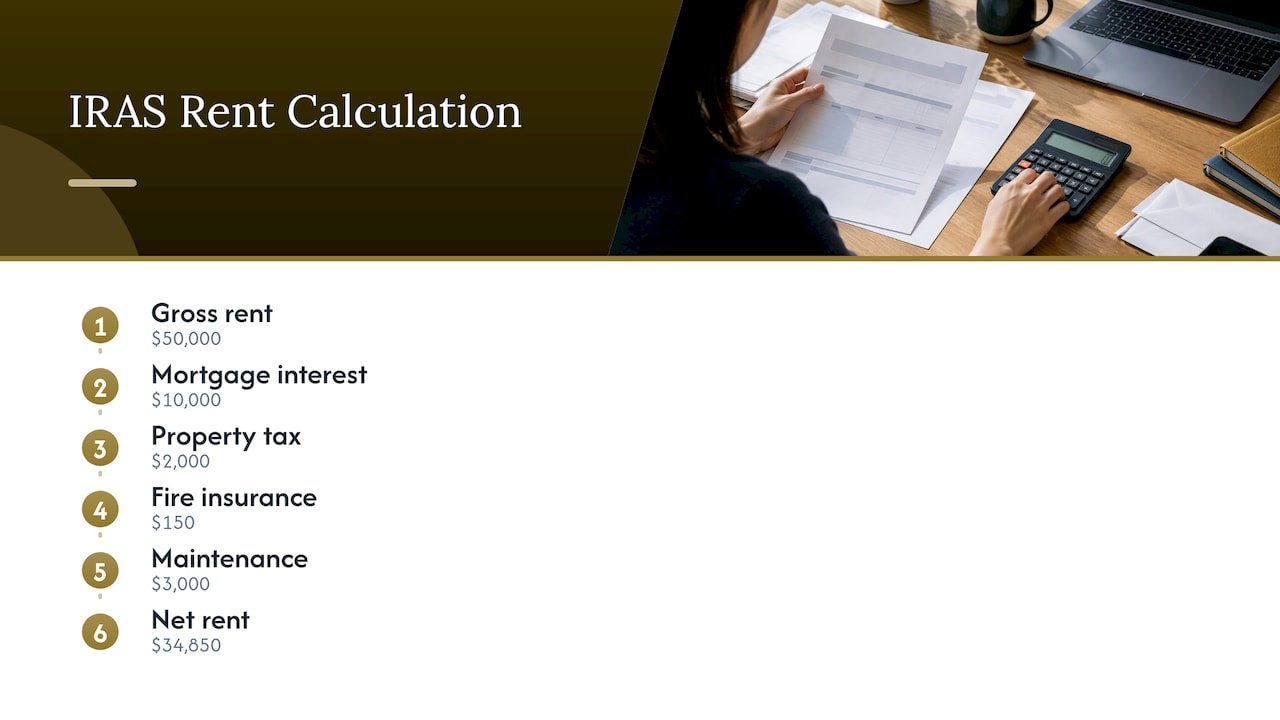
IRAS gives an example of a non-residential property let at a gross rent of $5,000 a month for 10 months, which makes $50,000 of gross rent. After apportioned mortgage interest of $10,000, property tax of $2,000, fire insurance of $150 and maintenance of $3,000, the net rent comes to $34,850. Almost a third of the gross figure disappears before tax is calculated.
What counts as “gross rent” can be wider than rent
The courts have looked at this too. In a 2013 Court of Appeal decision, gross rent was taken to mean the actual sum paid by each tenant, which can include components that are not rent in the strict sense, such as a per-square-foot monthly charge for the depreciation of plant and machinery. The same decision held that annual value for property tax must include only the elements of rent or letting. The lesson for readers is practical: a single number on a lease can contain several different things, and it is worth asking what each part is.
The two meanings: tax and investment versus leasing
People searching this topic usually have one of two situations in mind.
| Situation | What “gross” means | What “net” means |
|---|---|---|
| Owner or investor working out income | All rent and related receipts | Receipts after allowable expenses |
| Tenant or landlord negotiating a commercial lease | One rent figure with certain outgoings included | Base rent only, with outgoings billed separately |
| Valuation | Rental before outgoings | Income after outgoings, used to value the asset |
The label is the same in every row, but the arithmetic is different. A landlord saying “net rent of S$5 per square foot” is describing a leasing structure. An investor saying “net rental income of S$40,000” is describing the result of subtracting costs from income. Mixing them up is the most common reason two quotes look far apart when they are not.
How gross and net work in a Singapore commercial lease
In commercial leasing, the question is which outgoings sit inside the quoted rent and which are added on top.
What a gross rent figure usually bundles
One Singapore legal guide states that gross rent is derived from base rent, GST where the landlord is GST-registered, and service charges. Under that view, the figure on the quote is the monthly total the tenant should expect to pay the landlord.
The same guide defines service charges as payments to the landlord for general services such as building maintenance, repairs and security. It adds that lease agreements usually allow the service charge to change during the term, so the landlord can recover any increase from the tenant. That detail matters for budgeting: a base rent may be fixed for the term while the service charge is not.
What a net rent figure leaves out
Under a net quote, the base rent is only part of the monthly bill. Service charges, GST and utilities come on top. A professional guide to leasing office premises notes that electricity for general use and telecommunication bills are paid by the tenant to the service providers, while centralised air-conditioning electricity is included in the computation of service charges. So even within one building, some costs go to the landlord and some go directly to utility and telecom providers.
Why landlord-side definitions matter
Property tax shows how the landlord’s costs are framed in law. Under the Property Tax Act 1960, annual value is the gross amount at which a property can reasonably be expected to be let from year to year, with the landlord paying for repair, insurance, maintenance or upkeep and all taxes other than GST. That is a statutory definition used for property tax, not a template for any particular lease, but it shows why “gross” in Singapore property law carries the idea of a landlord who bears the running costs.
A simple way to line up two quotes
Suppose two offices of the same size are quoted as follows (illustrative figures only):
| Item | Office A (quoted net) | Office B (quoted gross) |
|---|---|---|
| Base rent per sq ft per month | S$5.00 | S$6.20 |
| Service charge per sq ft per month | S$1.00 | Included |
| Total before GST and utilities | S$6.00 | S$6.20 |
Office A looks cheaper at first sight, and it is, by S$0.20 per square foot, but only once the service charge is added. If Office A’s service charge later rises, the gap widens in the tenant’s favour only if Office B stays fixed. Ask each landlord to state what is included, in writing, before comparing.
From rent to yield: gross yield and net yield
Investors use the same gross and net split to measure return on the purchase price.
Gross rental yield is annual rental income divided by the purchase price, multiplied by 100. Net rental yield subtracts the annual costs of holding the property (maintenance or management fees, property tax, insurance, agent fees, and where relevant mortgage interest and minor repairs) from the rental income before dividing by the price. Income tax on the rent is normally left out of the yield figure.
Worked example
Take a condominium unit bought at S$1,200,000 and let at S$4,000 a month. These numbers are for illustration only.
| Line | Amount |
|---|---|
| Annual gross rent (S$4,000 × 12) | S$48,000 |
| Gross yield (48,000 ÷ 1,200,000) | 4.0% |
| Maintenance fees | S$3,600 |
| Property tax | S$1,500 |
| Insurance | S$300 |
| Agent fee | S$2,000 |
| Total annual costs | S$7,400 |
| Net rent (48,000 − 7,400) | S$40,600 |
| Net yield (40,600 ÷ 1,200,000) | about 3.4% |
The gap between 4.0% and 3.4% is typical in nature: net yield sits below gross yield because costs always reduce income. Our own Singapore rental yield snapshot sets out how large that gap tends to be across the market, and the price-to-rent ratio guide shows the same relationship from the other direction.
Vacancy changes the picture
Both yields assume the unit is let all year. A month without a tenant removes one twelfth of the rent while the costs continue. When you model an investment, run the numbers at full occupancy and with a vacant month or two. The Singapore rental market outlook is a useful place to check how vacancy has been moving.
Gross yield versus cap rate
The cap rate is a close relative of net yield, used mostly for commercial property. It divides net operating income by the property’s value. Valuers turn the formula around to value an asset: value equals net operating income divided by the capitalisation rate, an approach used for Singapore commercial property. The same source gives an example of a S$1.2m office earning a 3.8% net yield.
The practical difference is the numerator:
- Gross yield uses rent before any costs.
- Net yield uses rent after the owner’s costs, and often after mortgage interest.
- Cap rate uses net operating income, which is rent less operating costs, generally before financing costs, so it describes the property rather than the loan.
If an agent quotes a “yield” on a commercial unit, ask which of the three it is. A gross figure will look more attractive than a cap rate for the same building. For the buying side of commercial property, our commercial property guide covers use checks, stamp duty and financing rules.
Net effective rent and rent-free periods
Net effective rent answers a different question: what does the tenant actually pay per month, on average, once incentives are counted? Landlords sometimes offer rent-free months, fitting-out contributions or stepped rents. The headline rent stays high, but the average cost falls.
How to calculate it
A simple version: add up all the rent actually payable over the lease, subtract any cash incentives, and divide by the number of months in the term.
Example (illustrative): a 24-month lease at S$5,000 a month with 2 months free.
- Rent payable: 22 × S$5,000 = S$110,000
- Net effective rent: S$110,000 ÷ 24 = about S$4,583 a month
The tenant has a headline rent of S$5,000 and an effective rent of about S$4,583. This simple method does not adjust for the time value of money or the timing of the free months, as one industry explanation of net effective rent points out, so treat it as a comparison tool and not an accounting figure.
Why landlords prefer to offer free months
Keeping the headline rent high protects the quoted rental level for the building, while the free months attract the tenant. For the tenant, the free period often matters more than a small headline discount, particularly at the start of a lease when fitting-out costs fall.
A Singapore example of rent being waived
Singapore has a recent official example of rent concessions. Under the Rental Relief Framework, applicable rent and interest on the rent were waived for eligible months, and IRAS explained that landlords providing waivers could offset those reductions against certain benefits passed on to tenants. That framework dates from 2020 and is no longer a guide to current terms, but it illustrates that the rent actually paid can differ from the contract rent, and that the difference has tax consequences for the landlord.
How to compare rental figures consistently
When figures come from different sources, put them on one footing before deciding. A workable routine:
- Confirm the basis. Is the figure gross or net, and does it include service charge, GST and air-conditioning?
- Convert to the same unit. Use total monthly outlay, or per square foot per month, for every option.
- Adjust for incentives. Calculate net effective rent over the same lease term.
- Add the costs outside the rent. Utilities, telecom, fitting out, and the security deposit.
- Check escalations. Look for service charge reviews and rent step-ups in the draft lease.
- For investment, state the yield type. Gross, net or cap rate, and the price it is measured against.
Before signing, the lease should say exactly what is covered. Our guide to the tenancy agreement process in Singapore covers stamping and templates, and the guide to getting your deposit back explains what is deducted at the end of a tenancy.
What this means for homeowners and renters
Residential tenancies are rarely described as net or gross in the commercial sense. The monthly rent is usually a single figure, with utilities paid by the tenant and maintenance and property tax paid by the owner. Even so, the same discipline applies. An owner assessing a purchase should work from net yield, not the headline rent. A renter comparing flats should add the upfront costs and utilities to the monthly figure. Our cost of renting in Singapore page lists typical rents and upfront payments, and the expat renting guide covers the rules and areas that matter to people relocating.
Our perspective
We see the same pattern in many enquiries: an investor compares two properties on gross yield, picks the higher one, and only later finds that the running costs and the way the rent is structured have reversed the ranking.
Our view is that a rental figure is only useful once it is on a stated basis. That is why we start every evaluation by establishing what the rent includes, what the owner pays, and what the property would cost to hold in a quiet year. A detailed market evaluation looks for the gap between what a property is priced at and what it can realistically earn, and it is far more reliable when built on net figures.
For buyers, we also look at how the purchase is structured, because the cost of acquiring a property affects the return as much as the rent does. Our approach is built around helping investors buy without the burden of Additional Buyer’s Stamp Duty, which can make the difference between a property that works on paper and one that works in practice.
Whether the property is residential or commercial, we recommend working from net yield, checking vacancy and comparing leases on net effective terms.
Anderson
Put your numbers on a firm basis
If you own a property and want to know what it could let or sell for, we offer a free property valuation. If you are looking for a place to buy or rent, you can browse commercial office listings or residential listings, and our team can help you work through the yield and structure of any property that interests you.

To discuss a purchase, sale or rental, start from the Register Today home page.
FAQ
What does gross rent mean?
Gross rent is the total rent and related payments received before any costs are deducted. For tax, IRAS counts items such as maintenance payments and forfeited deposits as part of rental income. In a commercial lease, a gross quote usually means one figure that bundles certain outgoings.
What is the difference between gross and net rental yield?
Gross yield divides annual rent by the purchase price. Net yield first subtracts costs such as maintenance fees, property tax, insurance and agent fees. Net yield is therefore always lower, and it gives a more realistic picture of what an owner keeps.
What is net effective rent?
Net effective rent is the average monthly rent over the whole lease once incentives such as rent-free months are counted. For example, 22 paid months at S$5,000 across a 24-month term averages about S$4,583 a month. It is the fairest way to compare offers with different incentives.
Is net rent cheaper for a tenant than gross rent?
Not necessarily. A net quote looks lower because service charges and other outgoings are billed on top. Add those items to the base rent and compare the total monthly outlay with the gross quote.
Is net rental income the same as taxable rental income?
Broadly, IRAS taxes rental income after allowable expenses, so net rent is the starting point. Which expenses are allowable depends on the property and your circumstances, so check the IRAS guidance or ask a tax professional for your own case.
Sources
- IRAS: Income from property rented out
- Property Tax Act 1960, Singapore Statutes Online
- 2013 SGCA 4, Court of Appeal decision
- Common commercial lease terms in Singapore
- Guide to leasing office premises in Singapore
- Valuing strata-title commercial property in Singapore
- IRAS: Rental Relief Framework
- Net effective rent guide