
Defects Liability Period in Singapore: How It Works
The defects liability period (DLP) in Singapore is the 12 months after you receive a new home during which the builder or developer must repair defects at its own cost. For a new HDB flat it runs from key collection. For a new private home it runs from the earlier of vacant possession or a set number of days after the Temporary Occupation Permit (TOP) paperwork reaches you. The practical rule is the same for both: inspect early, report in writing, and keep records.
This guide is for buyers of new flats, condos and landed homes, including first-time buyers and families, and for investors who buy new units to hold or let out. It explains the length of the period, when it starts, what counts as a defect, how to report one, and what you can do if the repair never happens.
TL;DR
- The DLP is 12 months for new HDB flats and new private homes bought from a developer. For HDB it starts on key collection.
- For private homes, the start date is set in the Sale and Purchase Agreement (SPA). Rules announced in November 2025 move it from the 15th to the 35th day after the TOP payment notice, or earlier if you take vacant possession.
- Report HDB defects within 30 days of key collection and before renovation starts, so responsibility is clear.
- In a private purchase the developer has one month to fix a reported defect. If it does not, you give 14 days’ further notice, then hire a contractor and recover the cost.
- Defects found after the DLP are harder to claim, so use the 12 months fully.
Table of Contents
- What a defects liability period is
- How long it lasts and when it starts
- What counts as a defect
- How to inspect and report defects, step by step
- When the developer does not fix the defect
- What happens after the DLP ends
- Mistakes that cost buyers their claim
- Why the DLP matters when you choose and price a home
- Work with a team that knows the handover stage
- Our perspective
- FAQ
- Sources
What a defects liability period is
A DLP is a fixed window after completion in which the party that built the home must come back and make good faulty work without charging you. The idea is simple: some problems only show once someone lives in the unit, such as a tile that sounds hollow when tapped, a window that jams or a slow seepage mark.
In construction contracts the same concept is sometimes called a maintenance period. The names differ by contract form, but the logic is shared: during the period the contractor repairs defective work at its own expense, and after it the employer’s remedy shifts to damages within the statutory limitation period. For a home buyer, you will mostly meet the term in your HDB handover documents or in clause 17 of the SPA.
Two points are worth knowing from the start. First, the DLP is a contractual protection. Workmanship defects inside your unit are not policed by the building regulator in the way structural safety is: the Building and Construction Authority (BCA) checks compliance with the Building Control Act and issues the TOP, while unit workmanship is a matter between you and the developer. Second, the protection only works if you use it in time, which is why the rest of this guide is about timing.
How long it lasts and when it starts
| Type of home | Length | Start date |
|---|---|---|
| New HDB flat (BTO) | 1 year | Key collection date |
| New private home (condo, executive condominium, landed) from a licensed developer | 12 months | Set by clause 17 of the prescribed SPA: the earlier of receiving the Notice of Vacant Possession or a set number of days after the TOP documents |
For HDB, the 1-year DLP begins on the key collection date, and HDB confirms the period is 1 year.
For private homes, the standard SPA is prescribed by law for licensed developers. Under clause 17, the vendor must make good at its own cost any defect that becomes apparent within 12 months from the date the purchaser receives the Notice of Vacant Possession, and must do so within one month of notice. In practice the clock can start before you hold the keys, because it also runs from a set day after the TOP-stage documents reach you. That is why the progress payment that falls due at TOP matters: it is the trigger. Our guide to the progressive payment schedule for Singapore buyers explains what you pay at that stage.
The change to the start date
The Straits Times reported in November 2025 that the start of the DLP and of maintenance-charge liability moves from the 15th to the 35th day after the progress payment notice is issued at TOP, or the date of vacant possession, whichever is earlier. The reason given is that developers have 21 days to deliver possession after collecting that payment, so buyers were losing time before they could even enter the unit. The same package requires site plans with structural walls marked and disclosure of developers’ CONQUAS track records (CONQUAS is BCA’s construction quality score).
The new terms apply to projects launched under the updated Option to Purchase and SPA, so the agreement you sign is what counts. Read the clause in your own SPA and note the exact start date in your calendar on the day you receive the TOP documents.
What counts as a defect
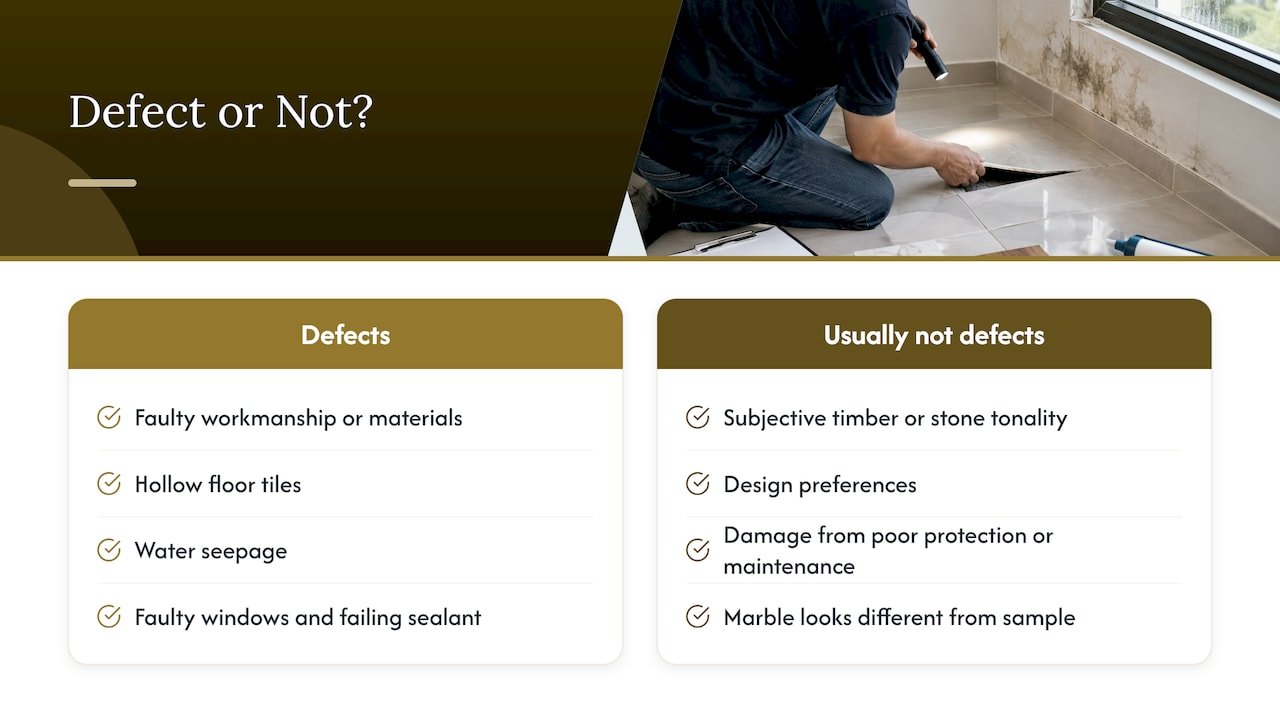
The standard SPA defines a defect as any fault in the building due to defective workmanship or materials, or to the building not being constructed in accordance with the specifications. Typical examples include hollow floor tiles, water seepage, faulty windows and failing sealant. Cracks, stains, uneven surfaces, doors that do not close and non-working power points also belong on your list.
Some things are normally not treated as major defects. BCA’s CONQUAS guidance, as summarised in a Singapore property guide, lists subjective views such as the tonality of timber or natural stone, design preferences, and damage caused by failing to protect or maintain the unit. If a marble slab simply looks different from the showflat sample, that is a matter of taste rather than a fault. If it is cracked, chipped or badly laid, it is a defect.
A useful test is to ask whether the problem is a fault in how the unit was built or finished, or a difference from what the specifications promised. If yes, list it.
How to inspect and report defects, step by step
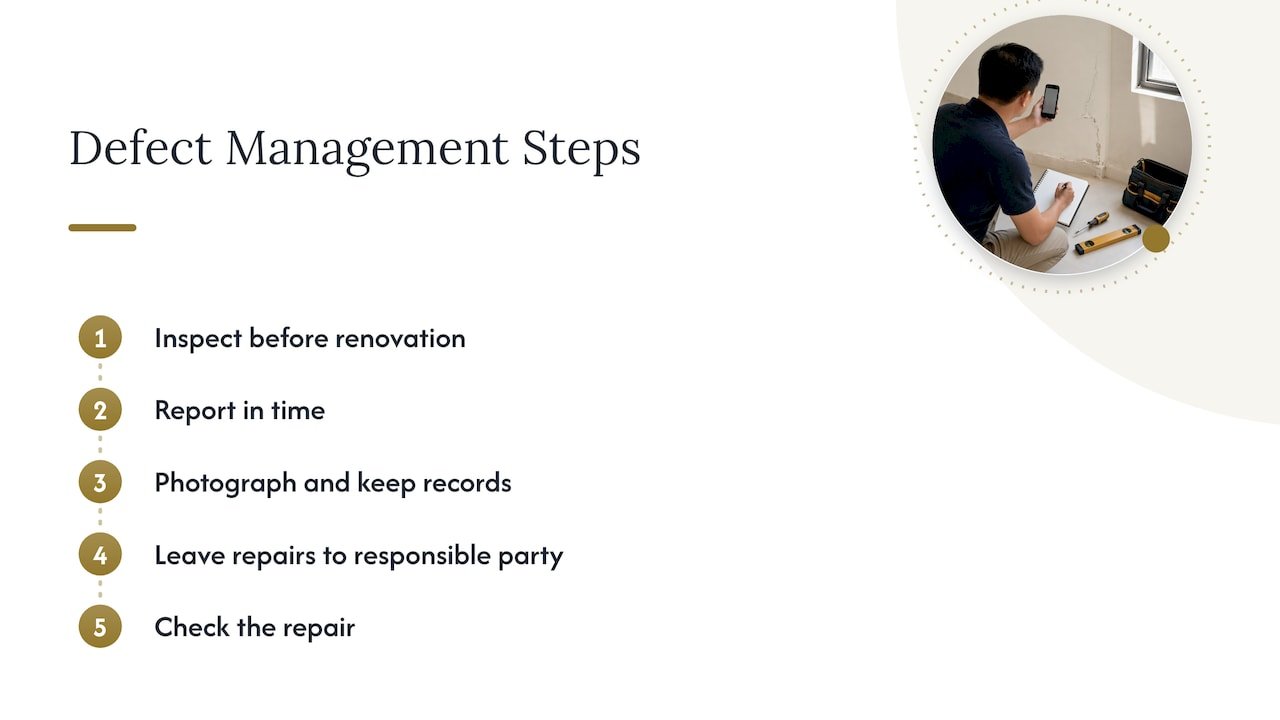
1. Inspect before you renovate
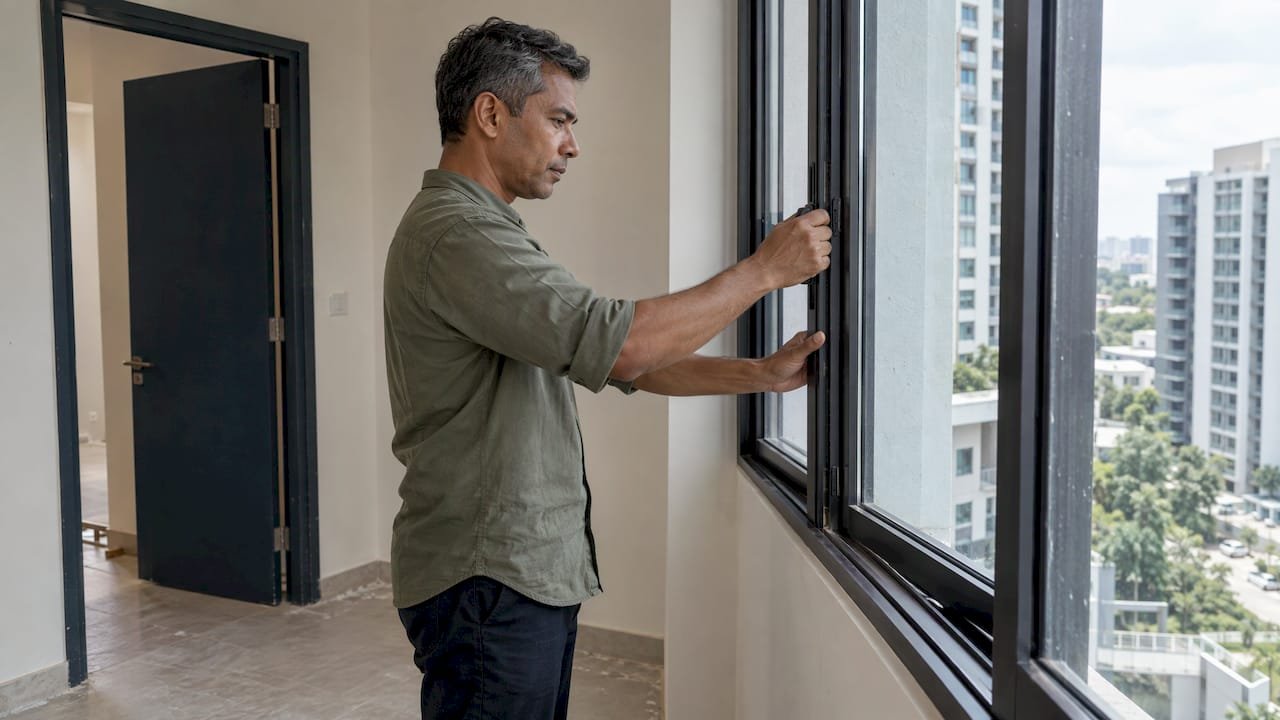
For HDB flats, MyNiceHome advises inspecting each space systematically, labelling defects with painter’s tape or sticky notes and recording them in a defect list. Work room by room: ceilings and walls, floors, doors and windows, plumbing, electrical points and air-conditioning provisions. Switch on every tap, flush every toilet and open every window. A torch held flat against a wall shows unevenness that normal light hides.
We have put the full walk-through in our property inspection checklist for Singapore buyers, so you can print it and mark it up on the day.
2. Report in time
For HDB, all defects should be reported within 30 days of key collection and before renovation works begin. The reason is practical: once your renovation contractor has been in, it is hard to show whether a crack or leak came from the building or from the renovation. HDB lets you submit defects online or at the Building Service Centre at the precinct.
For private homes, the developer provides a defect form at handover. Complete it, keep a copy and send further defects in writing as they appear within the 12 months. Do not rely on phone calls or chat messages alone.
3. Photograph and keep records
Take dated photographs and short videos of each defect before and after any repair. Keep your list, emails, form copies and receipts together in one folder. If a dispute comes later, a clear paper trail is the strongest thing you will have.
4. Leave the repair to the party responsible
Do not fix a defect yourself during the DLP and then ask for the money back unless the SPA process allows it. Doing your own repair can give the developer an argument that it no longer has to rectify the item. Follow the contract steps first.
5. Check the repair
Once the contractor has worked on an item, inspect it again. MyNiceHome states that HDB defect repairs typically take less than two weeks. Sign off only items that are properly fixed, and re-report anything that is not.
When the developer does not fix the defect
Clause 17 gives a private buyer a clear route. The developer must rectify within one month of notice. If it fails, the purchaser may give a further 14-day notice, then rectify the defect and recover the cost, including by deducting from sums held by the stakeholder.
The steps in order:
- Report the defect in writing within the DLP.
- Wait one month for the developer to make good.
- If nothing happens, send a second written notice giving 14 days, with a contractor’s estimate where possible.
- If the 14 days pass, engage a contractor and claim the cost, keeping photographs, notes and receipts.
BCA also notes that a defect reported during the DLP remains the developer’s responsibility even if it is still unresolved once the period ends. This is the reason to report early and in writing: a dated report protects an item that takes longer than expected to fix.
For a significant sum, speak to a lawyer before you deduct anything from money held by a stakeholder, because the contract wording and the amounts involved matter.
What happens after the DLP ends
After 12 months, you generally carry the cost of upkeep and repairs in your unit. The BCA says that after the DLP, owners bear upkeep costs and may need to engage their own contractor. But a defect that only appears later is not always lost.
Latent defects
A latent defect is a fault that was in the building from the start but could not reasonably be seen during the DLP. Clause 17 itself does not deal with these, but the Court of Appeal held that it does not remove the buyer’s other rights. In its 2020 judgment it recorded that beyond the DLP, homeowners can sue for latent defects in negligence or breach of contract within six years from when damage arose, or three years from discovery, whichever is later. Chambers’ Singapore construction guide adds that a 15-year long-stop applies to these claims. Whether a particular fault is latent is decided case by case, so serious or costly problems need legal advice.
HDB flats after year one
For HDB, the answer depends on cause. HDB has stated that where a post-DLP issue is caused by wear and tear or poor maintenance, the owner pays, but where engineering assessments attribute it to the contractor’s workmanship or a design issue, HDB will rectify it. HDB also provides longer warranties for specific problems such as ceiling leaks, external wall seepage and spalling concrete, so ask your HDB Branch about the terms for your flat. If you change the floor tiles or tamper with waterproofing in a wet area, you may put such cover at risk, so check before you renovate.
HDB says that after the DLP, owners can engage a repair contractor and approach their HDB Branch for further assistance.
Mistakes that cost buyers their claim
- Waiting until after renovation. The 30-day HDB reporting guidance exists to separate building defects from renovation damage.
- Verbal reports only. If it is not in writing, you cannot prove you reported it within 12 months.
- Treating the DLP as a single inspection. Some faults, such as slow leaks or door swelling in the wet season, only show over months. Do a second inspection around month 10 and report anything new.
- Ignoring the start date. With private homes, the clock can start before you collect keys. Diarise the date from the TOP documents.
- Confusing taste with defect. Keep your list to genuine faults and specification mismatches so that it is taken seriously.
- Forgetting the money side. Know what you have paid and what the stakeholder still holds. The stamp duty timeline for Singapore buyers is a useful companion when you plan the post-handover months.
Why the DLP matters when you choose and price a home
A new unit is not defect-free by default, and the DLP is the cheapest repair window you will ever have. For a first-time buyer, it turns a large purchase into a manageable one: you know that for 12 months faults are the builder’s cost. For an investor, it protects the rental start date, because a tenant who finds a leak in week two is a tenant you may lose. Families moving in with children benefit most from an early, thorough inspection, since wet-area and window faults affect daily life straight away.
If you are still deciding whether to buy new or resale, the DLP is one of the differences. A resale flat does not carry a developer’s DLP in the same way, so it needs a more careful look before you commit. Our first-time homebuyer guide for Singapore walks through the full path from budget to keys.
Work with a team that knows the handover stage
Register Today is a real estate platform for buying, selling and renting in Singapore, with residential and commercial listings and a free property valuation. If you are comparing new and resale homes, or want to know what your unit is worth before and after handover, start with the free property valuation. To see what is on offer, browse residential listings or reach us through the Register Today homepage.

We provide personalised negotiation and detailed market evaluations, so you can compare a new-launch unit with resale options on the same facts before you commit to either.
Our perspective
Most buyers think of the DLP as a clause. We think of it as a deadline that decides who pays for the first year of repairs, and the buyers who do best treat it that way from the day they sign.
The pattern is consistent: the people who inspect early, write everything down and keep a single folder of evidence are the ones whose repairs get done. Those who wait until after renovation, or report by phone, lose time they cannot get back.
That is also why we want buyers to know the numbers before they buy, not after the keys are in hand. A transparent view of the price, the payment stages and the handover timeline means the DLP start date is no surprise. Our free property valuation and market evaluations are built to give you that clear picture, whether you are a first-time buyer, a family choosing an area, an investor or an expat looking for a home to rent.
Anderson
FAQ
Is the defects liability period the same as a maintenance period?
In practice they describe the same thing: a fixed period after completion when the contractor repairs defects at its own cost. Public-sector contracts tend to say DLP and some private building contracts say maintenance period. For a home buyer, the length and start date in your HDB documents or SPA are what matter.
Does the DLP start on key collection for private homes?
Not always. For private homes, the standard SPA runs the 12 months from the earlier of receiving the Notice of Vacant Possession or a set number of days after the TOP documents arrive. Rules announced in November 2025 move that second trigger to the 35th day. Check the clause in your own agreement.
Can I claim for a defect I find in month 14?
Not under the DLP itself, but you may have other options. A latent defect may be claimable in negligence or contract within the limitation periods, and HDB may rectify post-DLP issues that its assessment links to contractor workmanship. Get advice from a lawyer for a costly private-home defect, or contact your HDB Branch for a flat.
Do I need to report defects before I renovate?
For HDB flats, yes: report within 30 days of key collection and before renovation begins. For private homes, report in writing as early as you can within the 12 months. Early reporting shows the fault was there before any renovation work.
Sources
- How to Move Into Your HDB Flat, MyNiceHome
- Rectification of Defects in New Flats, HDB
- Court of Appeal judgment [2020] SGCA 86
- What to know as a condo owner, BCA
- Private home buyers to get better protection, The Straits Times
- Fixing Defects Due to Design or Construction Flaws After the DLP, Telescope
- Construction, Chambers Global Practice Guides: Singapore
- Defects in a New Condo or Landed Home Bought from a Developer
- New Home Defects Inspection in Singapore: Defects Liability Period Explained