
Net Lettable Area in Singapore: What It Is and How to Use It
Net lettable area (NLA) is the floor space a tenant or owner can actually use in a commercial unit, measured inside the unit and leaving out shared areas such as lift lobbies, staircases and toilets that serve the whole floor. In Singapore it is the figure that rent and valuation for offices and shops should rest on, and it is usually smaller than the strata area on a title or the gross floor area a planner quotes. If you compare commercial units by price per square foot (psf), knowing which area sits under that psf is the difference between a fair comparison and a costly one. Our team at Register Today prepares free property valuations and lists commercial and office units, so the area behind every figure is the first thing worth pinning down.
TL;DR
- NLA is the usable, exclusive floor area inside a unit. Gross floor area (GFA) is a planning measure, and strata area is the area recorded on a strata title.
- The three numbers for one unit can differ, so a psf quoted on one is not comparable with a psf quoted on another.
- For rent and yield, divide by NLA. For the title and ownership, check the strata area. For what can be built, GFA is the planning measure.
- A strata office means you own one lot plus a share of the common property. Leasing a whole floor means you rent the space and share the building’s running costs through the rent or service charge.
- Ask for each area figure, and what it includes, in writing before you compare two units.
Table of Contents
- What net lettable area means in Singapore
- NLA, GFA and strata area: three numbers for one unit
- A worked example: why the area under the psf matters
- Why NLA matters for rent and returns
- What is strata title, and how does it relate to NLA?
- Strata office or a whole floor: what changes
- A checklist before you compare two units
- Who needs this, and who can skip it
- How we help
- Our view on NLA
- FAQ
- Sources
What net lettable area means in Singapore
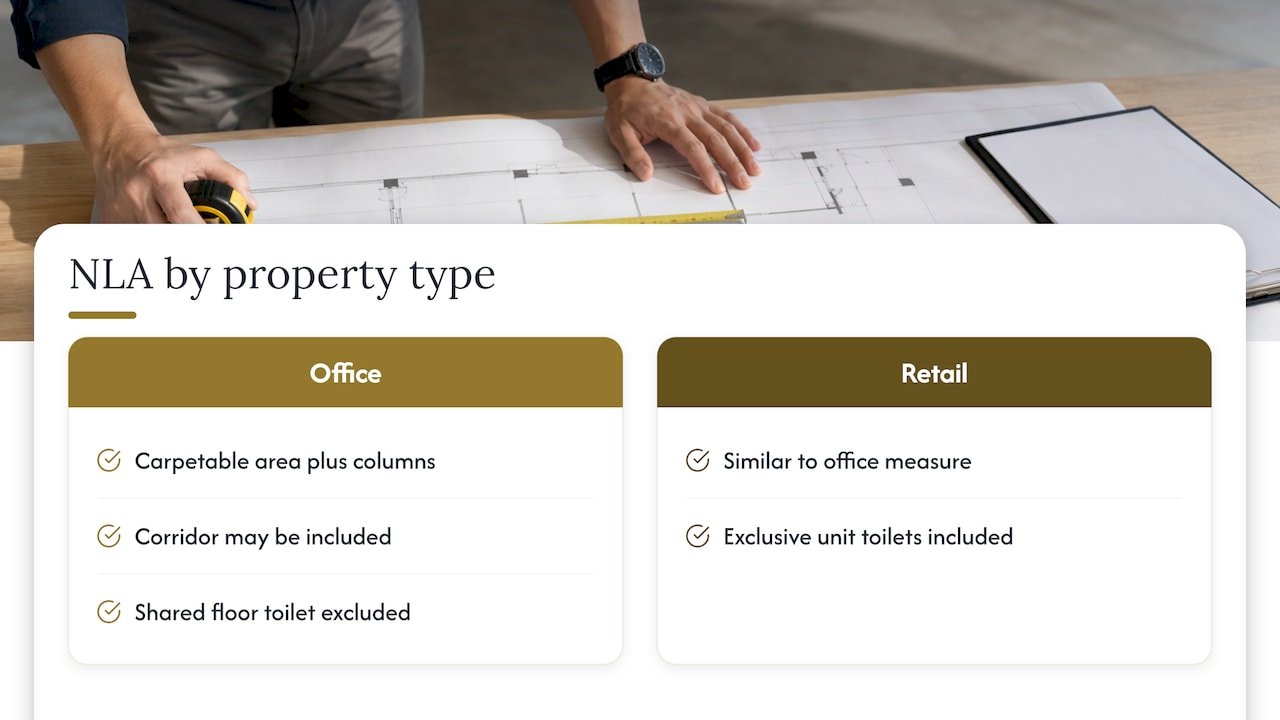
The word “lettable” is the clue. NLA is the part of a building that can be let to an occupier on an exclusive basis. The Singapore guide from the Royal Institution of Chartered Surveyors (RICS) describes office NLA as the carpetable area available for office use plus structural columns, and notes that corridor space may or may not be included. That last point matters: two offices on the same floor can both quote an NLA and still count the corridor differently.
In plain terms, “carpetable” means the area you could lay a carpet on, or in practice the area your desks, meeting rooms and pantry sit on. Walls, lift shafts, riser cupboards and shared toilets are not part of it.
For retail, the same RICS guide says NLA is similar to the office measure but includes toilet areas used exclusively by the retail unit. So a shop with its own toilet counts that toilet, while an office sharing a floor toilet does not.
You will also see “net floor area” and “net lettable area” used for the same idea in market documents. They are generally treated as interchangeable, but the wording of each listing still decides what is counted.
What is usually in and what is usually out
| Usually counted in NLA | Usually not counted |
|---|---|
| Floor space inside the unit up to the inner face of the perimeter walls | Shared lift lobbies, staircases and common corridors |
| Structural columns inside the unit | Lift shafts, risers and plant rooms |
| For retail, toilets used only by that unit | Shared toilets serving the whole floor |
| Space you can fit out and occupy exclusively | Thickness of external walls |
Treat this as a starting point. Corridor treatment and similar details vary by building and by who measured it, which is why the definition printed next to the figure matters as much as the figure.
NLA, GFA and strata area: three numbers for one unit
First-time commercial buyers often meet three area terms in the same brochure. They measure different things for different purposes.
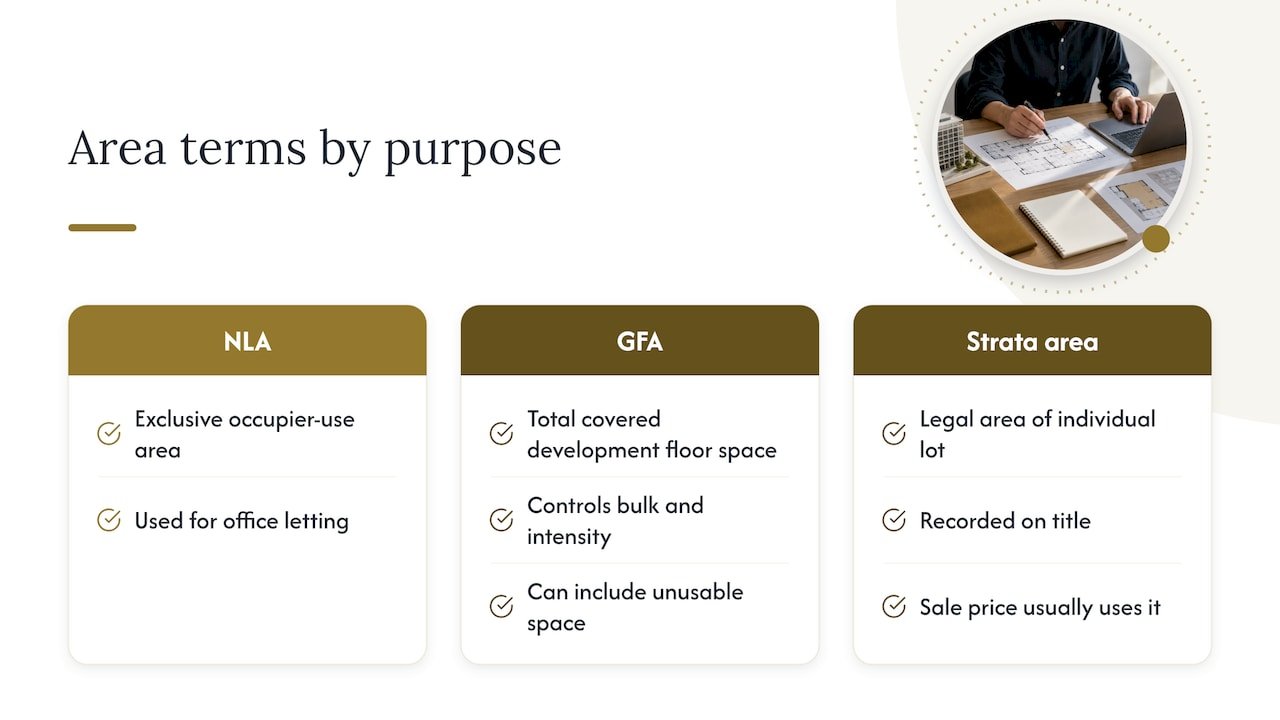
Gross floor area (GFA) is a planning measure. The Urban Redevelopment Authority (URA, Singapore’s land-use planning agency) says GFA is the total covered floor space of a development, used to control its bulk and intensity. Its handbook explains that GFA generally includes half the thickness of external walls and excludes voids. It is not a tenant’s leasable area. The same handbook says covered floor area, uncovered area used for commercial purposes, and strata area generally count towards GFA unless specifically exempted, whether or not the space is accessible or usable. In other words, GFA can include space a tenant would never be able to use.
Strata area is the area recorded for a strata lot, the individual unit in a building divided into strata titles. It is the number on the title, and it is what the sale price is usually multiplied against.
Net lettable area is what you use. RICS notes that in Singapore office letting and valuation use NLA, while the URA-defined construction floor area equates to IPMS 1, one of the international property measurement standards.
Why the numbers used to differ more
Until mid-2023, different agencies measured differently. URA’s circular on harmonising floor area definitions explains that URA GFA was measured to the full thickness of the external wall, while the Singapore Land Authority’s strata area was measured to the middle of the wall and could include voids. The harmonisation took effect on 1 June 2023, and its stated aim was to cut duplicated calculations by qualified persons and the confusion for owners carrying out works inside strata units.
There is a detail for anyone looking at older buildings. Under the 2025 revised cadastral survey rules, a strata lot’s floor area is defined by reference to approved lot boundaries and excludes void area, while strata area is separately defined to include an existing void area in specified cases. So the title area of an older unit can carry a void that a floor-area calculation would now leave out. When the title area and the area in a lease or valuation do not match, ask which definition each used and when it was measured.
A worked example: why the area under the psf matters
The figures below are a hypothetical illustration, not a market quote.
Two offices are advertised at the same price per square foot.
- Unit A: 1,000 sq ft strata area, asking $2,000 psf, so $2,000,000.
- Suppose its NLA is 900 sq ft. The price per sq ft of usable space is $2,000,000 ÷ 900 = about $2,222.
- Unit B: 950 sq ft strata area, with an NLA of 900 sq ft, asking $2,100 psf, so $1,995,000. Per sq ft of usable space it is about $2,217.
Unit B looked 5 per cent dearer by headline psf, yet for the same usable space the two cost almost the same. The same logic applies to rent. If you pay $9,000 a month for a quoted 1,000 sq ft and only 900 sq ft is usable, you pay $10.00 per usable sq ft, not $9.00.
The lesson: compare psf only after converting both units to the same area basis, ideally NLA. Our guide to PSF analysis in Singapore walks through the same habit for residential units.
Why NLA matters for rent and returns
For a landlord, NLA is the area that earns money. Monthly rent in Singapore office leasing is typically quoted per square foot, so rent is roughly NLA multiplied by the psf rate. If you size a unit by title area, you can overstate income by the gap between the two.
For an investor, the gap flows into yield. A yield calculated as annual rent divided by price depends on both numbers being right. If the price was set per square foot of strata area and the rent per square foot of NLA, the ratio of one to the other (often called the efficiency ratio) is built into your return. A unit that loses a larger share of its title area to walls, columns or an unusual layout will deliver a lower rent for the same price.
For an occupier, NLA drives fit-out and headcount planning. How many desks, meeting rooms and a pantry will fit is a question about usable space, not title area.
Rent basis is the other half of the comparison. Our explainer on gross versus net rent in Singapore shows how to put two quotes on the same footing once you know the area.
What is strata title, and how does it relate to NLA?
Strata title is the ownership system for units in a building that has been divided into separately owned lots. A strata owner holds title to an individual lot together with an undivided share in common property, such as lifts, corridors, the roof and the grounds. Condominium apartments and many office and shop units are held this way.
The law behind it is the Land Titles (Strata) Act. Singapore Statutes Online describes a strata title plan as registered land divided into two or more strata or lots, which must be lodged with and approved by the Chief Surveyor before registration. Subdivision and collective sales fall under that Act, while maintenance is governed by the Building Maintenance and Strata Management Act.
What this means for area: the title area describes your lot’s legal boundaries. NLA describes the part you can use and let. They are related but not identical, and one does not automatically convert into the other. If you are weighing a strata unit, the title area tells you what you own, and NLA tells you what that ownership can earn.
A note on change: a Land Titles (Strata) (Amendment) Bill was published on 4 August 2026. A bill is not law until it is passed and brought into force on a date appointed by notification in the Gazette, so check the Singapore Statutes Online page for what is in force when you transact.
Strata office or a whole floor: what changes
The choice between owning one strata office and taking a whole floor is mostly a choice about ownership, control and cost sharing. Area is part of each.
| Strata office | Whole floor (leased) | |
|---|---|---|
| What you hold | Title to one lot plus a share of common property | A tenancy over the floor |
| Area basis | Strata area on the title; NLA for rent and use | NLA quoted in the lease |
| Control | Owner decides on use within planning rules, and takes part in the management corporation | Landlord controls the building; the lease sets what you may do |
| Shared costs | Maintenance contributions to the management body | Usually inside the gross rent or a service charge |
| Exit | Sell or lease the unit | End or renew the lease |
On costs, Chambers’ 2026 Singapore guide says common-area maintenance and repair costs in multi-tenanted buildings are usually recovered through service charges or management fees, apportioned by floor area or share value. Because your share is tied to area, it is worth knowing which area. Ask for the basis of apportionment, not only the monthly sum.
For investors weighing strata offices, our guide to office investment in Singapore covers strata offices, costs and yields in more detail. If your focus is the whole-property side, the commercial property guide covers permitted use, buyer’s stamp duty and the total debt servicing ratio.
A checklist before you compare two units
- Ask for all three areas. Strata or title area, NLA, and the GFA if relevant. Write them side by side.
- Ask what each includes. Corridors, columns, shared or exclusive toilets, balconies and voids are the usual differences.
- Ask who measured and when. An older title area may predate the 2023 harmonisation of definitions, so the basis can differ from a recent survey.
- Convert psf to the same basis. Divide the total price or annual rent by NLA for every unit.
- Check the use. The permitted use under the planning rules decides whether the unit is suitable for an office, shop or something else. The URA Master Plan guide shows how to read it.
- Ask how running costs are shared. Know whether maintenance or service charges follow floor area or share value.
- Check the total. Add stamp duties, financing and maintenance to the headline price before you compare returns.
Who needs this, and who can skip it
If you are renting a home, buying a first flat or looking for a family-friendly area, NLA is not your measure. Residential listings use their own area basis, and the practical question is simply what you are paying per square foot. Our guides on renting in Singapore as an expat and renting versus buying are the better starting points.
If you are a commercial investor, an owner of an office or shop, or a business choosing premises, NLA is the number to anchor on.
How we help
A free valuation is a practical place to start when you hold or want to buy a commercial unit. Our team prepares free property valuations and detailed market evaluations that look for gaps and opportunities, and we negotiate on your behalf, so the area basis and the psf behind a figure can be put in front of you before you decide. Browse commercial office listings or request a free property valuation.

If you are choosing between buying, selling and renting commercial space, our commercial listings show current units, and you can tell us what you need from the Register Today homepage.
Our view on NLA
Most mistakes we would expect to see in commercial property start with a single number copied from a brochure. A psf figure feels precise, but it is only as good as the area under it.
Our approach is to put the area basis first. Before we talk about price, we want the strata area, the NLA and what each includes on one page, so a buyer or landlord can compare units on the same footing. Our market evaluations are built to find gaps and opportunities, and that work is much more reliable when every unit is measured on the same basis.
For sellers, the same discipline helps. A clear NLA and a well-explained title area make a unit easier to price and easier for a buyer to trust. We offer free valuations and personalised negotiation so that the numbers you rely on are the numbers that matter.
Anderson
FAQ
What is the difference between net lettable area and gross lettable area?
Gross lettable area counts the total space that can be let, including some shared parts depending on the definition used. Net lettable area narrows that to the space inside the unit that an occupier uses exclusively, leaving out common areas such as staircases and shared lobbies. Always read the definition in the listing, because usage varies between documents.
Is net lettable area the same as the area on my strata title?
Not necessarily. The title area records the lot’s legal boundaries, and since June 2023 URA and the Singapore Land Authority have aligned how floor area is defined. NLA is measured for letting and valuation and excludes shared parts. For older units, the title area may include voids that are treated differently now.
Is a strata office better than leasing a whole floor?
They suit different goals. A strata office gives you ownership of one lot and a share of common property, which suits an investor or a business that wants to hold its premises. Leasing a whole floor gives flexibility and no purchase outlay. Our office investment guide sets out strata offices, costs and yields.
Does gross floor area decide how much rent I can charge?
No. GFA is a planning measure used by URA to control the bulk of a development, and it can include space that is not usable. Rent is normally quoted on the area you occupy, so use NLA for rent and yield.
How do I know which area a listing is quoting?
Ask the agent to state in writing whether the figure is strata area, NLA or GFA, and what is included. A free property valuation with us can help you place a unit’s quoted figures on a comparable basis.
Sources
- RICS Valuation – Global Standards 2017, Singapore jurisdiction guide
- URA: Gross Floor Area handbook
- URA circular: Harmonisation of Floor Area Definitions
- Singapore Statutes Online: Boundaries and Survey Maps (Conduct of Cadastral Surveys) Rules
- Chambers Practice Guides: Real Estate 2026, Singapore
- Singapore Statutes Online: Land Titles (Strata) Act 1967
- Singapore Statutes Online: Land Titles (Strata) (Amendment) Bill