Commercial Property Tax in Singapore: 10% Annual Tax and 9% GST
Owning commercial or industrial property in Singapore brings two separate charges that are often confused. The first is annual property tax, a flat 10% of the property’s Annual Value. The second is GST, currently 9%, which applies when a GST-registered seller sells a non-residential property or when a landlord charges rent on one. Stamp duty on the purchase or lease sits on top of both. Work out all three before you make an offer, because they decide whether the yield you were quoted is the yield you keep. If you are weighing a shophouse, an office unit or an industrial space, our free property valuation is a practical first step before you commit.
TL;DR
- Commercial and industrial property is taxed at a flat 10% of Annual Value (AV) every year, whether it is let, vacant or used by the owner. No owner-occupier rates apply.
- AV is the estimated gross annual rent the property could fetch, not what you actually collect. It is set by the tax authority, IRAS, from comparable rents.
- GST of 9% is payable on the purchase of non-residential property when the seller is GST-registered, and on commercial rent when the landlord is registered or running a leasing business.
- GST paid on a business property can generally be claimed back if the property is used to make taxable supplies. Annual property tax cannot.
- Stamp duty, not covered by GST or property tax, is a separate cost on purchases and leases.
Table of Contents
- How commercial property tax is calculated
- What Annual Value means and why it matters
- When the bill arrives and who pays
- GST on commercial property
- GST on commercial rent
- Can you claim back the GST you paid?
- The other costs on a commercial purchase
- Why a specialist helps with a commercial purchase
- Perspective
- Start with your own numbers
- FAQ
- Sources
How commercial property tax is calculated
IRAS describes the formula in one line: annual property tax equals the Annual Value multiplied by the applicable rate. For commercial and industrial buildings and land, the rate is a flat 10%. IRAS’s own example: an AV of S$54,000 gives S$5,400 of tax a year.
Two points surprise first-time commercial buyers:
- There is no owner-occupier discount. Residential homes get lower progressive rates when you live in them. A shop, office or factory pays 10% even if you run your own business from it.
- Vacancy does not help. The Ministry of Finance (MOF) explains that property tax is a tax on ownership, payable whether the property is owner-occupied, rented out or vacant. In a September 2025 parliamentary reply, the Government confirmed the flat 10% and said there was no strong basis to introduce different rates for vacant and non-vacant commercial and industrial properties.
The rate is stable, so the variable you can actually influence is how the AV compares with the rent you really earn.
What Annual Value means and why it matters
IRAS defines Annual Value as the estimated gross annual rent if the property were rented out, excluding furniture, furnishings and maintenance fees. It is based on market rents of comparable properties, looking at size, location, condition and other physical attributes, and not on your actual lease.
That has practical consequences:
- A unit you own and keep empty is still taxed on the rent it could earn.
- A unit let well below market rent is still taxed on the market figure.
- Land and development sites follow a different rule: IRAS sets their AV at 5% of the estimated freehold market value. A site valued at S$5,000,000 freehold has an AV of S$250,000, so the tax would be S$25,000 at 10%.
Because the AV comes from rent comparables, the headline rent in a listing is the number to start from. When you compare two units, check whether the rent quoted is gross or net of service charges. Our guide to gross versus net rent in Singapore shows how the two differ and how to compare them fairly.
Worked example: an office unit
Suppose IRAS assesses an office unit at an AV of S$120,000.
- Annual property tax: S$120,000 x 10% = S$12,000
- Monthly equivalent: S$1,000
If you let the unit at S$11,000 a month, your gross rent is S$132,000 a year, and property tax takes about 9% of it before any other cost. If it sits empty for six months, the S$12,000 is due all the same. Use this kind of calculation on every shortlisted unit, not just the one you like most.
When the bill arrives and who pays
Property tax is paid yearly in advance. IRAS sends the bill at the end of each year for the following year, and owners who pay by GIRO receive an instalment plan with the bill. Check IRAS for the current due date and payment options, as these are administered by IRAS and can be updated.
When you buy, IRAS advises that the buyer becomes liable for outstanding property tax, including the previous owner’s arrears, so the buyer’s lawyer should make a legal requisition to the authority. For a newly built property, IRAS bills the buyer from the date of the Temporary Occupation Permit (TOP), and the lawyer apportions the current year’s tax between seller and buyer.
GST on commercial property
Singapore has GST, not VAT, and the rate is 9%. The key line is between residential and non-residential property. IRAS states that the sale and lease of non-residential property are subject to GST, while residential sales and leases are exempt. In a mixed-use building, only the non-residential portion is subject. Movable furniture and fittings carry GST in either case.
GST on buying a commercial property
A buyer pays GST on a non-residential purchase if the seller is GST-registered. The seller is the one who collects it, so the question to ask early is whether the seller is registered. If the answer is yes, add 9% to the price in your budget.
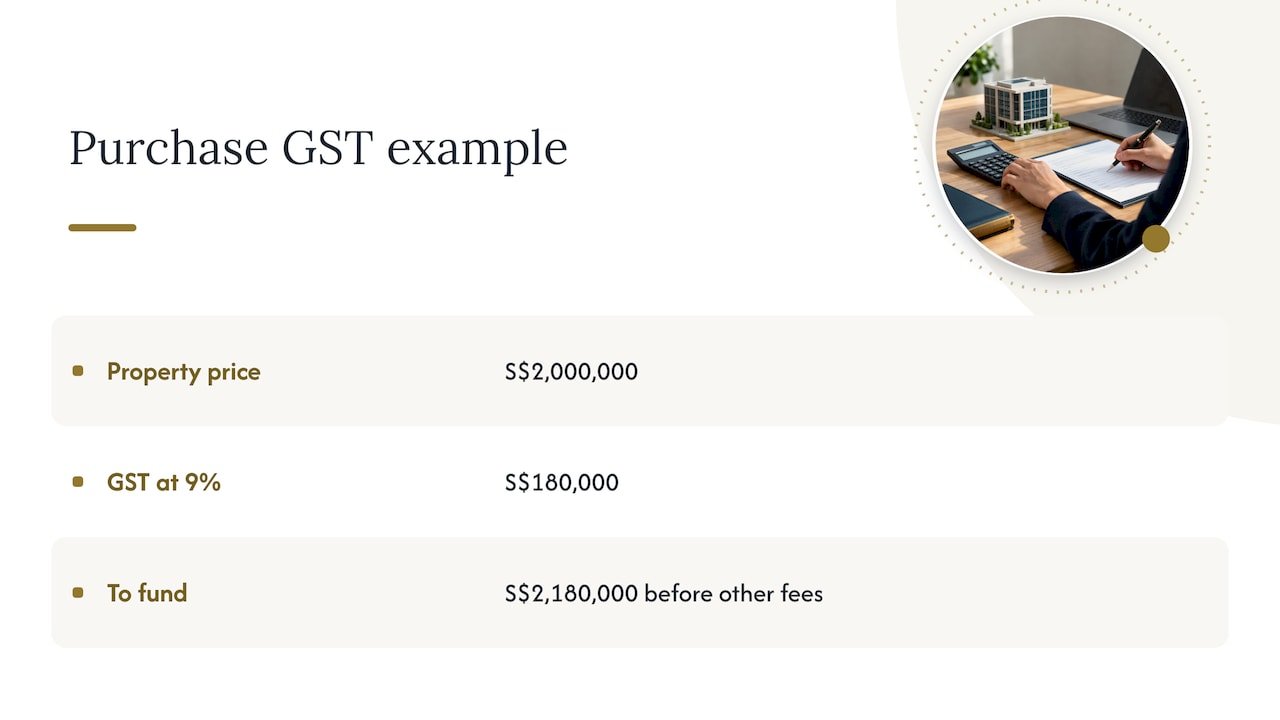
Worked example: a shop unit at S$2,000,000 with a registered seller carries S$180,000 of GST, so the amount to fund is S$2,180,000 before stamp duty and legal fees. If you will use the unit for taxable business activity, that GST is generally recoverable, but you still need the cash on completion day.
GST on selling
For a completed non-residential property, IRAS sets the timing as follows:
- GST on the option fee and deposit is due at the earlier of payment received or invoice issued.
- GST on the balance is due at the earliest of payment, invoice, the property being made available for occupation, or transfer of title.
- Even if the lawyer remits GST to IRAS directly, the seller must still report the sale in the GST return.
There is a special case for sales to a GST-registered Singapore-listed REIT or its registered property vehicle. There, the buyer accounts for the GST itself, and the seller issues a tax invoice saying so.
Does the seller have to register?
GST registration is required when taxable supplies exceed S$1 million at the end of a calendar year, or are expected to exceed it in the next 12 months. A non-residential sale counts as a taxable supply, so a person in the business of selling properties may need to include the price in that calculation and apply within 30 days of the contract date. Residential sales are exempt and do not count toward the threshold. Registration below the threshold is possible on a voluntary basis, subject to conditions, according to PwC’s Singapore tax summary.
If a non-residential property is sold at a discounted or nominal price to a connected party, GST must be accounted for on the open market value, per IRAS’s property owner guide. Sellers planning a family or company transfer should plan for that.
GST on commercial rent
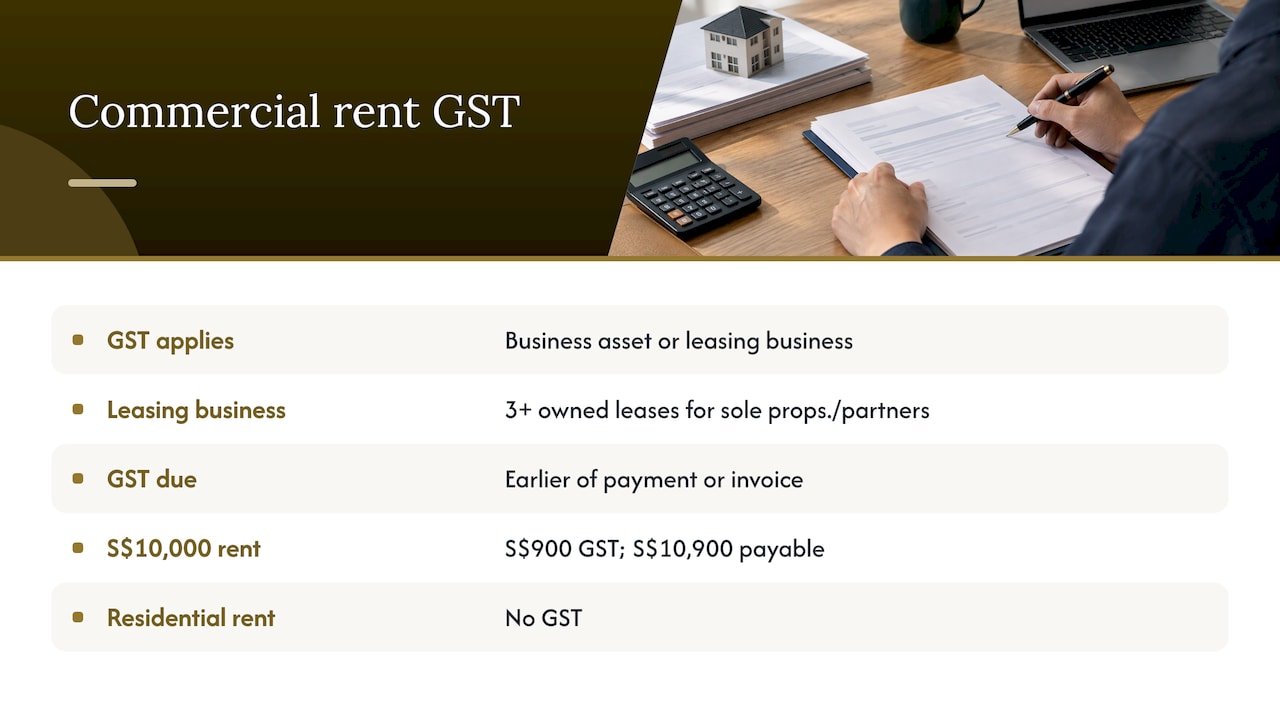
Landlords often ask whether they must add GST to rent. The IRAS guidance says a person letting non-residential property must charge and account for GST if the property is a business asset or if a leasing business is being run. A sole proprietor or partnership is treated as running a leasing business when it creates three or more leases from properties it owns. On rentals, GST falls due at the earlier of payment or invoice.
Worked example: rent of S$10,000 a month from a registered landlord means S$900 of GST, and the tenant pays S$10,900. A tenant that makes taxable supplies can generally claim that GST back, so for many business tenants the GST is a cash-flow item more than a cost. Residential rent, by contrast, carries no GST.
Rental income itself is a different matter: it is subject to income tax and is not part of the property tax bill. If you let to a tenant, also see our explanation of rental stamp duty in Singapore. PwC’s summary gives lease duty at 0.4% of total rent for leases up to four years, with leases averaging S$1,000 or less a year exempt.
GST-registered businesses are also being phased into e-invoicing through InvoiceNow-ready solutions between 2026 and 2031, according to PwC, which affects how landlords and sellers issue invoices.
Can you claim back the GST you paid?
IRAS says GST is claimable on the purchase and rental of non-residential property if it is used, or will be used, for business activities that generate taxable supplies. That is why a trading company that buys an office for its own use can often recover the GST, while a buyer who plans to hold it empty cannot show taxable use.
For property bought jointly by co-owners who are not business partners, input tax can be claimed only in proportion to the ownership share, and output tax on a later sale follows the same share. If you plan to buy through a company, read our guide on buying property under a company before you sign, since the owner structure changes both the GST and the duty position.
The other costs on a commercial purchase
Property tax and GST are only part of the picture. The same PwC summary lists buyer’s stamp duty of up to 5% for non-residential property, on the higher of the price or market value. Seller’s stamp duty can apply to properties sold within a short holding period, and for properties bought from 4 July 2025 the top seller’s rate is 16%, according to PwC. Buyers must pay stamp duty within 14 days of the contract date, as IRAS states. For the day counts that apply to your document, see our stamp duty timeline. Sellers can read how holding periods affect them in our guide to seller’s stamp duty.
Capital gains are generally not taxed on property sales in Singapore, according to a Withers real estate guide, although a seller trading in property may be treated differently. Our article on capital gains tax and selling within four years covers that boundary.
A simple cost checklist
| Item | Rate or basis | Who bears it |
|---|---|---|
| Annual property tax | 10% of AV | Owner, every year |
| GST on purchase | 9% if seller is registered | Buyer (often claimable if used for taxable business) |
| GST on rent | 9% if landlord registered or leasing as a business | Tenant (often claimable) |
| Buyer’s stamp duty | Up to 5% for non-residential | Buyer |
| Lease stamp duty | 0.4% of total rent for leases up to four years | Per lease terms |
| Income tax on rent | Per IRAS rules | Landlord |
Rates change with Budget announcements, so confirm each against the IRAS pages before you transact.
Why a specialist helps with a commercial purchase
The tax rules are public. The hard part is applying them to a particular unit: its zoning, its permitted use, the seller’s GST status, the realistic rent behind the AV, and how the structure of the purchase changes the duties. A small mistake in any of these changes the return by tens of thousands of dollars.
This is where working with Register Today changes the outcome. We offer detailed market evaluations to find gaps and opportunities, a free property valuation, and personalised negotiation, so the figures above are tested against the price you are about to pay. Our approach is also built around helping investors avoid Additional Buyer’s Stamp Duty (ABSD). Our guide on zoning checks that avoid ABSD surprises shows where the use of a property decides which duties apply, and our commercial property guide covers use, BSD and TDSR together.
Perspective
Most buyers we meet start with the price and the rental yield. The tax comes later, and it should come first. A flat 10% on Annual Value does not care whether your tenant is late or your unit is empty, and a 9% GST bill arrives on completion day whether or not you can claim it back months later.
Our view is that a commercial purchase is won in the preparation. We compare the asking price with the market evidence, look at what rent the AV is really assuming, confirm the permitted use, and negotiate with all the costs in view. Our team has handled over $1 billion in sales, and that is the routine we apply to every transaction, from a small office unit to a larger commercial space.
If you are an investor, a first-time buyer of a business space, or a seller who wants to keep stamp duty from eroding the proceeds, start with the numbers on your own unit.
Anderson
Start with your own numbers
If you are considering a commercial or industrial purchase, sale or rental, our team can value the property and walk through the costs with you. Request a free property valuation, or browse current commercial listings and commercial office space.
If you are selling, buying or renting, you can start from our main page.
FAQ
How much is commercial property tax in Singapore?
It is a flat 10% of the property’s Annual Value, charged every year. IRAS’s example is an AV of S$54,000, which produces S$5,400 of tax. The same rate applies to commercial and industrial buildings and land, with no owner-occupier rate.
Is GST charged on commercial property in Singapore?
Yes, on non-residential property. A buyer pays 9% GST on a purchase if the seller is GST-registered, and GST also applies to commercial rent charged by a registered landlord. Residential sales and leases are exempt, as set out on IRAS’s real estate page.
Do I pay property tax on an empty commercial unit?
Yes. Property tax is a tax on ownership, so it applies whether the property is let, owner-occupied or vacant. The tax is based on the Annual Value, which is the rent the unit could earn, not the rent you actually collect.
Can I claim GST back on a commercial property I buy?
Generally yes, if the property is used or will be used for business activities that make taxable supplies. Co-owners who are not business partners can claim only their ownership share. Check your own position with IRAS or your tax adviser before you rely on a claim.
Is GST the same as property tax?
No. Property tax is an annual charge on owning the property. GST is a transaction tax on the sale or rent of non-residential property by a registered supplier. Rental income is separately subject to income tax.
Sources
- IRAS: Property tax rates
- MOF: Property tax
- MOF: Differentiated property tax rates for vacant and non-vacant commercial and industrial properties
- IRAS: About Annual Value
- IRAS: Tax bills and notices
- IRAS: Information for buyers of other types of properties
- IRAS: Current GST rates
- IRAS: GST for real estate
- IRAS e-Tax Guide: Property owner guide (registration, leasing, input tax)
- IRAS e-Tax Guide: Property owner guide (non-arm’s-length sales)
- PwC: Singapore corporate other taxes
- Withers: Singapore commercial real estate guide