
URA Change of Use in Singapore: Fees, Steps and Approvals
A URA change of use is the planning permission you need when a property will be used for something other than its approved use, for example a shop becoming a commercial school or an office becoming a restaurant. Whether you are buying, leasing or selling, the practical rule is the same: confirm the approved use first, pick the right route (a $150 lodgment or a $500 full application), and secure the fire safety and licensing clearances before the new business opens. This guide sets out each step, what it costs and where applications tend to stall, so the use of a unit is settled before you commit money to it.
TL;DR
- A change of use is needed when the new use differs from the approved use of the premises. A new tenant running the same approved use is not a change of use.
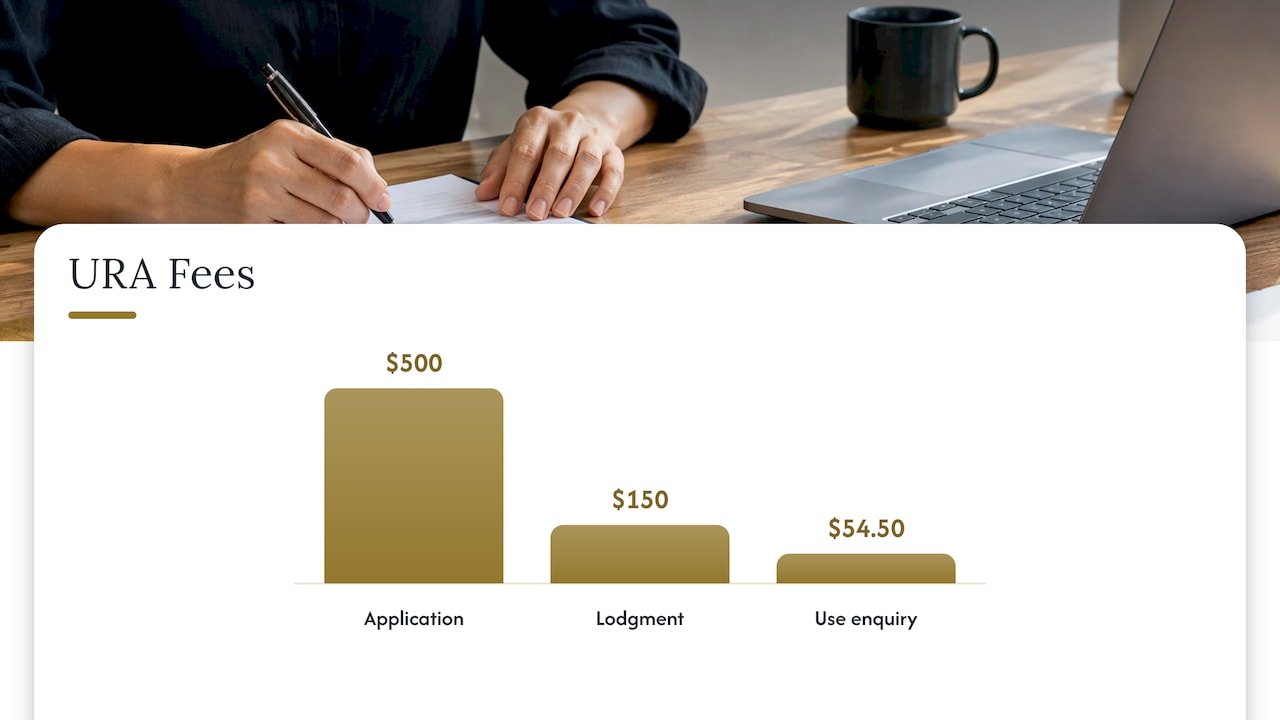
- The two main routes are the Change of Use Lodgment ($150, instant approval, only for pre-identified uses) and the full application ($500, non-refundable, generally about 10 working days).
- Check the approved use first with URA’s Enquiry on Approved Use of Premises, which costs $54.50 including GST per unit.
- URA approval is the first step, not the last: fire safety (SCDF), licences and, for some premises, SLA or HDB consent may still apply.
- Make purchase and lease commitments conditional on approval, and do not renovate or start operating before permission is granted.
Table of Contents
- What URA means by a change of use
- Step 1: Check the approved use of the premises
- Step 2: Choose the right route
- Step 3: Prepare and submit the application
- What it costs and what happens if you change your mind
- Conditional contracts: protecting a purchase or lease
- URA approval is the first approval, not the last
- A checklist before you commit
- Who this matters to
- How Register Today fits in
- Our perspective
- FAQ
- Sources
What URA means by a change of use
URA, the Urban Redevelopment Authority, is Singapore’s land use planning agency. On its official page, URA describes a change of use as changing the use of your property, such as from a shop to a commercial school, which may require planning permission. The reason is neighbourliness: a new use can create amenity problems for the premises around it, so URA assesses whether the proposed use is compatible and acceptable. Applications are judged against the zoning in the Master Plan, the prevailing guidelines, and the potential disamenity to neighbouring developments. URA also works with agencies such as SLA, LTA, SPF and NEA so that the proposal meets their requirements.
Three situations show where the line falls:
- Same use, new occupant. A new tenant who carries on the same approved use, or a change of owner, does not by itself change the use.
- Different use class. Turning a shop into a tuition centre, or an office into a restaurant, changes the use and generally needs permission.
- Pre-authorised changes. Some changes need no planning application. Under the Planning (Development of Land Authorisation) Notification, part of a commercial building or shophouse can change to a shop from uses such as office, restaurant, pub, nightclub, child care centre or commercial school. The conditions include no increase in floor area, no unauthorised works, and the change not covering the whole building.
The same notification pre-authorises a change from residential to home-office through a registration form with a $20 fee. The conditions are no floor-area increase, no unauthorised works, the owner’s consent if the lodger is not the owner, and compliance with URA’s home-office planning guidelines.
The point for any buyer or tenant is that URA states you should find out whether permission is needed before committing to a tenancy or starting renovation works. That ordering protects your deposit and your fit-out budget.
Step 1: Check the approved use of the premises
Every change-of-use question starts with two facts: what the unit is approved for today, and what you want it to be. URA lets you submit an electronic Enquiry on Approved Use of Premises using the unit’s address. The fee is $54.50 including GST for a single-unit enquiry. The reply is instantaneous if the use is in URA’s online database, and otherwise comes within 10 working days.
The same page points to URA’s Considerations for Property Use, which helps you judge whether your proposed use needs planning permission. Applications are evaluated against Master Plan 2025 zoning and prevailing guidelines, so zoning is the next thing to read. Our guide on how to read the URA Master Plan before you buy walks through the zoning categories and what they allow.
Where buyers go wrong is assuming that a listing’s description equals the approved use. A unit marketed as an office may be approved as something else, and a shophouse may allow different uses upstairs and downstairs. Verify before you sign an option.
Step 2: Choose the right route
URA’s own pages describe a lodgment route for simple, pre-identified cases and a full application for the rest. There is also a renewal route for uses approved on Temporary Permission.
| Route | Fee | Speed | Who it suits |
|---|---|---|---|
| Change of Use Lodgment | $150 | Instant approval, acknowledgement slip emailed the same day | Pre-identified uses in selected commercial buildings and 1st-storey shophouses |
| Full change of use application | $500, non-refundable | Generally about 10 working days | Uses outside the lodgment scheme |
| Renewal of Temporary Permission | $500 | To be submitted within three months before expiry | Uses approved on a temporary basis |
The fee and processing figures for the first two rows come from URA’s change of use page and its Change of Use Lodgment page, both updated in November 2026. Fees and schedules can be revised, so confirm them on the official page before you budget.
When the lodgment route applies
The lodgment scheme applies only to pre-identified uses within selected commercial buildings and the 1st storey of shophouses on sites zoned Commercial, Commercial & Residential, Hotel or White in the Master Plan. URA’s lodgment conditions also require that:
- the premises are approved for commercial use or computed as commercial gross floor area;
- there is no increase in floor area;
- the site is not affected by special planning controls;
- the building is not a gazetted monument or a conserved building in the Historic Conservation Areas (Kampong Glam, Chinatown, Little India, Boat Quay, Blair Plain, Emerald Hill and Cairnhill);
- the owner’s written consent has been obtained; and
- the proposed use has not yet started on the ground.
If any one of these fails, the lodgment route is closed and the full application is the way forward. The last condition matters most for tenants in a hurry: starting the use first and regularising it later is not what the scheme is for.
Step 3: Prepare and submit the application
URA directs applicants to submit through GoBusiness Singapore. The application can be filed by the business owner, the landlord, a consultant or a Qualified Person (QP, a registered architect or professional engineer). URA’s page lists the documents it expects:
- a location plan;
- a floor plan showing the proposed layout and usage;
- the property or unit owner’s consent; and
- supporting documents where they apply, such as a cover letter and relevant agency clearances.
A few practical points make the difference between a clean submission and a slow one:
- Make the floor plan readable. It should show what each area will be used for, since the plan is how URA reads your intended use.
- Get the owner’s consent in writing early. Tenants often start the application and then wait weeks for the landlord’s signature.
- Attach agency clearances where they apply. URA notes that processing takes longer if a submission is incomplete or other agencies must be consulted.
For a full application, URA says assessment generally takes about 10 working days. For planning purposes, add a margin for queries rather than counting on the minimum.
What it costs and what happens if you change your mind
The full application fee is $500, and the lodgment fee is $150. You may withdraw an application at any time after submitting it, but GoBusiness states that fees will not be refunded. So the $500 is a sunk cost once you submit, and the sensible time to check is before you pay it.
Two further items can affect your budget and timeline:
- Land Betterment Charge. SLA may collect this charge, and planning permission can only be granted once it is paid.
- Validity. GoBusiness states that planning approval is typically valid for 3 years or longer.
A worked example: a tenant wants to turn an office unit into a tuition centre. The enquiry on approved use costs $54.50, the application $500, and if URA consults other agencies the decision may take longer than 10 working days. The total official fees come to $554.50 before any QP, fire safety or licensing costs, and the timeline is roughly two to three weeks if the paperwork is complete. A lease signed before approval, with rent running from day one, can cost far more than these fees if approval is refused or delayed.
Conditional contracts: protecting a purchase or lease
Whether you are buying a unit for investment or leasing it for a business, tie the commitment to the outcome. Make the option, the sale and purchase agreement or the lease conditional on URA approval, with a long-stop date that covers URA’s processing time plus a margin for queries. Until permission is granted you should not take up the tenancy or begin renovation works.
Investors comparing asset types should note how much of the return depends on permitted use. If you are weighing commercial against residential investment, the permitted use of a property shapes who can lease it and what the lease can be for. In Singapore, our overview of commercial property: use, BSD and TDSR checks covers how use is checked alongside the financing rules, and five zoning checks for commercial property covers the zoning side for buyers concerned about ABSD.
URA approval is the first approval, not the last
A change of use usually triggers other requirements. GoBusiness advises applicants to obtain separate clearances and licences before starting the use. These include:
- Fire safety (SCDF). A valid Temporary Fire Permit or Fire Safety Certificate is needed.
- Licences. Examples are SFA’s Foodshop Licence and SPF’s Liquor Licence, depending on the business.
- Landlord-agency consent. SLA or HDB consent is required for their relevant leased or commercial premises.
On the fire safety side, the stakes are real: GoBusiness notes that unauthorised fire safety works or change of use may result in fines of up to $200,000 and/or imprisonment for up to 2 years. A change of use also changes how a space is occupied. An office converted to a classroom, for instance, changes the occupant load and exit capacity, which is why fire safety is best planned in parallel with the URA application rather than after it. Fire safety plans for a change of use must be prepared and submitted by a QP, so many projects engage one even though URA does not require a QP for the planning application itself.
Authorised works on other types of land
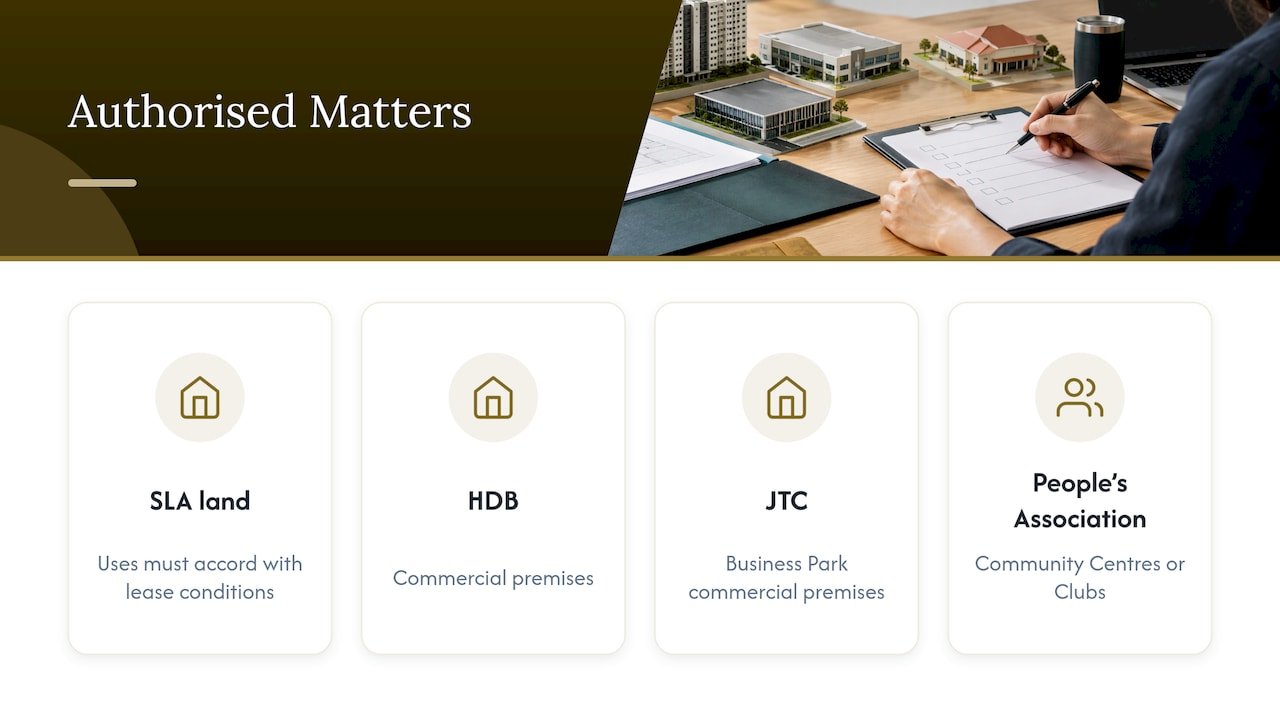
URA’s Planning Permission page lists categories where a change of use is an authorised planning matter: existing buildings or renewals of Temporary Permission on SLA-leased land where uses accord with lease conditions; HDB commercial premises; and commercial premises in Business Park developments on JTC land and in Community Centres or Clubs managed by the People’s Association. If your unit is in one of these categories, check the landlord agency’s own requirements alongside URA’s.
Conserved buildings and shophouses
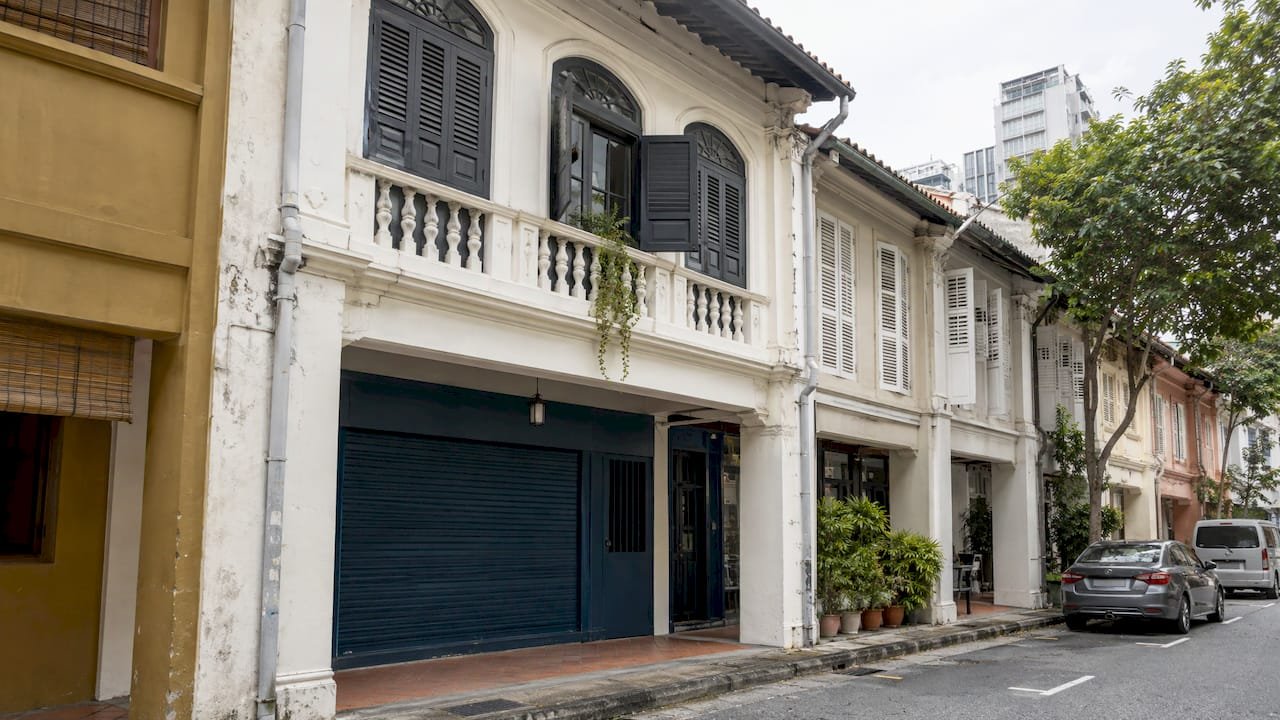
If the building is in one of the Historic Conservation Areas (Chinatown, Little India, Kampong Glam, Boat Quay, Blair Plain, Emerald Hill and Cairnhill), URA’s conservation guidance says you must apply for conservation permission before starting business operations. A change of use that involves additions and alterations to a conserved building must be incorporated into a formal A&A submission. This is also why the lodgment route excludes conserved buildings. Investors looking at heritage assets can read our note on shophouse investment for the wider picture.
A checklist before you commit
- Confirm the approved use through the URA enquiry.
- Read the Master Plan 2025 zoning for the site.
- Check the building type: private commercial, shophouse, HDB commercial, SLA-leased, JTC or conserved.
- Decide between lodgment ($150) and full application ($500).
- Get the owner’s written consent.
- Plan the SCDF and licensing steps in parallel.
- Make the lease or purchase conditional on approval, with a realistic long-stop date.
- Do not start renovation or operations until permission is granted.
For current rules, fees and schedules, URA’s pages are the reference. The figures above reflect those pages as updated in November 2026.
Who this matters to
Commercial investors feel it first, because the lettable uses of a unit decide its tenant pool. Families and first-time buyers meet the issue differently: a home-based business or a part of the home used for work may fall under the home-office registration noted above. Sellers benefit too, because a unit with a clear, confirmed approved use is easier to value and to market. Expats renting a unit for a business or a studio should have the landlord confirm the approved use before signing.
How Register Today fits in
We list commercial and commercial office properties alongside residential homes, and we conduct detailed market evaluations to identify gaps and opportunities before you decide. If you own a property and want to understand what it is worth in its current use, our free property valuation costs nothing. Buyers, sellers and tenants can start from our main page to buy, sell or rent.
We also provide personalised negotiations, which is where conditions such as approval-linked completion dates are agreed.
Our perspective
Most change-of-use problems we would want a buyer to avoid begin before any application: someone falls in love with a unit, signs, and only then asks what it is approved for. The URA rules are clear and the fees are modest. The expensive part is the time between commitment and permission.
That is why we treat approved use as part of the property’s value, not as paperwork. A unit whose use fits your plan is worth more to you than one that needs an application, and a unit that needs one should be priced and negotiated with that in mind. Our detailed market evaluations look for exactly these gaps between what a property is and what it could be.
For investors, we think the best returns come from clean, well-checked transactions. Our focus on helping investors and sellers deal with ABSD goes hand in hand with this: both depend on knowing, before you commit, what you are really buying. Ask for the approved use, read the zoning, and negotiate the timeline. We are glad to do that with you.
Anderson
FAQ
How long does a URA change of use take?
A full application generally takes about 10 working days, longer if the submission is incomplete or other agencies must be consulted. A qualifying Change of Use Lodgment receives instant approval, with an acknowledgement slip emailed the same day. Allow extra time for fire safety and licensing, which are separate.
How much does a URA change of use application cost?
The full application fee is $500 and the lodgment fee is $150. Checking approved use costs $54.50 including GST per unit. Fees are non-refundable once you submit, and SLA may charge a Land Betterment Charge in some cases.
Can I withdraw a URA submission?
Yes. You may withdraw an application at any time after submitting it, but the fees will not be refunded. If you are unsure that the use will be approved, confirm the approved use and zoning before you submit.
Do I need a Qualified Person to apply?
The application can be filed by the business owner, landlord, consultant or a QP. A QP is, however, needed for the fire safety plans in a change of use, so many applicants engage one for the whole project.
Do I need approval if a new tenant keeps the same use?
No. A new tenant using the same approved use, or a change of owner, is not a change of use. Confirm the approved use first to be sure the existing use is the one on record.
Sources
- Changing the Use of Your Property, URA
- Change of Use Lodgment, URA
- FAQs for Enquiry on Approved Use of Premises, URA
- Planning Permission, URA
- Use of Buildings in Conservation Areas, URA
- Change of Use Approval, GoBusiness
- Planning (Development of Land Authorisation) Notification, Singapore Statutes Online
- Planning (Development of Land Authorisation) Notification, home-office provision