

Buy or Sell First? How to Sequence Your Next Home in Singapore
For most Singapore homeowners, selling first is the lower-risk order. Your budget is fixed by real sale proceeds, and the new purchase is treated as your first housing loan. Buying first suits owners who have spare cash, a flexible exit and a firm plan to sell within six months. This guide sets out the costs and deadlines on each side, so you can pick the order that fits your finances.
TL;DR
- Sell first: the new home is financed as a first housing loan, with no ABSD, but you must plan for a gap between completions, usually covered by a rental, an extension of stay or family.
- Buy first: you keep a home to live in while you search, but ABSD is payable upfront and a lower loan cap applies until the first loan is cleared.
- Six months is a hard line: ABSD relief for a second property depends on selling the first within the stated window, and IRAS does not extend it.
- Sell and buy together: a bridging loan can cover the cash gap, for up to six months, but it needs an Option to Purchase (OTP) for the new home and proof of the sale.
Table of Contents
- The short answer: which order suits whom
- Why selling first is the lower-risk path
- What buying first really involves
- The six-month ABSD remission window
- Selling and buying at the same time: bridging loans
- CPF and HDB timing checks
- Reading the market before you choose
- Our perspective
- Plan your sequence with Register Today
- FAQ
- Sources
The short answer: which order suits whom
The right order depends on three things: how much cash you hold outside your current home, how fast homes in your target area sell, and whether you own HDB or private property.
| Your situation | Usually the better order | Why |
|---|---|---|
| Little cash beyond your home equity | Sell first | The sale fixes your budget and avoids upfront ABSD |
| Substantial liquid cash, tight market, specific home in mind | Buy first, with a firm sale plan | You secure the home, but must meet the six-month sale deadline |
| Both transactions can be timed closely | Sell and buy together with a bridging loan | The loan covers the gap between downpayment and sale proceeds |
| Need to move out quickly after selling | Sell first, negotiate an extension of stay | The buyer can often agree a short stay after completion |
No order removes risk entirely. You are choosing which risk you would rather carry: being without a home for a while, or carrying two properties at once.
Why selling first is the lower-risk path
When you sell first, you know your exact net proceeds before you commit to the next home. That matters because Singapore property sale proceeds and CPF refunds are only released at legal completion, not when the OTP is signed, as a guide to bridging timing from the banks’ association also frames the gap between downpayment and net sale proceeds.
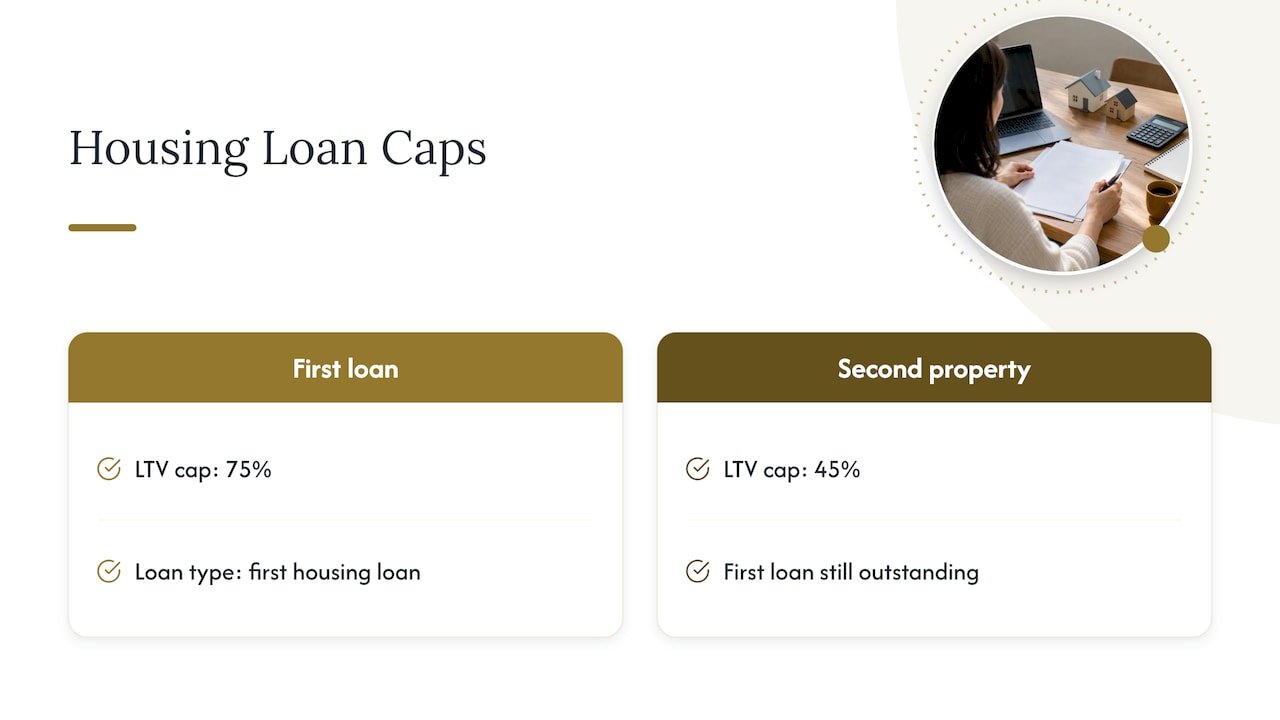
The financing is also simpler. According to one 2026 market commentary, selling first means the new purchase is treated as a first housing loan with a 75% loan-to-value limit, with no ABSD and no remission clock to watch. Buying first, by contrast, makes the new property your second residential property.
What selling first costs you
The trade-off is housing in between. If you sell an HDB flat, an extension of stay after completion is negotiated with the buyer and is typically capped at around three months, according to the same commentary. If your new home is not ready, you will need a short-term rental or a stay with family, plus storage and a second move. Budget for these before you list.
There is also a market risk. If prices in your target area rise while you rent, you buy later at a higher price. If you expect a long search, a rental costs more than a short one.
How to reduce the gap
- Start viewing homes before you list, so you know what you want and roughly what it costs.
- Ask potential buyers for a longer completion period or an extension of stay, and weigh that against the headline price.
- Line up a rental or family stay before you accept an offer.
- Keep the sale and purchase completion dates in view. HDB resale completion takes about 8 weeks from the date HDB accepts the application, while private resale completion is commonly 10 to 12 weeks after the OTP is exercised.
If you are weighing whether to hold on to a property as a rental instead of selling, read about renting versus selling your home before you decide.
What buying first really involves
Buying first gives you a place to move into and time to renovate. It is a liquidity strategy more than a financing one. The new property counts as a second residential property, so ABSD applies at the time of purchase.
ABSD on a second property
For a Singapore Citizen buying a second residential property, the rate is 20%. As an example from a rate summary, a citizen couple buying a S$2 million second condominium would pay S$400,000 in ABSD, due within 14 days of exercising the OTP or signing the sale and purchase agreement. Check the current rate for your own profile on the IRAS website before you commit.
That sum is payable in cash or CPF at the start, and recovered only if you qualify for relief and meet its conditions. Our own page on second property costs and sequencing walks through the upfront figure in more detail.
The loan cap
While your first loan is outstanding, the loan-to-value cap on the second property is lower. The 2026 commentary quoted above puts it at 45%, against 75% for a first housing loan. The practical effect is a larger cash and CPF downpayment, exactly when your capital is tied up in the home you have not yet sold.
The six-month ABSD remission window
The deadline is where buy-first plans succeed or fail. IRAS sets conditions for a married couple, including a Singapore Citizen, who jointly buy a second residential property. In summary, the remission conditions require that:
- the property is bought in both spouses’ names only;
- neither spouse owned interests in more than one residential property at the time of purchase;
- the first property is sold within six months of the purchase date for a completed property, or the earlier of the TOP or CSC issue date for an uncompleted one;
- the couple stays married, with no change in ownership of the second property;
- no other residential property is acquired in the meantime; and
- the refund application is made within six months after the sale.
IRAS states that it will not extend the six-month timeline. It encourages couples to market the first property early at realistic prices, or to secure a buyer before buying the next property. If you plan to buy first, price your current home to sell, not to test the market.
Single Singapore Citizens aged 55 and above have a separate route. For a second residential property bought on or after 16 February 2024, IRAS offers a refund if the first property is sold within six months and the second property’s value is less than that of each first property sold. Our page on the six-month ABSD remission sets out how owners plan around this window.
Selling and buying at the same time: bridging loans
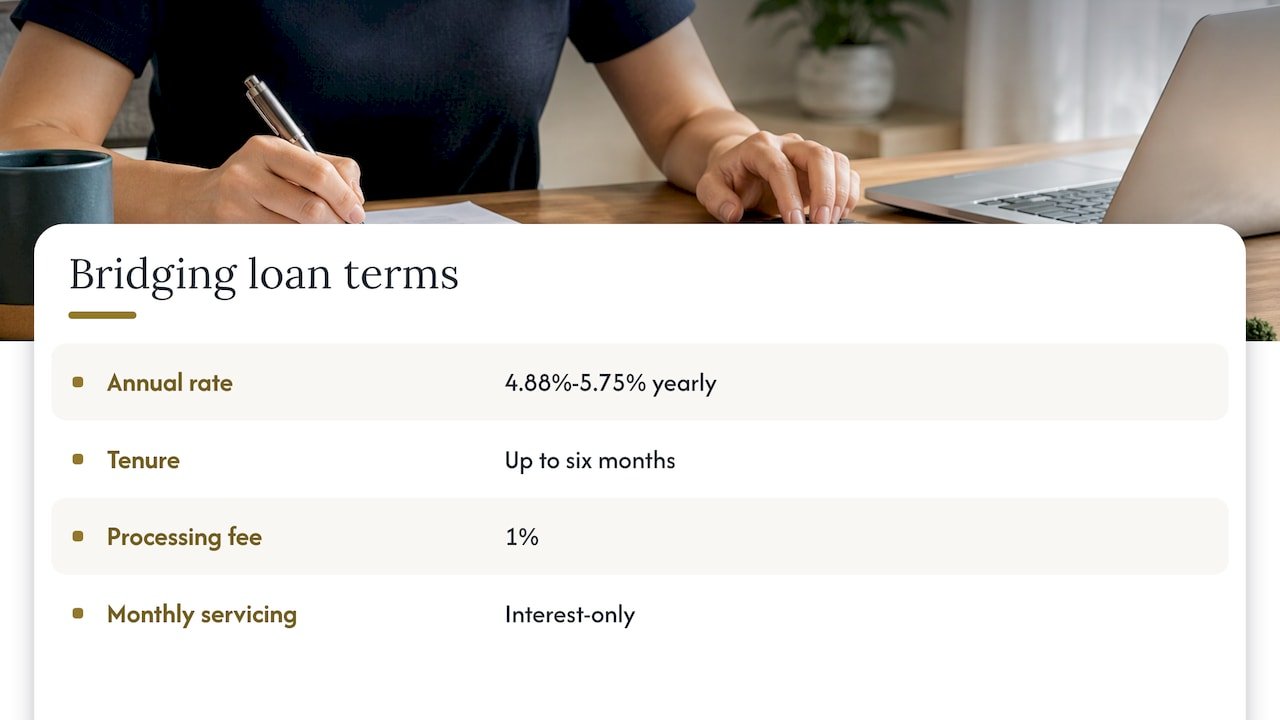
If neither order works cleanly, you can overlap the two. The banks’ association describes a bridging loan as short-term borrowing to cover the gap between your new downpayment and the net sale proceeds. It is granted together with the housing loan for the new property, for up to six months, on condition that you have an existing property that you are selling or have sold. Monthly servicing is interest-only, and the full amount is expected to be repaid by the end of the tenure by cash or CPF, subject to the CPF usage cap.
Recent figures from a 2026 bridging loan guide show rates of 4.88% to 5.75% a year (3M SORA plus a spread), tenure of up to six months and a 1% processing fee. If the sale drags beyond six months, the bank may convert the loan to a personal loan at a much higher rate, so the sale timeline needs a margin.
Working out whether a bridge pays
A simple test: add the interest and the 1% fee to your cost of the new home, then compare that with the cost of renting for the same period plus a second move. If the bridge costs less and you have a buyer lined up, it gives you the security of buying first without the full ABSD problem. If your buyer is uncertain, it adds risk rather than removing it.
CPF and HDB timing checks
If you own an HDB flat and plan to buy next, the CPF Board’s guidance gives you a defined window. You generally have up to six months after collecting the keys to your next home to sell your current flat. If you want to reuse the CPF housing refunds for the next purchase, sell earlier, because the refunds can take up to 15 working days from when CPFB receives them to be credited to your CPF account.
A practical order of checks:
- Confirm your eligibility to buy the next home type, whether HDB or private.
- Request a refund figure for your CPF usage and accrued interest, so your net proceeds are accurate.
- Map the completion date of the sale against the downpayment date of the purchase.
- Decide whether the gap is covered by savings, a bridge, an extension of stay or a rental.
Our HDB resale process guide lists the stages from OTP to completion.
Reading the market before you choose
The usual rule of thumb is simple. In a fast-moving market where good homes sell within days, you risk losing your target if you wait to sell. In a slower market, you risk carrying two properties if you buy first. Singapore adds a twist: a new launch runs to TOP over years, so it suits sell-first owners who can rent for a long stretch, while a resale completes in weeks.
Two checks help:
- How long do you need to find a home? If you already know the project and unit type, buying first is less rushed. If you are still exploring areas, selling first removes pressure.
- How firm is your sale price? Recent transactions in your block or project show whether your price will attract a buyer within the six-month window. A free property valuation gives you a starting figure.
For a longer-term view, see our guidance on planning an exit before you buy.
Our perspective
We see the order question decided less by the market and more by cash flow. Owners who sell first sleep better, because the budget is real and ABSD does not enter the picture.
We also work with buyers who want to move on a specific home before it is gone. For them, the answer is to treat the six-month window as a project plan: value the current home, set a realistic asking price and start marketing early. Our focus is helping clients reduce or avoid ABSD through careful sequencing, supported by market evaluations that identify gaps and opportunities.
Whichever order you choose, we negotiate on your behalf and give you the numbers upfront, so that the timeline works before you sign anything.
Anderson
Plan your sequence with Register Today
We help owners buy, sell and rent across residential and commercial property in Singapore, with free property valuations and personalised negotiation. If you are deciding what to do first, start with a valuation of your current home, so you can see your likely proceeds and the timeline.

Get your free property valuation, or browse residential listings to see what your budget could secure.
FAQ
Should I sell my home before buying another in Singapore?
For most owners, yes. Selling first fixes your budget, and the next purchase is financed as a first housing loan without ABSD. The cost is housing in between, which you can plan with an extension of stay, a rental or family.
Can I buy and sell at the same time?
Yes, with careful timing. A bank bridging loan can cover the gap between the new downpayment and the sale proceeds, for up to six months. You will usually need an OTP for the new home and proof of the sale.
How long do I have to sell the first property to avoid ABSD?
For the married-couple remission, six months from the purchase date for a completed property, or the earlier of the TOP or CSC date for an uncompleted one. IRAS does not extend the deadline, so start marketing early.
When do I receive sale proceeds and CPF refunds?
At legal completion, not when the OTP is signed. HDB resale completion is about eight weeks from the date HDB accepts the application, and CPF refunds can take up to 15 working days to be credited after CPFB receives them.
Sources
- ABS home loans guide (updated 1 October 2025)
- Bridging loan guide, SingSaver
- IRAS: Remission of ABSD for a married couple
- IRAS: ABSD concession for single Singapore Citizen seniors
- CPF Board: Home buying guide for members below 55
- CEA: Selling an HDB flat
- HDB and condo price commentary, 2Q2026
- ABSD rates summary, 2026
- Rent vs. sell your house