

How to Price My Home in Singapore: A Practical Guide
To price your home in Singapore, start with what similar homes actually sold for, not what they are listed at. Adjust that figure for your unit’s lease, floor, condition and layout, then test it against a free valuation before you set an asking price. This guide walks through each step, explains where the numbers come from, and shows where an estimate stops being enough.
TL;DR
- Use recent transaction prices for comparable units as your anchor. Asking prices are a weaker guide because sellers often list above what buyers eventually pay.
- Remaining lease, floor, facing, condition and distance to MRT move value, and lease length can move it a lot on 99-year leasehold homes.
- Market value, bank valuation and IRAS annual value are three different numbers. Do not mix them up.
- Online estimates are a starting range. Get a human valuation before you list, especially if the buyer needs a loan.
- Price to the market you can prove, then leave room to negotiate without going far above it.
Table of Contents
- Start with what homes sold for, not what they are listed at
- A simple method to estimate your price
- Features that move your home’s value
- Market value, bank valuation and annual value are different numbers
- How reliable are online estimates?
- From estimate to asking price
- Know your net proceeds before you commit
- Our perspective
- Get a free valuation from Register Today
- Common mistakes when pricing a home
- FAQ
- Sources
Start with what homes sold for, not what they are listed at
The most common pricing mistake is copying listing prices from property portals. A listing shows what a seller hopes to get. DBS points out that listing prices often exceed actual transaction prices, because sellers may list higher than market value to leave room for negotiation. If you price off those listings, you copy their optimism.
Transaction records are the better anchor. The same DBS guide notes that recent private-property transaction prices are available from URA, while HDB’s map service shows resale-flat prices. For private condos and apartments, the URA property data pages are the official starting point. URA also runs REALIS, a subscription service with up-to-date market data, including project-level details. Casual sellers rarely need it, but a professional valuer or agent will often use it on your behalf.
What counts as a comparable
A useful comparable matches your home on most of the following:
- Same project or a very close neighbour. Two condos 300 metres apart can trade at quite different levels.
- Similar size. Compare price per square foot (psf) as well as total price, because smaller units usually carry a higher psf.
- Similar tenure. A 99-year leasehold and a freehold unit are not directly comparable without an adjustment.
- Recent sale date. Prefer the latest few months. Older sales reflect a different market.
- Similar floor and view. A high floor with an open view is a different product from a low floor facing a carpark.
If you cannot find enough comparables, widen the search by one factor at a time, such as a nearby project of the same age, rather than loosening everything at once.
A simple method to estimate your price
Here is a step-by-step approach any owner can follow in an evening.
- Collect five to ten recent sales in your project or the closest equivalent. Write down price, size, floor, lease and date.
- Convert each to psf. Divide the price by the floor area. This makes units of different sizes comparable.
- Remove outliers. A unit sold between relatives, or one in unusually poor or exceptional condition, can skew the picture.
- Adjust for differences. Move your estimate up or down for floor, view, renovation and layout compared with each comparable.
- Form a range, not a single number. A range such as the low and high end of your adjusted psf figures, multiplied by your floor area, is more honest than one point value.
- Check the range against current listings to see how many homes are competing with you and how long they have been unsold.
For a deeper look at how psf figures translate into real budgets, our guide to PSF analysis in Singapore shows what a S$1.5M condo really costs once you work through the numbers.
The same logic of comparing recent sales underpins professional appraisal. A guide to building valuation in Singapore describes how valuers use comparable-sales evidence alongside other methods, which is useful background if your property is larger or more complex than a standard flat.
Features that move your home’s value
Two homes in the same block can sell at noticeably different prices. These are the features that usually explain the gap.
Remaining lease
For leasehold homes, lease decay matters. An academic study of private residential properties in Singapore found that for non-landed 99-year leasehold homes, a 1% increase in remaining lease was associated with 1.46% higher transaction prices. That is an average association across many sales, not a rule for your unit, but it shows why a 60-year-lease home and a 90-year-lease home should not be priced the same way, even when they look alike.
Location and access
Walking distance to an MRT station, good schools and amenities typically supports price. So does a quiet position within the estate. Buyers with children often shortlist by school proximity first, so this can widen or narrow your pool of buyers.
Unit-specific factors
- Floor level and facing. Higher floors and unblocked views tend to attract a premium.
- Layout efficiency. A well-planned 2-bedroom can outperform a poorly planned larger unit.
- Condition and renovation. Fresh, neutral finishes help. Heavy personalised renovation rarely adds its full cost to the price.
- Tenant situation. A unit sold with a tenant in place is viewed differently from one with vacant possession.
Property type
HDB flats, private condos, landed homes and commercial units are priced on different evidence. HDB resale prices follow the flat type, town and remaining lease. Landed homes depend heavily on land size and the plot’s specific location. Commercial and office units lean on rental yield and tenant quality. If you are weighing rent against sale value, our price-to-rent ratio guide explains how to read that relationship.
Market value, bank valuation and annual value are different numbers
Owners often get confused here, and it affects how you set expectations.
| Figure | What it is | Who uses it |
|---|---|---|
| Market value | What a willing buyer would pay a willing seller today | You and the buyer, when agreeing the price |
| Bank valuation | A lender’s assessment of the property, used to set loan limits | The buyer’s bank |
| IRAS annual value | An estimate of the yearly rent the property could fetch, used for property tax | The tax authority |
Annual value is not a price guide. It relates to property tax, not to what someone will pay to buy. Treat it as a separate figure and do not use it to justify an asking price.
The bank valuation is the one that can derail a sale. If your agreed price is higher than the bank’s valuation, the buyer must cover the difference in cash. We explain that risk in valuation shortfall in Singapore, and 3 ways to avoid loan shortfalls shows how to plan for it before you accept an offer.
How reliable are online estimates?
Free online tools are good for a first look. They draw on past transactions and give a rough range in seconds. Their limits are predictable:
- They cannot see your renovation, your view or your unit’s condition.
- They lean on past sales, so they lag in a market that is moving quickly.
- Thinly traded projects give less reliable estimates because there are fewer comparables.
- Different tools often return different numbers for the same unit.
Use two or three estimates to build a rough band. If the band is narrow, you probably have a clear market. If it is wide, your project is either thinly traded or your unit has features the tools cannot capture, and a professional view is worth getting.
When you need a professional valuation
Get a human valuation when:
- You are about to list and want a price you can defend in negotiation.
- Your project has few recent transactions.
- Your home is unusual: a penthouse, a corner landed plot, a strata-titled landed home or a commercial unit.
- You expect the buyer to need a large loan, so the bank valuation matters.
- You are separating, settling an estate or dealing with a similar situation that needs a formal figure. In these cases, ask a licensed valuer for a formal report rather than relying on an agent’s opinion.
From estimate to asking price
Your estimated range is not yet your asking price. Three decisions turn one into the other.
How fast do you need to sell? If you need a quick sale, price near the middle or lower half of your range. If you can wait, you can test the top of it, but long time on market tends to weaken your position.
How much room do you leave? A small buffer above your target helps you negotiate. A large one can deter buyers who filter by price. Remember that a buyer’s offer is often tied to what the bank will value the unit at, so a stretched ask can collide with the valuation later. Our piece on negotiating property price in Singapore covers how valuation gaps affect the final number.
What does the wider market look like? If prices are rising and stock is thin, you have more leverage. If supply is growing, price sharper. Our market outlook for Singapore property sets out scenarios and a checklist that help you read the direction.
Know your net proceeds before you commit
The price on the contract is not what you take home. Before you settle on a number, work backwards from what you need:
- Outstanding mortgage and any early-repayment penalty
- CPF refund, including accrued interest, for any CPF used on the purchase
- Agent commission and legal fees
- Any seller’s stamp duty if you are selling within the holding period that applies to your property
Check current rates and holding periods on the official IRAS pages for your own situation, because the rules change and depend on when you bought. Then compare the net figure with what you need for your next move. If you intend to buy again, our guide to the resale levy is relevant for some HDB upgraders, and the rent vs buy model helps you test whether to buy at all.
Our perspective
We see the same pattern again and again: sellers who price from listings, not transactions, spend months on the market and then cut. The fix is a disciplined comparison, plus an outside check before the first viewing.
Our approach is built on detailed market evaluation. We look for gaps between what similar homes have actually traded for and what the market currently asks, which is the same exercise we describe in our screening for undervalued properties. Applied to a seller, the same discipline tells you where your home really sits. It is also why we negotiate with the evidence in hand rather than with a hopeful number.
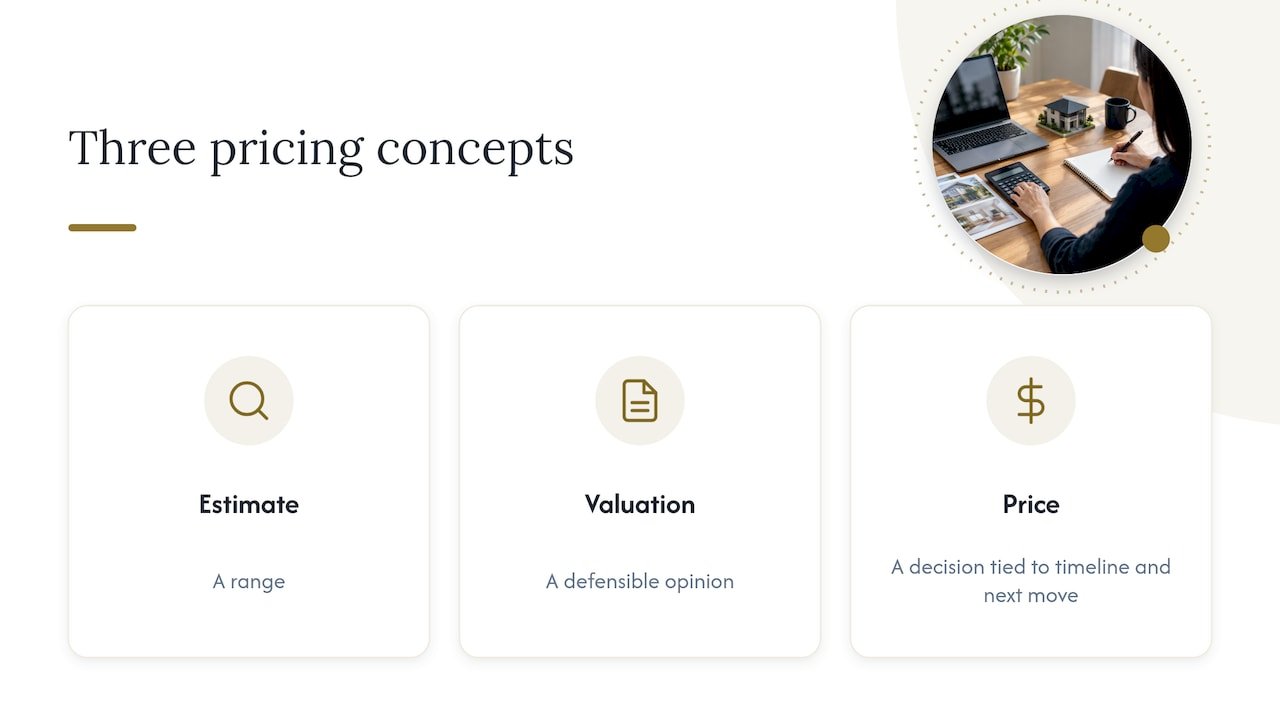
We would also say that no tool replaces a conversation. An estimate is a range, a valuation is a defensible opinion, and the price is a decision you make with your timeline and your next move in mind. Be clear about which of the three you are looking at.
— Anderson
Get a free valuation from Register Today
If you want a second opinion on your range, our free property valuation costs nothing and carries no obligation. You can also read about our home valuation approach, or start from our homepage if you are ready to sell, buy or rent. We combine the valuation with personalised negotiation, so the number you set is one you can stand behind in the room.
Common mistakes when pricing a home
- Anchoring on a neighbour’s listing. It tells you what they hope for, not what they will get.
- Pricing on what you spent. Renovation cost and what you paid years ago do not set today’s market value.
- Ignoring lease length. Buyers and banks both care about it.
- Using annual value as a price guide. It is a tax figure.
- Setting the price after the first viewing. A price adjusted downward after weeks online sends a weak signal.
- Skipping the bank valuation risk. An agreed price above valuation can leave the buyer short of cash and the deal at risk.
FAQ
Where can I find recent sale prices for homes like mine?
For private properties, use the URA property data pages, which publish transaction prices. For HDB flats, the HDB resale price information and map service lists recent resale transactions by town and flat type. Always prefer these sales records over asking prices.
Is a free online valuation accurate enough to set my price?
It is accurate enough to give you a starting range, not a final price. Tools cannot see your condition, view or renovation. Use them to form a band, then confirm with a valuation from a professional before you list.
Is IRAS annual value the same as my home’s market value?
No. Annual value is an estimate of yearly rent used for property tax. Market value is what a buyer would pay today. They are linked loosely at best, so do not use one to set the other.
Does remaining lease really change the price?
Yes, for leasehold homes. In one academic study of non-landed 99-year leasehold private homes, a 1% rise in remaining lease was associated with 1.46% higher prices. Your own unit will differ, so compare against sales with a similar lease.
Sources
- How to use free online tools to check home prices (DBS)
- Property Data (URA)
- Lease Decay and the Prices of Private Residential Properties in Singapore