
How to Sell a Part Share of Property in Singapore
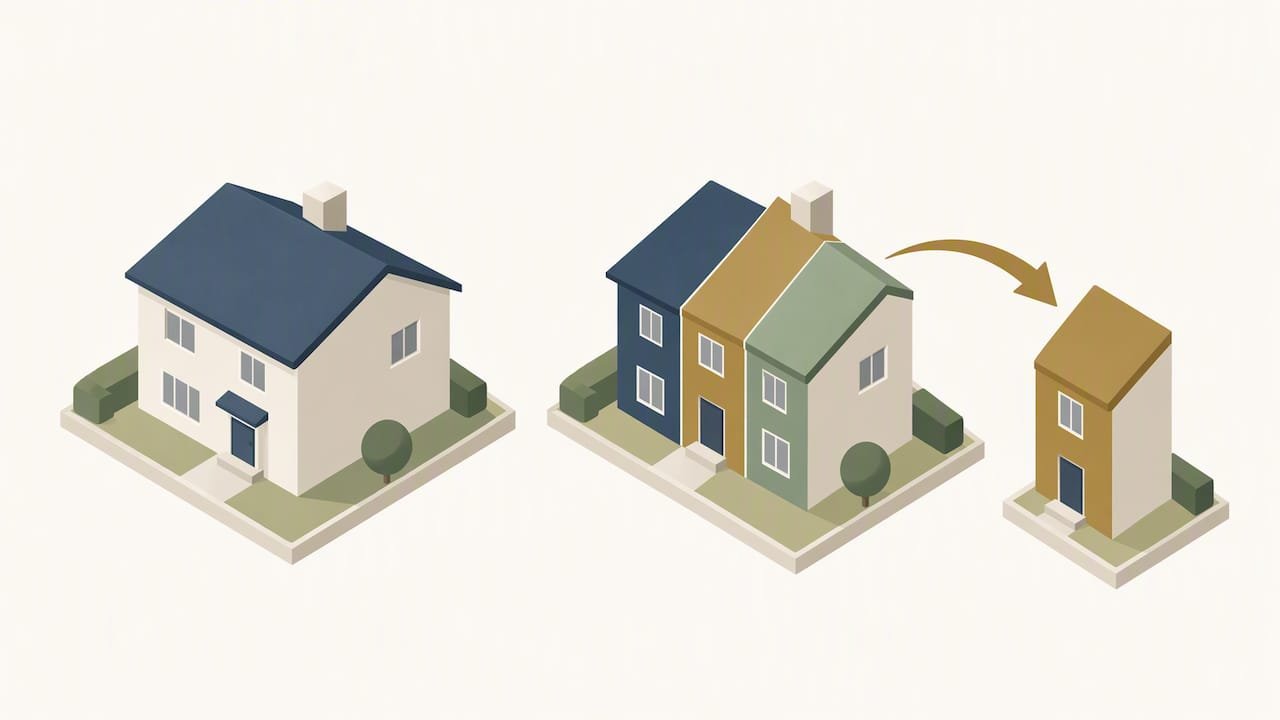
Selling a part share of a Singapore property usually means one co-owner transferring their undivided share to the other co-owner, so that one person becomes the sole owner. This is often called decoupling. It is a legal transfer with real costs: stamp duty, a CPF refund, a valuation, two sets of conveyancing and, usually, a new loan for the owner who stays. This guide sets out how the process works, what it costs, and where co-owners most often run into trouble.
TL;DR
- A part-share sale transfers one co-owner’s interest to the other, at fair market value, supported by a valuation. The seller exits and the buyer becomes sole owner.
- Buyer’s Stamp Duty (BSD) and any Additional Buyer’s Stamp Duty (ABSD) are worked out on the price or market value, whichever is higher. Seller’s Stamp Duty (SSD) can apply if the share is sold within the holding period.
- CPF used on the property generally has to be refunded with accrued interest. Do not estimate it from ownership percentage alone.
- The remaining owner typically needs to refinance or settle the existing mortgage, so check affordability before signing anything.
- Private property and HDB flats follow different rules. Use a conveyancing lawyer for private property, and check HDB’s conditions for a flat.
Table of Contents
- What selling a part share means
- Joint tenants or tenants-in-common
- Private property and HDB flats
- How the share is valued
- Stamp duties you may face
- CPF refunds and the outstanding loan
- Financing the buyout
- Step-by-step process for a private property
- Our perspective
- Where Register Today can help
- Risks to check before you agree
- FAQ
- Sources
What selling a part share means
When two or more people own a property, each holds a share. A part-share sale is the transfer of one person’s share to another existing owner. Legal practitioners describe decoupling as transferring a part-share from one co-owner to another, so that one becomes the sole owner and the other is free to acquire further residential property without ABSD or at a lower rate.
The usual situations are:
- Married couples who want one spouse to hold the home so the other can buy a second property with a lower ABSD burden.
- Divorcing or separating couples where one party buys the other out.
- Family or business co-owners, such as siblings who inherited a property, where one wants to exit.
- Investors who bought together and now want to split their portfolios.
A part-share sale is not the same as selling the whole property. The property stays in place and only the ownership changes. That is why the costs look different from a normal sale: there is no new buyer on the open market, but there are still stamp duty, valuation, legal and CPF consequences.
Joint tenants or tenants-in-common
How you hold title decides what can be transferred. Under Singapore law, tenants-in-common own specified undivided shares that can be transferred. Joint tenants own the property as a whole, and must sever the joint tenancy to become tenants-in-common before a part-share transfer can take place.
Check your title first. A lawyer can confirm from the property’s title records whether you hold as joint tenants or tenants-in-common, and at what share. Do this before you discuss price, because the share you hold affects both the valuation and the CPF position.
Private property and HDB flats
The two property types follow different rules and different authorities.
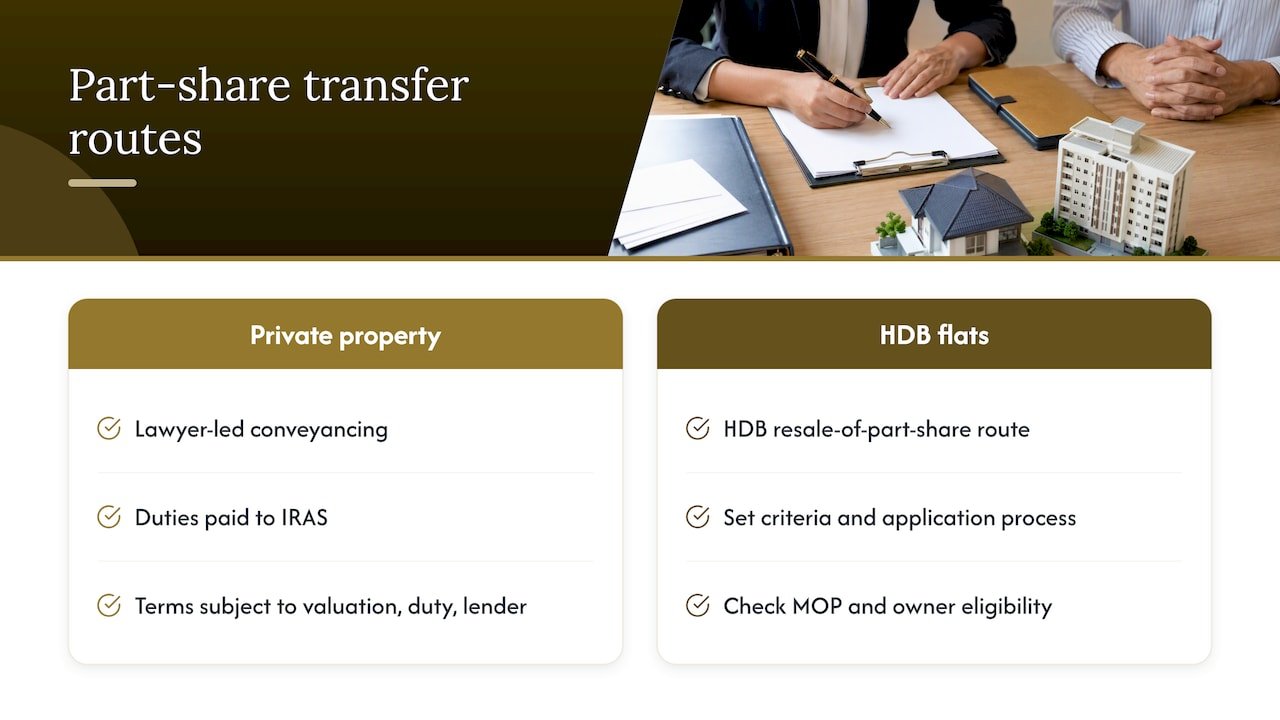
Private property (condominiums, landed homes, commercial units) is transferred by a conveyancing process handled by lawyers, with duties paid to IRAS. Co-owners have a lot of freedom to agree terms between themselves, subject to valuation, stamp duty and lender requirements.
HDB flats are governed by HDB’s own resale rules. HDB provides a resale of part-share route with set criteria, conditions and an application process. In divorce cases, for example, an HDB flat owner may buy over an ex-spouse’s share by resale of part-share, provided the divorce document indicates the transfer and the divorce is finalised after the flat’s Minimum Occupation Period is met. If your flat is still within its MOP, or if either owner is not yet eligible, ask HDB before you agree anything with your co-owner.
The rest of this guide concentrates on private property, where the stamp duty and ABSD questions are most pressing.
How the share is valued
A part-share sale may be done at fair market value, and that requires a valuation of the property and of the share being transferred. In practice that means:
- Both co-owners agree to use a valuation, commonly from a bank-panel or independent valuer.
- The share is priced as a proportion of that value, adjusted for the outstanding loan and CPF position.
- The figure becomes the basis for stamp duty and the transfer document.
The valuation matters for tax as well as price. IRAS states that BSD is payable on documents for the transfer or sale of Singapore property, based on the purchase price or market value, whichever is higher. If you agree a price that sits below market value, you cannot assume the duty will be calculated on your agreed number. Our note on why valuation risk raises BSD explains how this plays out, and valuation shortfall is worth reading if the bank values the property below the agreed price.
A free, no-obligation property valuation gives both co-owners a common starting reference before they commission a formal valuation.
When co-owners disagree on price
If co-owners cannot agree, the matter can end up in court. Singapore courts may order a sale of the property or, in some cases, grant a right of first refusal. In Sun Yanyuan, the High Court allowed one co-owner the right to buy the other share at a stated percentage of market valuation or higher, but required an open-market sale if the buyout did not happen within six months. The court also said it could not compel a buyout below the best price obtainable.
The practical lesson: a valuation is a reference point, not a guarantee. If one co-owner believes the property could fetch more on the open market, the other should expect that argument. Agreeing a price early, in writing, avoids a court-ordered outcome.
Stamp duties you may face
Three duties can come into play. They are separate, and each has its own trigger.
| Duty | Who pays | Basis |
|---|---|---|
| BSD | The buyer (the co-owner taking the share) | Price or market value, whichever is higher |
| ABSD | The buyer, depending on residency and number of properties owned | Price or market value |
| SSD | The seller, if the share is sold within the holding period | Higher of sale price or market value for a partial interest |
IRAS publishes the current rates. BSD and ABSD are based on the purchase price or market value, and SSD on a partial interest uses the higher of its sale price or market value. For SSD, IRAS shows rates of 16%, 12%, 8% and 4% for disposals within four years, for properties bought on or after 4 July 2025. Properties bought earlier follow the rates for their acquisition date, so check which table applies to you. Our guide to Seller’s Stamp Duty goes through the holding periods in more detail.
ABSD when you buy more of a property you already own
A co-owner buying out the other usually already owns a share, so the question is whether ABSD applies to the additional interest. IRAS provides for ABSD remission where a Singapore Citizen or Permanent Resident acquires an additional interest in a single residential property they already own, subject to specific conditions. The conditions vary by instrument date, so confirm them against the current page before you rely on them.
For the seller, the benefit of decoupling is on the next purchase: once the share has been transferred, the seller no longer counts that property in their own holdings. See our overview of ABSD rates for the current tiers, and the guide on avoiding ABSD on a second property for how the planning typically works.
A caution: decoupling to reduce ABSD only works if the transfer is genuine, properly documented and at a value that withstands IRAS scrutiny. If the sale is a sham or the price is understated, you invite problems. Speak to a conveyancing lawyer before acting, not afterwards.
Transfers between spouses
When the co-owners are married, the transfer has its own considerations, including CPF and bank consent. Our notes on spousal transfers and ABSD and on transferring property to a spouse cover the checks before you sign.
CPF refunds and the outstanding loan
If either owner used CPF to pay for the property, a part-share sale triggers a refund. CPF Board says that selling or transferring a property share generally requires refunding the CPF principal withdrawn plus accrued interest. Sale proceeds are first used toward the outstanding housing loan and the required CPF refund, subject to CPF’s rules where the sale price falls short of market value.
This is the line item most co-owners underestimate. The refund depends on how much CPF each person actually used and the interest accrued on it, not on the percentage they own. A 50% owner who used little CPF may owe far less than the other 50% owner, or the reverse. Ask your conveyancer for a written breakdown of where every dollar of the proceeds goes: loan redemption, CPF refund, costs and the cash you receive.
Here is a simple illustration with made-up numbers, to show the order of payments. Suppose the agreed value of a seller’s share is S$600,000. From that:
- The seller’s portion of the outstanding mortgage is repaid first.
- The seller’s CPF principal and accrued interest is refunded to the seller’s CPF account.
- Legal and other costs are deducted.
- Whatever remains is paid to the seller in cash.
If the first three items are large, the cash in hand can be a fraction of the headline price. Build that table before you agree to a figure.
Financing the buyout
The co-owner who stays will normally need money to pay for the share and to deal with the existing loan. An existing mortgage may need to be fully settled or refinanced, and the transferee may choose to refinance and obtain a fresh loan to fund the share purchase.
Banks handle this as a change of ownership. OCBC, for example, closes the existing loan account and assesses a new loan for the remaining owner against its affordability and loan-to-value criteria, with a panel lawyer handling the loan documents. Other lenders have their own processes, so speak to your bank early.
Things to check before committing:
- Income and debt servicing. The remaining owner has to qualify for the loan alone, not on joint income.
- Loan-to-value. The new loan is limited by the property’s valuation. If the valuation is low, the buyer may need more cash.
- Lock-in and penalties. Closing an existing loan early may incur a penalty if it is still in a lock-in period.
- Timing. Line up the loan offer, valuation and legal completion so no one is left holding a gap.
Our mortgage refinancing checklist helps you work out whether the new loan actually makes sense against the old one.
Step-by-step process for a private property
- Confirm title and shares. Check whether you hold as joint tenants or tenants-in-common, and sever the joint tenancy if needed.
- Agree the principle in writing. Who sells, who buys, at what basis of valuation, and by when.
- Obtain a valuation. Use it to set the price and to estimate stamp duty.
- Check the numbers. Work out BSD, ABSD or remission, SSD, CPF refund, loan redemption and legal costs.
- Arrange financing. Get the remaining owner’s loan approved in principle.
- Appoint lawyers. Private property decoupling is normally done with two separate law firms, one for the seller and one for the buyer, so each side has its own advice.
- Sign the transfer and pay stamp duty. The timeline for stamping is short; see stamp duty deadlines in Singapore.
- Register the transfer. The process involves preparing a transfer document, settling any outstanding mortgage and registering the transfer with the Singapore Land Authority. Sale and gift transfers use different instruments, and CPF handling depends on the transfer type.
- Notify IRAS. A conveyancing lawyer must file a Notice of Transfer with IRAS within one month of a property transfer. For HDB transactions, HDB handles this notification.
Expect legal and valuation costs on top of the duties. Quotes vary with the property type, and landed properties tend to cost more, so ask each law firm for a written fee estimate before you instruct.
Our perspective
We see part-share sales most often when an owner wants to reposition: to buy another home or an investment without carrying a heavy ABSD bill, or to settle a shared ownership cleanly. The tax outcome tends to attract the attention, but the transactions that go wrong are usually the ones where the basics were skipped: nobody checked the title, the valuation came in below the agreed price, or the CPF refund was a surprise.
Our advice is to start with the numbers, not the intention. Get a valuation, list every payment from the sale proceeds, and confirm the buyer can be financed on their own. If the arithmetic works, the paperwork is straightforward. If it does not, you want to know that before you sign, not after stamp duty has been paid.
We also encourage sellers to compare two routes honestly: transferring the share to a co-owner, or selling the whole property on the open market. The right answer depends on price, timing, SSD exposure and what each party plans to buy next.
— Anderson
Where Register Today can help
If you are weighing a part-share transfer against a full sale, a clear view of the property’s market value is the first step. Register Today offers a free property valuation with no charge, and we can discuss selling, buying or renting through our main platform. If you are planning your next purchase after the transfer, browse our residential listings.
Risks to check before you agree
- Valuation gaps. If the bank values the property below the agreed price, the buyer may need extra cash, and the seller’s net proceeds may change.
- Understated prices. A price below market value does not lower BSD, which is charged on the higher of price or market value.
- SSD on a recent purchase. If the property was bought recently, selling a share can trigger SSD for the seller.
- Unclear CPF position. Ask for a written CPF refund calculation from the conveyancer rather than working from your percentage share.
- One-sided advice. Using one law firm for both sides can leave one party without independent advice. Two firms protect both.
- Unfinished divorce terms. In a divorce, decoupling can complicate the division of assets. Clear written agreements and legal advice matter, and the court order or agreement must support the transfer.
- Future sale. If the remaining owner sells soon after acquiring the share, SSD may apply to them, and IRAS has a way to check if it does.
FAQ
Can I sell part of my property to my spouse or co-owner?
Yes, a co-owner can sell their share to another co-owner, typically at fair market value supported by a valuation. For a private property held as joint tenants, the joint tenancy must first be severed so the shares are defined. For an HDB flat, use HDB’s resale of part-share process and meet its conditions.
Do I pay ABSD when I buy my co-owner’s share?
It depends on your residency, the properties you own and the conditions at the transfer date. IRAS provides a remission for a Singapore Citizen or Permanent Resident acquiring more interest in a single residential property they already own, subject to conditions. Confirm the current terms with IRAS or your lawyer before signing.
What happens to the CPF I used?
CPF used on the property generally has to be refunded with accrued interest when you sell or transfer your share. The amount depends on your own CPF usage, not just your ownership percentage. Ask your conveyancer for a written calculation.
Can the other owner refuse to sell or buy?
Neither co-owner can be forced into a private agreement. If you cannot agree, a court may order a sale of the property or, in some cases, give one owner a right of first refusal. It will not compel a buyout below the best price obtainable, so a negotiated price is usually cheaper than litigation.
Do I need a lawyer?
For private property, yes. The transfer needs to be documented, stamped and registered, and it is normally handled by separate law firms for each side. For an HDB flat, the process runs through HDB, but legal advice is still sensible if there is a divorce or dispute.
Sources
- Decoupling Property in Singapore: Transfer of Part-Share
- How Can I Buy My Co-Owner’s Share of the Property?
- Buying Your Spouse’s Share of the Private Property, Family Assist
- IRAS: Buyer’s Stamp Duty (BSD)
- IRAS: Stamp Duty rates
- IRAS: Acquisition of additional interest in property
- IRAS: Selling my Property
- CPF Board: CPF refund when selling or transferring property
- OCBC: Change of property ownership
- Singapore High Court grounds of decision, 2023 SGHC 268
- Decoupling Property Singapore 2026: Calculator and Full Guide