

Resale Levy in Singapore: Budget S$15,000 to S$55,000 Before Booking
If you have already received a housing subsidy and are buying a second subsidised HDB flat or an eligible Executive Condominium (EC), you will pay a resale levy. The amount runs from S$15,000 for a 2 room flat to S$55,000 for an EC, halved for Singles Grant recipients, and it must be settled in cash or from your sale proceeds at the point you book your next home.
TL;DR:
- A previous BTO subsidy, CPF Housing Grant on a resale flat, or grant supported EC before its Minimum Occupation Period can trigger liability.
- An HFE letter provides an early estimate, but HDB confirms the levy at booking using the first flat’s resale price or 90% of valuation.
- CPF savings and HDB loans cannot cover the levy; if sale proceeds fall short after booking, the household must pay the difference in cash.
- For first flats sold before March 3, 2006, deferred balances may accrue interest, while eligible seniors moving to smaller flats can receive an interest waiver.
- Buying a resale flat without a CPF Housing Grant avoids the levy; using that grant can trigger it on a later subsidized purchase.
Table of Contents
- What the resale levy is and why it exists
- When the levy applies: timing, MOP and EC rules
- How much the resale levy is: headline amounts, halving for singles grant, and caps
- How and when you pay the levy: cash, sale proceeds, timing and temporary loan options
- Exemptions, waivers and special cases
- Practical planning checklist
- Comparison between resale levy and other related housing levies or fees
- Detailed examples or case studies illustrating resale levy calculations
- Author perspective: common pitfalls and quick mitigation tactics
- How we can help with valuation, sequencing and negotiation
- FAQ
- Sources
What the resale levy is and why it exists
The resale levy is not a tax or a penalty. It is a partial recovery of the subsidy you received on your first subsidised flat, whether that came through a Built to Order (BTO) purchase or a CPF Housing Grant used on a resale flat. HDB collects the levy to keep the allocation of limited housing subsidies fair between first timers, who have never benefited from one, and second timers, who have.
The liability is triggered by the benefit you received the first time round, not by how the flat performed as an investment. Common triggers include:
- A new flat bought directly from HDB with the standard first timer subsidy.
- A resale flat bought with a CPF Housing Grant applied at purchase.
- An EC bought with housing grants before the project reached its Minimum Occupation Period.
When the levy applies: timing, MOP and EC rules
The levy becomes relevant the moment you decide to buy a second subsidised flat or EC after disposing of a first subsidised one. For HDB flats, this means booking a new flat or applying for one on the open booking system after your Minimum Occupation Period has passed. For ECs, the same logic applies once the project clears its 30 month window before private resale eligibility.
A few timing details matter more than buyers expect:
- Whether your first flat was sold before or after 3 March 2006 affects how interest is calculated on any deferred portion of the levy.
- HDB discloses your indicative levy as part of the HDB Flat Eligibility (HFE) letter, so applying early tells you the number before you commit to a booking.
- The levy amount is only finalised at the point you book your second subsidised flat, not when you first enquire.
How much the resale levy is: headline amounts, halving for singles grant, and caps
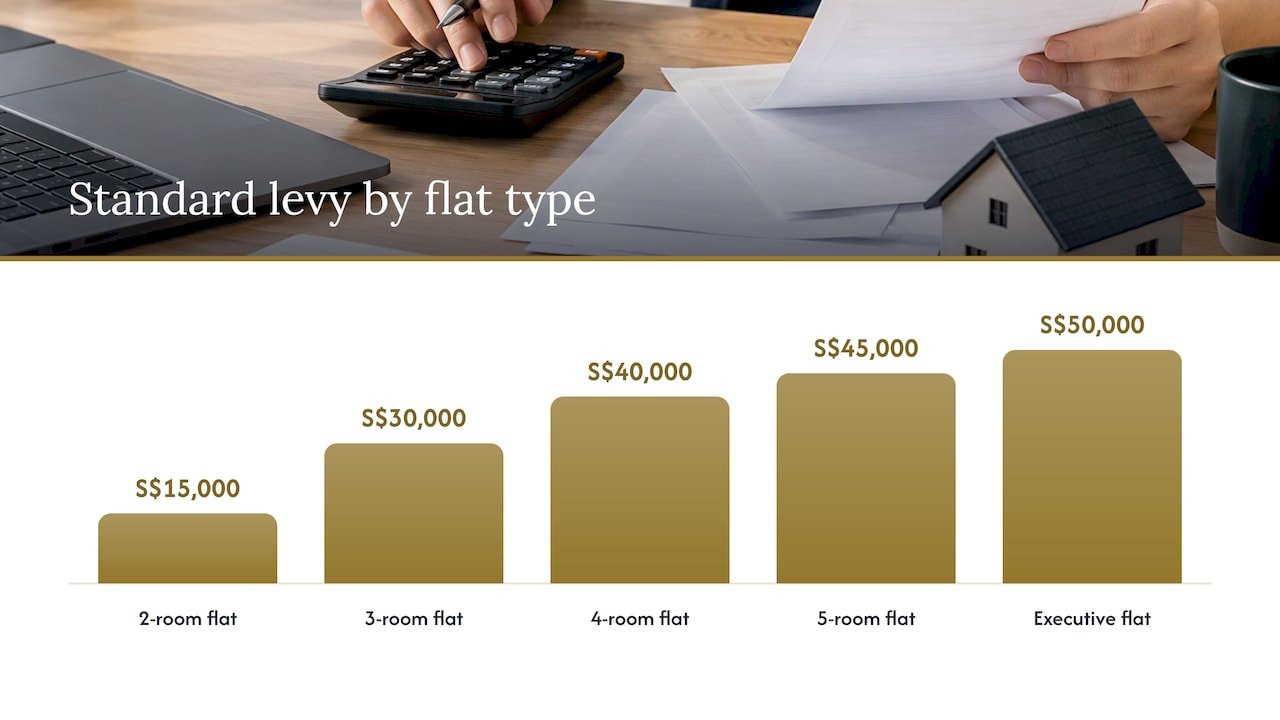
The standard resale levy bands run from S$15,000 for a 2 room flat up to S$55,000 for an Executive Condominium, with S$30,000 for a 3 room flat, S$40,000 for a 4 room flat, S$45,000 for a 5 room flat and S$50,000 for an executive flat sitting in between. These are the figures most second timer households need to budget against before they start comparing flat types.
Households that received the Singles Grant on their first subsidised purchase pay half these amounts, so a couple who previously qualified under that scheme and is now buying a 4 room flat would see S$20,000 rather than S$40,000. Short lease 2 room Flexi flats carry their own caps and adjustments, reflecting the shorter lease term rather than the full standard band.
The number you see at your HFE application stage is indicative. The figure confirmed at booking can reference the resale price of your first flat or 90% of its valuation, depending on how HDB assesses your case, so it is worth treating the early estimate as a planning guide rather than a fixed sum.
How and when you pay the levy: cash, sale proceeds, timing and temporary loan options
Payment rules are strict and worth understanding before you commit to a booking date. According to HDB guidance on conditions after buying, the levy cannot be paid from CPF savings or an HDB housing loan.
- The levy is payable in cash or deducted directly from your sale proceeds.
- If your first flat’s sale completes after you have already booked the second one, any shortfall between the levy and your proceeds must be topped up in cash.
- HDB considers temporary loan arrangements and case by case assistance for households facing financial difficulty, including incorporating the levy into the purchase price in exceptional circumstances, as noted in MND’s written parliamentary answer on resale levy collections.
- For flats sold before 3 March 2006, deferred portions of the levy may attract interest, so settling early where possible avoids extra cost.
Pro Tip: Apply for your HFE letter before you start viewing flats, so your indicative levy is on paper before you negotiate a booking date.
Exemptions, waivers and special cases
Not every second timer household pays the full headline figure, and a few categories warrant a closer look before you assume the standard band applies to you.
- Seniors right sizing to a smaller flat may qualify for an interest waiver on any deferred levy balance, often alongside the Silver Housing Bonus for those moving to a smaller unit.
- Households that used the Singles Grant on their first subsidised flat pay half the standard levy amount on their second purchase.
- EC buyers face the S$55,000 headline figure in the relevant scenarios, and must also clear the 30 month rule before the unit can be treated as eligible for open market resale.
Practical planning checklist
Sequencing matters as much as the levy amount itself. A clear order of operations keeps your cash position predictable through booking and collection.
- Apply for your HFE letter to see your indicative resale levy before house hunting begins.
- Estimate your likely sale proceeds realistically, factoring in agent fees and any renovation costs that reduce your net return.
- Decide whether to sell first or buy first based on which sequence leaves less exposure to a cash shortfall at booking.
- Check your CPF usage limits against the new flat’s valuation so you know exactly how much cash the levy will require on top.
- Arrange bridging finance in advance if your sale is expected to complete after your booking date.
Pro Tip: Run the levy bands and cash checklist together with agent fees and renovation costs in one worksheet. Treating them separately is how households underestimate their true cash need at booking. A free property valuation gives you a realistic figure for expected sale proceeds early, which makes this whole sequence far easier to plan around.
Comparison between resale levy and other related housing levies or fees
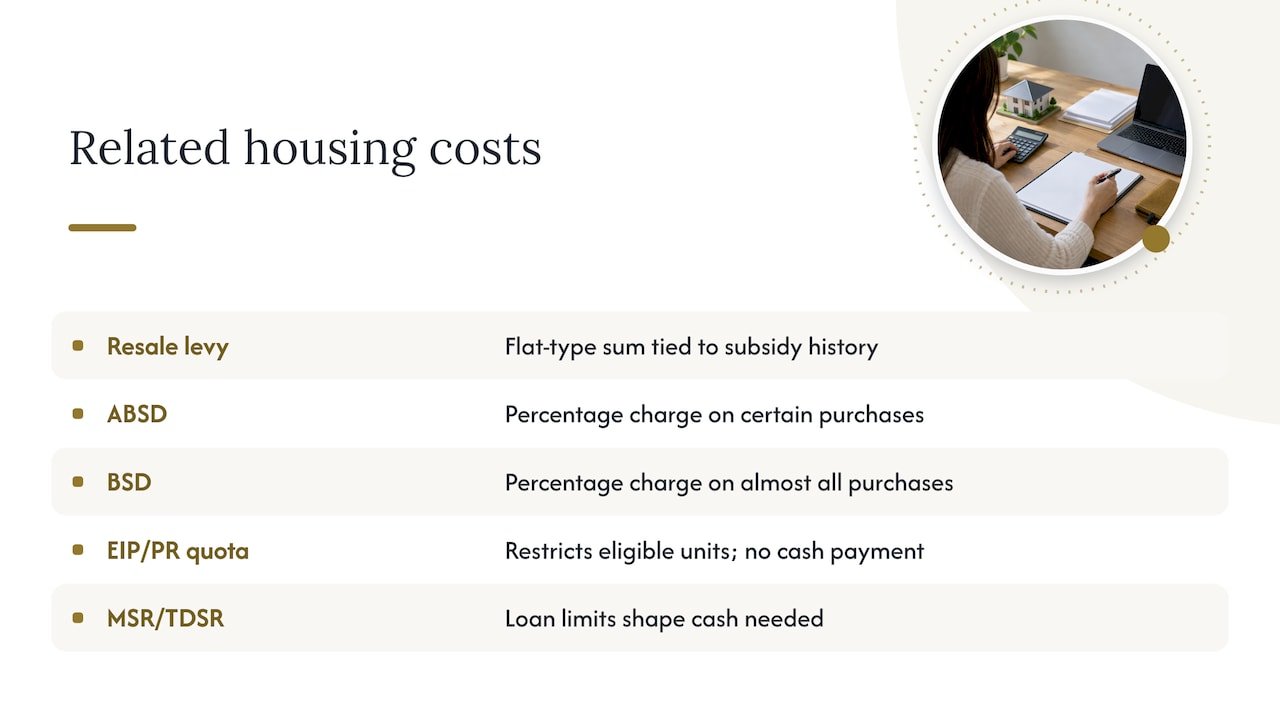
The resale levy sits alongside several other costs that second timer buyers sometimes confuse with it. Additional Buyer’s Stamp Duty (ABSD) is a separate charge levied by IRAS on certain property purchases, calculated as a percentage of purchase price rather than a fixed band tied to flat type, and it applies to a different set of buyers and circumstances than the resale levy does. Buyer’s Stamp Duty, also charged on a percentage basis, applies to almost every property purchase regardless of subsidy history, which makes it a universal cost rather than a second timer specific one.
The Ethnic Integration Policy and Singapore Permanent Resident quota conditions can restrict which units you are eligible to buy, but neither involves a cash payment in the way the resale levy does. Mortgage Servicing Ratio and Total Debt Servicing Ratio limits affect how much loan you can draw against a new purchase, which indirectly shapes how much cash you need to find elsewhere, including for the levy itself.
The practical distinction worth remembering is that the resale levy is a one time, flat type specific sum tied directly to your subsidy history, settled in cash or sale proceeds at booking. The other charges are either percentage based, loan related, or eligibility conditions rather than direct cash levies. Buyers who avoid a subsidised purchase entirely, by choosing a resale flat without a CPF Housing Grant or a private property instead, do not encounter the resale levy at all, as HDB’s EC conditions guidance confirms.
Detailed examples or case studies illustrating resale levy calculations
Consider a household that previously bought a 4 room BTO flat and is now buying a 5 room resale flat from HDB’s open booking system. Their standard resale levy band is S$45,000. If their first flat sells for net proceeds of S$420,000 after outstanding loan and CPF refunds, say the figures work out that way, the levy is deducted directly from those proceeds and the remaining balance goes toward the new flat’s purchase price and any cash top up needed.
Now take a couple who previously used the Singles Grant to buy a 3 room resale flat and are now eligible to buy a 4 room BTO flat as a married couple. Their standard levy band of S$40,000 is halved because of their Singles Grant history, bringing the figure to S$20,000.
A third scenario involves a senior right sizing from a 5 room flat to a 2 room Flexi unit on a short lease. The levy here is capped and adjusted for the shorter lease term, and if the household qualifies for right sizing support, any deferred balance may carry an interest waiver rather than standard interest charges. Each of these examples shows the same underlying mechanic: the headline band from the flat type you are buying, adjusted by your specific subsidy history and any applicable caps or waivers.
Author perspective: common pitfalls and quick mitigation tactics
The most common mistake we see is leaving the resale levy out of early affordability models entirely, then discovering it only once a booking date is close. Budgeting the levy explicitly, whether you plan to sell first or buy first, turns a potential cash shortfall into a manageable line item rather than a last minute scramble.
— Anderson
How we can help with valuation, sequencing and negotiation

Getting the resale levy right is really a cash flow problem, and cash flow problems are easier to solve when you know your numbers early. We offer a free property valuation to give you a realistic read on your likely sale proceeds before you commit to a booking date, which is the single most useful number for working out whether you need bridging finance.
Alongside valuation, we support:
- Sale timing advice that weighs selling first against buying first based on your specific levy exposure.
- Personalised negotiation support to help you secure sale proceeds closer to market value.
- Guidance on sequencing your sale and purchase to reduce the risk of a cash shortfall at booking.
If you are weighing up a second subsidised flat or EC purchase, get in touch through our homepage to start with a valuation and a clear picture of your numbers.
FAQ
Can a PR buy a resale HDB flat in Singapore?
Singapore Permanent Residents can buy a resale HDB flat, subject to eligibility conditions such as forming a family nucleus and meeting the relevant quota restrictions for the block or estate. The resale levy applies to them the same way it applies to citizens, based on their own subsidy history rather than citizenship status.
How much is property tax for a 5 room HDB flat?
Property tax on an HDB flat is assessed by IRAS based on the Annual Value of the unit, not on a fixed amount tied to flat type, and owner occupied flats are taxed at concessionary rates lower than non owner occupied ones. This is a separate charge from the resale levy and is not covered by HDB’s levy bands.
Is resale flat cheaper than BTO?
Resale flats and BTO flats are priced differently, with BTO typically subsidised at launch and resale prices set by the open market, so neither is reliably cheaper in every case. Choosing a resale flat without a CPF Housing Grant does avoid the resale levy entirely, which is a meaningful saving for second timer buyers.
How much is a down payment on a HDB?
The down payment on an HDB flat depends on the loan type and the proportion covered by CPF versus cash, with a cash component typically required alongside CPF savings. This is separate from the resale levy, which is a distinct cash obligation settled at booking rather than part of the standard down payment structure.


