
PSF Analysis in Singapore: What a $1.5M Condo Really Costs
PSF (price per square foot) equals price divided by the official floor area; in Singapore, it should usually act as a tie-breaker rather than a primary decision metric. Total quantum, stamp duties and financing limits typically decide what a property actually costs you, so we recommend comparing PSF only between genuinely similar units and checking quantum, ABSD) and loan terms before anything else.
TL;DR:
- Use strata area from the title or sale agreement for PSF, and request livable area plus labeled dimensions when comparing older and newer homes.
- For projects built more than a decade apart, different area rules can inflate older homes’ floor area with air conditioning ledges and voids, lowering their quoted PSF.
- As of April 2023, foreigners faced 60% ABSD and entities 65%; duties use purchase price or market value, and secured loans face a 55% TDSR cap.
- For financed investments, compare cash on cash return after debt service; cap rate ignores financing, while net yield accounts for running costs beyond gross rent.
Table of Contents
- How to calculate PSF and which area measure to use in Singapore listings
- Why PSF can mislead in Singapore: GFA harmonisation and layout efficiency
- How PSF interacts with total buyer costs in Singapore
- Investment metrics to use alongside PSF: cap rate, cash on cash and rental yield
- A repeatable PSF analysis method with a worked Singapore condo example
- How our team supports PSF and buyer cost analysis
- What actually matters when you analyse PSF
- Quick next steps: book a valuation or request a PSF and quantum check
- FAQ
- Sources
How to calculate PSF and which area measure to use in Singapore listings
The formula itself is simple: PSF equals the transacted or asking price divided by the floor area in square feet. A $1,500,000 condo unit measuring 1,000 square feet works out to $1,500 PSF. The difficulty in Singapore is not the arithmetic, it is knowing which area figure sits on the bottom of that fraction.
Developers and agents in Singapore commonly quote three different area measures, and mixing them produces PSF figures that look comparable but are not:
- Gross floor area (GFA): the total built area counted for planning purposes, which may include some non-liveable spaces depending on the project’s approval year.
- Strata area: the area stated on the title deed or sale and purchase agreement, which is the figure most PSF calculations should use.
- Net or liveable floor area: the usable internal space excluding air-conditioning ledges, bay windows and similar features, useful for judging how much actual living space you are paying for.
Before comparing two units, confirm which area figure appears in the listing and, where possible, cross-check it against the sale and purchase agreement or the floor plan schedule. When in doubt, ask the agent to confirm the area source rather than trusting the headline figure on a listing portal.
Why PSF can mislead in Singapore: GFA harmonisation and layout efficiency
Singapore’s planning rules have changed how floor area is measured over time, and this directly affects how PSF figures compare across projects of different ages. Market commentary on this shift explains that GFA harmonisation and the exclusion of non-liveable spaces such as air-conditioning ledges and strata voids mean newer units often report a smaller floor area for broadly the same built footprint as an older unit.
The practical effect is that a newer unit can show a higher PSF than an older one nearby, even when the two offer a similar amount of liveable space. The older unit’s larger reported area, inflated by ledges and voids that nobody can actually furnish, drags its PSF down and makes it look like better value than it is once renovation and layout inefficiency are factored in.
This distortion runs across the whole market, not just within one project. A landed house, an HDB resale flat and a new launch condo all use different area conventions and different planning-era rules, so stacking their PSF figures side by side rarely produces a fair comparison. Even within the same property type, a 1990s condo and a 2020s condo can carry different implicit allowances for non-liveable space.
Pro Tip: Ask for the net liveable area and the room-by-room dimensions before comparing PSF across units built more than a decade apart.
A few checks help keep the comparison honest:
- Confirm the project’s launch or TOP year, since area reporting conventions shifted over time.
- Request a floor plan with labelled dimensions rather than relying on a single headline area figure.
- Factor in renovation cost when an older unit’s lower PSF comes with an inefficient layout that needs structural work to fix.
How PSF interacts with total buyer costs in Singapore
PSF tells you about the asset, but stamp duties and lending limits apply to the full purchase price, not to a per-square-foot rate. That single fact is why quantum usually matters more than PSF once you are deciding what you can actually afford.
Additional Buyer’s Stamp Duty is tiered by buyer profile and charged on the higher of purchase price or market value. As of April 2023, foreigners pay 60% ABSD and entities pay 65% on residential property, rates that apply regardless of how attractive the PSF looks on paper. Singapore citizens and permanent residents face lower tiers, but the duty is always computed on quantum. Buyer’s Stamp Duty applies on top of ABSD and follows its own progressive scale based on price.
On the lending side, the Monetary Authority of Singapore sets a Total Debt Servicing Ratio cap of 55% of gross monthly income for secured loans, alongside Loan-to-Value limits and maximum loan tenures that shape how much you can borrow. These settings mean your monthly repayment, and therefore your real affordability, is driven by quantum and financing terms rather than by the PSF figure quoted in a listing.
When modelling the true cost of a purchase, include:
- Purchase price (quantum), the base for every duty calculation.
- ABSD and BSD, calculated on quantum using the applicable buyer-profile tier.
- Legal and conveyancing fees.
- Renovation allowance, especially for older or inefficiently laid-out units.
- Monthly loan repayment under your LTV limit and TDSR cap.
To move from a PSF figure to a realistic monthly cost, work through the quantum first (price times area), add ABSD and BSD based on your buyer profile, deduct your downpayment and CPF usage to find the loan amount, then apply your interest rate and tenure to estimate the monthly instalment, checking it against your TDSR ceiling throughout.
Investment metrics to use alongside PSF: cap rate, cash on cash and rental yield
PSF describes price relative to size. It says nothing about what a property will earn, so investors need separate metrics for that side of the decision.
- Cap rate divides net operating income by the property’s market value, giving an unlevered return figure that ignores how the purchase was financed.
- Cash on cash return divides annual cashflow after debt service by the actual cash invested, capturing the levered outcome that matters once a mortgage is in place.
- Gross rental yield divides annual rent by purchase price, a quick screening figure for comparing units.
- Net rental yield subtracts running costs such as maintenance, property tax and agent fees before dividing by price, giving a more honest picture of what lands in your pocket.
Cap rate suits comparing assets independent of how they are financed, while cash on cash answers the question most Singapore buyers actually care about: what does my equity earn once the loan is serviced? Gross yield works as a first filter across many listings; net yield and cash on cash deserve a closer look once you have shortlisted a handful of units, particularly given how TDSR and LTV settings shape the financed outcome.
A repeatable PSF analysis method with a worked Singapore condo example
A consistent method turns PSF from a vanity figure into a useful filter. Here is a worked example using illustrative numbers, replace them with your own listing details to run the same comparison.
Assume two condo units in the same district: Unit A is a 15-year-old resale unit at 1,100 strata square feet asking $1,600,000, and Unit B is a 2-year-old unit at 950 strata square feet asking $1,520,000.
- Compute PSF for each unit. Unit A: $1,600,000 ÷ 1,100 sq ft = $1,455 PSF. Unit B: $1,520,000 ÷ 950 sq ft = $1,600 PSF. On PSF alone, Unit A looks cheaper.
- Compute quantum and duties. Unit A at $1,600,000 carries a higher BSD bracket purely because of its larger quantum; Unit B at $1,520,000 sits slightly lower. A citizen buying a first residential property faces no ABSD on either unit, but BSD still scales with price in both cases.
- Compute monthly repayment. At 75% LTV, Unit A’s loan is $1,200,000 and Unit B’s is $1,140,000. Over 25 years at 3.5%, Unit A’s estimated monthly instalment runs noticeably higher than Unit B’s, purely because of the larger loan quantum, and both must sit within the 55% TDSR cap.
- Compute rental yield if renting out. If Unit A rents for $4,200 a month and Unit B for $4,000, Unit B’s smaller quantum gives it a higher gross yield despite its higher PSF.
- Synthesise by goal. A buyer optimising for lower PSF and more floor area picks Unit A; a buyer optimising for lower monthly cost, lower quantum-linked duties and better rental yield picks Unit B.
The PSF figure alone would have pointed our buyer towards Unit A as the “cheaper” choice. Once quantum, duties and monthly repayment enter the picture, Unit B comes out ahead for a yield-focused investor, exactly the kind of reversal that shows why PSF belongs after the cost analysis, not before it.
How our team supports PSF and buyer cost analysis
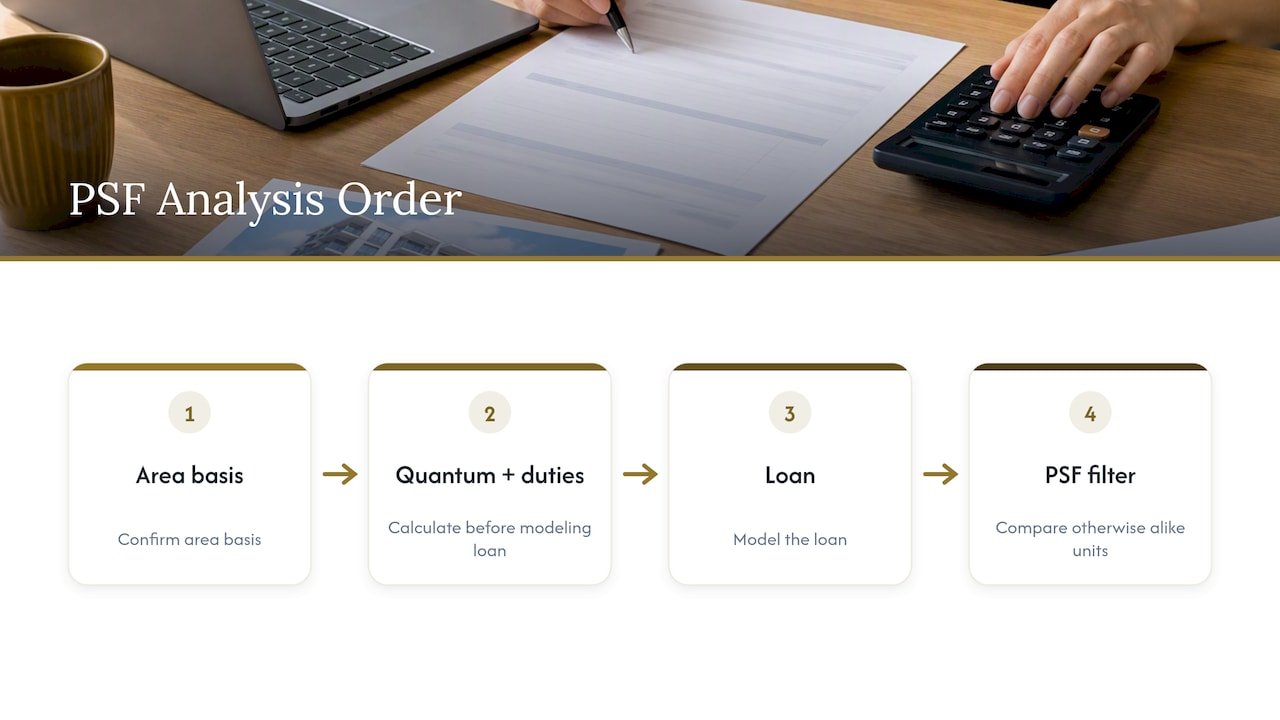
Across Singapore transactions, the most common pitfall we see is a buyer anchoring on PSF alone and only discovering the real affordability picture, ABSD tier, TDSR headroom, after making an offer. A simple checklist avoids this: confirm area basis, calculate quantum-linked duties, model monthly repayment, then compare PSF.
Our free property valuation gives you an independent read on a unit’s worth alongside personalised negotiation support and ABSD-aware guidance, drawing on market evaluations built to flag gaps between asking PSF and underlying value. Readers planning an ABSD-sensitive purchase can also work through a cash-flow walkthrough before approaching any listing.
What actually matters when you analyse PSF
The industry habit of ranking listings by PSF alone persists because it is easy to put in a spreadsheet column, not because it predicts value well. Our view, based on how GFA harmonisation and duty structures actually behave in Singapore, is that PSF deserves far less weight than it gets in casual property talk.
The bigger miss is treating PSF as a value signal rather than a size-adjusted price tag. A lower PSF on an older unit often hides a less efficient layout and a larger renovation bill; a higher PSF on a new launch often reflects a genuinely smaller non-liveable allowance rather than overpricing. Meanwhile, ABSD, BSD, TDSR and LTV act on quantum directly, which means two units with identical PSF can produce very different monthly costs and duty bills.
If you take one thing from this analysis, make it this order of operations: confirm the area basis, calculate quantum and duties, model the loan, then use PSF only to choose between units that are otherwise alike.
— Anderson
Quick next steps: book a valuation or request a PSF and quantum check

Running the calculations above on a real shortlist takes time, and getting the area basis wrong undoes the whole exercise. Our free property valuation gives you an independent figure to compare against any listing’s asking PSF, and our team pairs that with personalised negotiation and ABSD-aware guidance so quantum, not just PSF, drives your decision.
- Gather the listing’s price, strata area and launch year before requesting a review.
- Book a free property valuation to get an independent benchmark.
- Ask for a combined PSF and quantum breakdown, including ABSD and BSD exposure for your buyer profile.
This article is general information, not a substitute for advice from a qualified financial advisor. Consult a qualified financial professional about your own circumstances before acting on anything here.
FAQ
What is a good PSF for a Singapore condo?
There is no single “good” PSF figure, since it depends on district, project age and area basis. A PSF only becomes meaningful once you compare it against similar units with the same floor area convention and factor in quantum-linked costs such as ABSD and BSD.
Is PSF or total price more important when buying in Singapore?
Total price, or quantum, generally matters more because stamp duties and loan limits such as TDSR and LTV are calculated on the purchase price, not on PSF. PSF is most useful as a tie-breaker between two very similar units.
Why do newer condos often show higher PSF than older ones nearby?
Newer projects report floor area under harmonised GFA rules that exclude non-liveable spaces such as air-conditioning ledges, shrinking the reported area and pushing PSF up for similar liveable space. Older units often show a lower PSF partly because their larger reported area includes those non-liveable allowances.
Should investors use cap rate or cash on cash return?
Cap rate measures unlevered return and suits comparing properties independent of financing, while cash on cash return measures the actual return on your invested equity after loan repayments. Most Singapore buyers using financing find cash on cash more relevant to their real outcome.
How does ABSD affect my PSF comparison?
ABSD does not change the PSF figure itself, since it is charged on the purchase price rather than per square foot. It does change the real cost of a unit substantially, with foreigners facing 60% ABSD and entities 65% on residential property, so always add duty costs before judging two units purely by PSF.


