

Landlord Rights in Singapore: What the Law Lets You Do
A landlord in Singapore has the right to receive the agreed rent, to decide how the property is used through the tenancy agreement, to inspect it on notice, and to act when the tenant breaches the lease. Those rights are real, but they are exercised through the contract and legal process, not through self-help. Changing locks, removing belongings or sending a casual termination message can put the landlord in the wrong. This guide sets out what you can do, what you must do in return, and where HDB and private rules differ.
TL;DR
- Your rights come mainly from the tenancy agreement. The CEA templates are a guide, not a requirement, so write the clauses you need.
- You may demand rent, inspect the property (the Land Titles Act implies two visits a year on 2 days’ notice unless the lease says otherwise) and act on serious breaches.
- Ending a lease early is a legal process. Locking a tenant out or sending only a termination notice can backfire.
- HDB owners face extra rules: a 6-month minimum rental, maximum terms, HDB approval for each tenancy and occupancy caps.
- The Small Claims Tribunal can hear residential tenancy disputes for contracts of up to 2 years and can order delivery of vacant possession.
Table of Contents
- Where a landlord’s rights come from
- The core rights of a landlord
- Ending a tenancy early: what is valid and what is not
- The Small Claims Tribunal as a landlord’s tool
- Repairs: who is responsible for what
- HDB flats: extra rules every owner must follow
- Private property and commercial lettings
- What a landlord should not do
- Our view on landlord rights
- Before you decide to rent out or sell
- FAQ
- Sources
Where a landlord’s rights come from
Singapore has no single landlord and tenant code that covers every situation. A landlord’s position rests on three layers:
- The tenancy agreement. Rent, deposit, notice periods, repairs, permitted use and the right to terminate are all set here.
- Statute. The Land Titles Act implies certain powers into leases of registered land, and the Conveyancing and Law of Property Act sets the steps for forfeiture. For flats, the Housing and Development Act and HDB regulations add conditions.
- Court and tribunal process. If a tenant does not comply, the remedy runs through the courts or the Small Claims Tribunal.
The practical result is that the contract you sign carries most of the weight. The Council for Estate Agencies (CEA) explains that its tenancy templates are only a guide and are not mandatory, so landlords can negotiate and draft their own clauses. If you are putting an agreement together, our guide to the Singapore tenancy agreement and the CEA and HDB templates walks through what to include and how stamping works.
The core rights of a landlord
The right to rent, on the agreed terms
The first right is the simplest: the tenant pays the rent on the dates and in the amount the agreement states. Write down the amount, the due date, the payment method, any late-payment consequences and the security deposit. Deposits are a frequent source of friction at the end of a tenancy, so state clearly what may be deducted. Our guide on getting a full deposit back covers the tenant’s side of the same discussion, which is useful to read so your clauses are fair and enforceable in practice.
The right to decide how the property is used
The agreement is also where you control use. Typical clauses cover:
- the named occupants and a limit on the number of people living there;
- a ban on subletting or assigning the lease without your written consent;
- whether pets are allowed (see our note on renting with pets);
- whether the unit may be used for anything other than a home;
- smoking, renovation and alteration rules.
Short stays are a separate matter. Letting a residential unit by the night is restricted, and a tenant who lists your home on a booking platform may expose you to enforcement. Set out a clear prohibition and read the four checks for short-term rentals in Singapore before agreeing to any flexible arrangement.
The right to inspect
A landlord cannot walk in whenever they like. Under the Land Titles Act, unless the lease says otherwise, a landlord has an implied power to enter twice a year to inspect, after giving 2 days’ notice. Many landlords prefer to put a more precise arrangement in the agreement, for example a notice period in writing, reasonable hours and access for urgent repairs. Whatever you choose, give notice in writing and keep a record.
The right to act on arrears and breaches
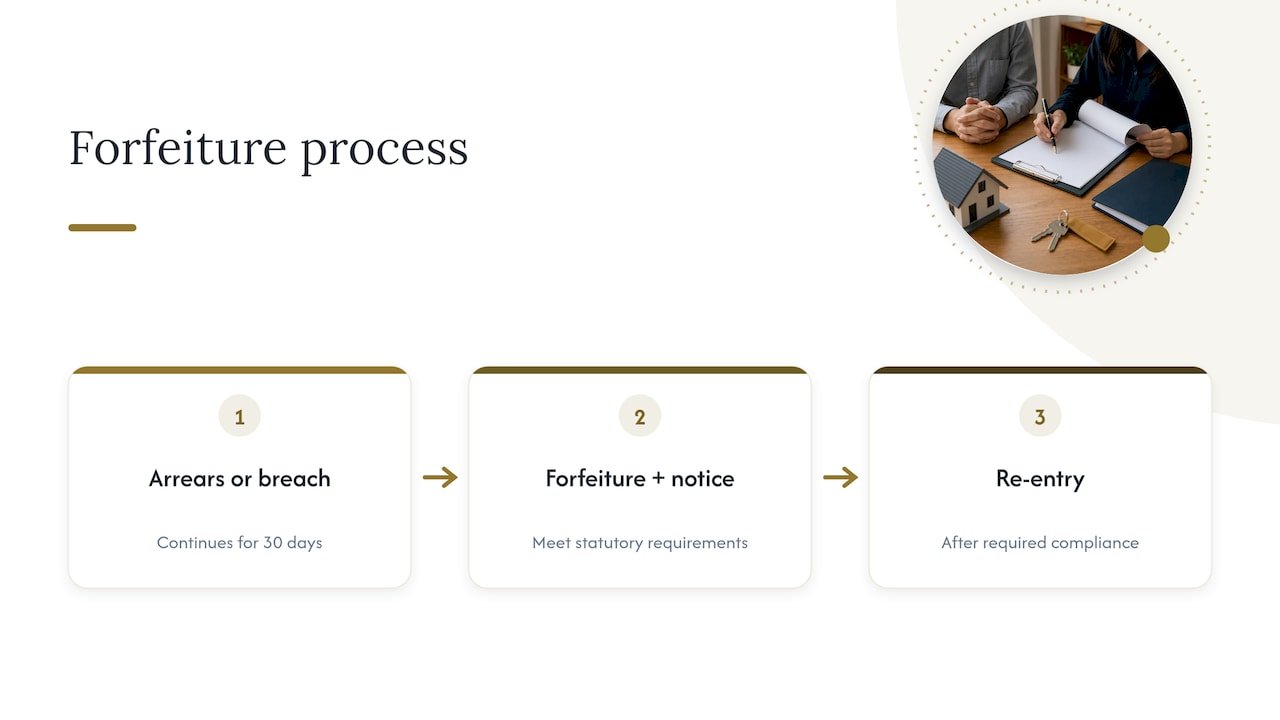
The same provision of the Land Titles Act is the basis for a landlord’s right to re-enter where rent has been in arrears for 30 days, or where a breach of the tenant’s covenants has continued for 30 days. That right is not a licence for quick action: the landlord must still comply with the statutory requirements for forfeiture and notice under the Conveyancing and Law of Property Act. The next sections explain why the order of steps matters.
Ending a tenancy early: what is valid and what is not
The most expensive mistake a landlord can make is to treat a termination notice as the end of the lease. The Singapore judiciary’s case brief on Campbell Hospitality Pte Ltd v Marchmont Pte Ltd explains that a tenancy is determined when the landlord exercises the right to forfeit, and that the landlord must first meet the statutory requirements before doing so. In summary of that guidance:
- A notice on its own does not forfeit the lease. The valid routes are physical re-entry or starting legal proceedings.
- If you accept a rental payment after the breach and after a termination notice, that can be treated as a waiver of your right to forfeit, which effectively resets the process.
- Locking out a tenant without a court order or proper forfeiture procedure can lead to civil liability.
This is why the tribunal and courts, not self-help, are the safe path. If you are facing a tenant who has stopped paying, take legal advice from a lawyer before you accept any further payment or change anything at the property, because the order in which you act can decide the outcome.
A short checklist before you act
- Read the termination and default clauses in your agreement.
- Record the breach: dates, amounts, messages, photographs.
- Send written notice of the breach in the form the agreement and statute require.
- Do not accept rent without advice if you intend to forfeit.
- Use the tribunal or court rather than re-entering by force.
The Small Claims Tribunal as a landlord’s tool
For residential rentals, the Small Claims Tribunal (SCT) is often the quickest route. According to a written answer from the Minister for Law, the SCT can hear tenancy disputes arising from residential rental contracts that do not exceed two years. The same source reported that tenancy disputes made up about 9% of the average 10,414 cases filed each year at the tribunals, as of 2019. Changes to the Small Claims Tribunals Act also gave the tribunal power to order delivery of vacant possession, which gives landlords a faster and cheaper way to recover a unit when rent is unpaid.
Two practical points follow:
- The two-year limit applies to the contract. A longer lease does not fall in the SCT’s residential tenancy jurisdiction, and you would need to look at other forums.
- The tribunal decides on documents and evidence. Vague clauses make for weak claims. If your agreement does not clearly say what happens on late rent, damage or early exit, you will have less to point to.
The tribunal works both ways. If you want to understand what a tenant can bring against you, including claims about deposits, repairs and early termination, our page on tenant rights in Singapore and preparing an SCT claim shows the process from the other side.
Repairs: who is responsible for what
Repairs are the second most common source of disputes after rent, and the agreement usually decides them. The CEA’s guidance is that many disputes come from vague or missing clauses about minor repairs, cleaning expectations or permitted use. The fix is to be specific.
A workable repairs clause usually answers these questions:
| Question | What to state |
|---|---|
| What counts as a minor repair? | A definition, ideally with examples such as light bulbs, filters, tap washers or hose replacements |
| Who pays for minor repairs? | Tenant, landlord, or a shared amount up to a stated cap per item |
| Who pays for major or structural problems? | Usually the landlord, but state it, including the air-conditioning servicing schedule |
| How is a fault reported? | In writing, by message or email, with photographs |
| How fast will you respond? | A stated time for urgent faults, such as water leaks or loss of power |
| Can the tenant arrange repairs? | With prior approval, up to a set amount, against receipts |
| What happens to tenant-caused damage? | Tenant bears the cost, with deductions from the deposit documented |
The agreement should also say whether appliances and furnishings are supplied, and attach an inventory list with photographs signed by both sides at move-in. That list is the evidence you will rely on at the end of the tenancy.
Note also what an agent does and does not do. The CEA explains that when you engage a property agent, the agent’s role is mainly the transaction itself, finding a tenant and finalising the lease. Handling repairs and collecting rent over the years falls outside the formal scope of estate agency work. Plan either to manage these yourself or to arrange separate management services in writing.
HDB flats: extra rules every owner must follow
If you rent out an HDB flat, your rights sit inside HDB’s regulations. The main conditions, as set out by HDB, are:
- Minimum period. Each tenancy must be at least 6 months per application. HDB states that you are not allowed to rent out a flat or bedroom on a short-term basis.
- Maximum period. For Singaporean or Malaysian tenants, the maximum is 3 years per application. Where the tenant is a non-Malaysian non-citizen, the cap is 2 years.
- Reapplication. You must reapply to HDB each time you renew a tenancy or change tenants.
- Occupancy limits. The limit is 6 occupants for a 3-room flat and 8 for a 4-room or larger flat, including owners and authorised occupiers. For rental periods that run beyond 31 December 2028, the cap reverts to 6 for all 4-room and larger flats. Check HDB’s current rules before you sign.
- Responsibility for tenants. Owners must ensure their tenants comply with the lease covenants and the Housing and Development Act, and the owner is responsible for infringements.
- Overseas owners. If you live overseas you must appoint an attorney to manage the flat, and that attorney cannot be a tenant of the same flat. Breaches can lead to serious enforcement action, including possible compulsory acquisition.
Tenants who are not citizens also fall under a quota. HDB’s page on the Non-Citizen Quota for renting out a flat explains how it applies to Permanent Residents and foreigners. If you expect to let to expatriates, our summary of HDB rental rules for foreigners sets out what to check before you advertise. The CEA’s page on renting out an HDB flat or bedroom gives the step-by-step process and was last updated on 1 April 2026.
Private property and commercial lettings
Private residential owners do not need HDB approval, but the tenancy agreement still decides most outcomes. The CEA recommends that you go through the checklists for rental transactions before signing. If you let to expatriates, you will meet requests such as a diplomatic clause, which allows early termination if the tenant’s posting ends. These clauses are common in Singapore, but vague wording often leads to disputes at the SCT, so define the minimum period, the notice and the evidence required. For the tenant’s perspective, see our guide to renting in Singapore as an expat.
Commercial lettings follow different considerations, including permitted use, which is a point to check before you commit. Our commercial property guide for Singapore covers use checks and the taxes and financing rules around such transactions. Note that the SCT’s residential tenancy jurisdiction does not extend to commercial leases, so draft those agreements with particular care.
What a landlord should not do
- Do not change the locks or remove belongings to force a tenant out. This can create civil liability.
- Do not rely on a termination message as if it ended the lease.
- Do not accept rent after a breach and a termination notice without advice, since this can be treated as a waiver.
- Do not enter without notice outside the terms of your agreement and the implied right.
- Do not let an HDB flat for less than 6 months or exceed the permitted period or occupancy.
- Do not assume your agent manages the property after the lease is signed.
Our view on landlord rights
We see the same pattern in rental disputes: the landlord who has the best outcome is the one who wrote the clearest agreement, not the one with the most aggressive stance. Rights in Singapore are enforced through process, so the quality of your paperwork, your inventory list and your records matters more than any single clause.
For owners who are also thinking about the property as an investment, there is a second point. A tenanted property is easier to value, to finance and to sell when the tenancy documents are in order and the rental has been properly approved. Buyers and valuers ask for the agreement, the rent history and the end date. A landlord who has kept those clean usually has more options when the time comes to sell or to renew.
Our approach at Register Today is to start from the facts of the property and the owner’s goals, assess the market, and then decide whether to hold, rent out or sell. We would rather an owner understand the rules before a dispute than after one.
— Anderson
Before you decide to rent out or sell
If you are weighing whether to keep letting a property or to sell it, start with its current value. Register Today offers a free property valuation at no charge, and our team can discuss renting out or selling through our main site. If you are comparing the long-term cost of owning against leasing, the rent versus buy model for a 10-year hold helps you test the numbers.
FAQ
Can a landlord enter the property without the tenant’s permission?
Not freely. Unless the lease provides otherwise, the Land Titles Act implies a power to enter twice a year for inspection after giving 2 days’ notice. Most landlords set out access terms in the agreement, including urgent repairs, and give notice in writing.
Can I call the police to evict a tenant?
The police are not a substitute for the legal process. If a tenant has stopped paying or has breached the lease, the valid routes are forfeiture through re-entry or legal proceedings, or a claim at the Small Claims Tribunal for residential contracts of up to 2 years. Lockouts without a court order or proper procedure can expose you to civil liability.
Can I write my own tenancy agreement?
Yes. The CEA templates are a guide and are not mandatory, so you can draft your own clauses. Be specific about rent, repairs, permitted use, notice and termination, because vague wording is a common cause of disputes.
Does my property agent manage repairs and rent collection?
Usually not. The CEA says an agent’s scope is largely the transaction, finding a tenant and finalising the lease, while ongoing repairs and rent collection fall outside formal estate agency work. Arrange separate property management in writing if you do not want to handle these yourself.
What is the shortest and longest period I can rent out an HDB flat?
The minimum is 6 months per application. The maximum is 3 years for Singaporean or Malaysian tenants and 2 years where the tenant is a non-Malaysian non-citizen. You must reapply to HDB each time you renew or change tenants.
Sources
- Land Titles Act, Singapore Statutes Online
- Campbell Hospitality Pte Ltd v Marchmont Pte Ltd, case brief, Singapore Judiciary
- Written answer on tenancy dispute cases at the Small Claims Tribunal, Ministry of Law
- Renting or renting out a private residential property, CEA
- Renting or renting out with a property agent, CEA
- Renting out an HDB flat or bedroom, CEA
- HDB