

Property Exit Strategy in Singapore: Plan Before You Buy
A property exit strategy is a written plan for how, when and at what cost you will leave an investment: by selling, refinancing, renting it out long term or passing it on. In Singapore the plan matters more than in many markets because the cost of leaving depends on how long you hold, how the purchase was funded and which stamp duties apply on the day you sell. This guide sets out the main exit routes, the costs that reduce your proceeds, and how to choose between them before you sign the Option to Purchase.
TL;DR
- Decide your exit route before you buy: sell outright, sell in stages, refinance and hold, or keep it for rental income and later transfer.
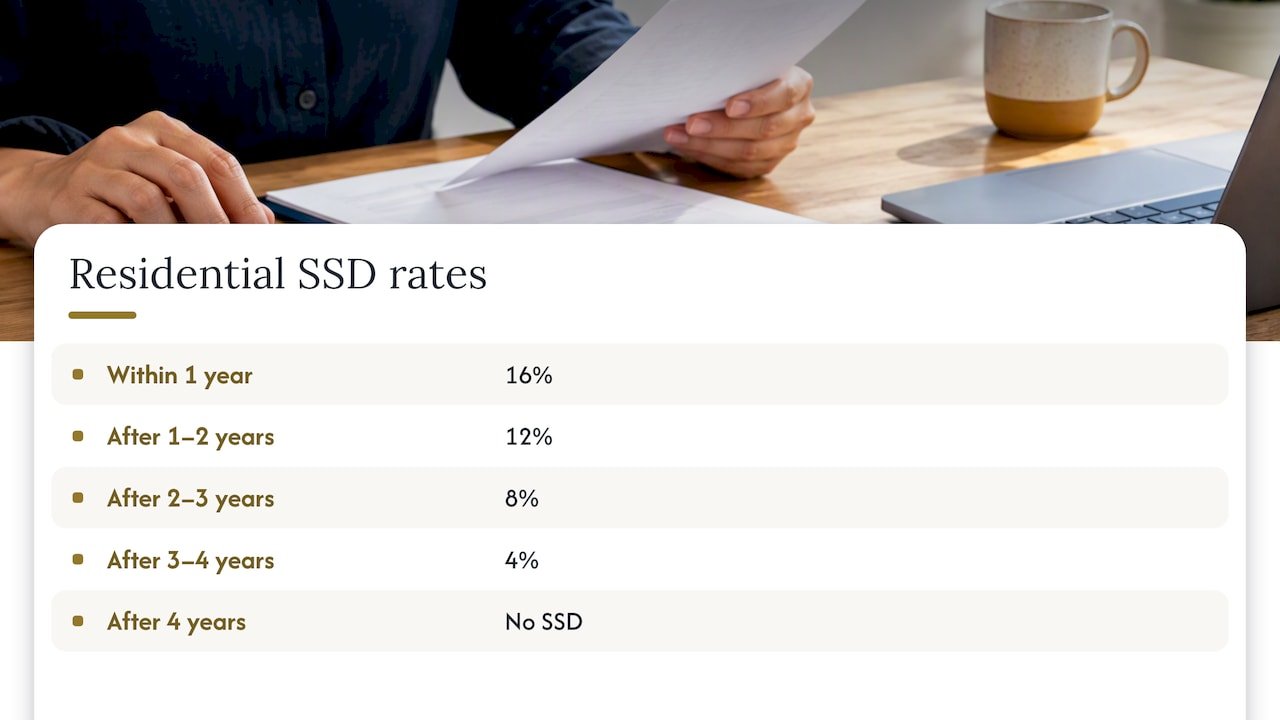
- Holding period drives cost. Under IRAS rules for residential property acquired on or after 4 July 2025, Seller’s Stamp Duty applies if you sell within four years and falls from 16% to 4% across that period.
- Your net proceeds are the sale price minus the outstanding loan, the CPF refund with accrued interest, SSD, agent and legal costs.
- Compare the net cash from selling with the rent you would collect after property tax and loan costs, not the headline yield.
- Review the plan every year against your finances, the market and your age, because the best exit at 40 is rarely the best at 60.
Table of Contents
- What an exit strategy is, and why it comes first
- The four main exit routes
- What reduces your proceeds when you sell
- Choosing the right time to sell
- Sell or hold: comparing the numbers
- Exit planning by type of owner
- Our perspective
- Get a starting number for your exit
- Review your plan every year
- FAQ
- Sources
What an exit strategy is, and why it comes first
Most buyers spend weeks on the entry: location, price, financing. Few write down the exit. The result is predictable. An owner needs cash in year three, discovers that selling now triggers Seller’s Stamp Duty, and has to choose between a poor sale and an awkward rental.
An exit strategy answers four questions:
- Why will I leave? A target gain, a life event, a retirement date, a loan that resets.
- When is the earliest sensible date? This is set mostly by stamp duty and loan terms.
- How will I leave? Sale, refinance, rental hold or transfer.
- What is the minimum I must receive? The floor price below which holding is better than selling.
Writing these down before the purchase also helps you judge the property itself. A unit that is easy to rent and easy to resell has more exit routes than one that suits a narrow type of buyer. For the purchase side, the free property valuation gives you a market reference point before you commit.
The four main exit routes
1. Sell outright
The simplest exit, and the one most readers mean. You sell, repay the loan, refund CPF, and keep the balance. It suits owners who have reached a target gain, need liquidity, or see better use for the capital.
The variables you control are timing and price. Timing is covered below. On price, a realistic valuation and a clear view of what comparable units have actually transacted for matter more than the asking prices you see online. Our sold properties page shows the kind of completed deals we handle.
2. Sell in stages
Owners with more than one property often exit gradually: sell the weakest asset first, use the proceeds to reduce debt on the rest, then repeat. This is the logic behind approaches such as selling part of a portfolio to pay down debt, or paying off one property after another. It lowers the monthly commitment and reduces how much you depend on a single sale date.
Staging works when each sale is independent of the next. It fails when you need all the cash at once, or when selling the first property pushes you into a stamp duty position on another that you did not plan for.
3. Refinance and hold
Refinancing replaces your loan with a new one, ideally at a lower rate or with a longer tenure, so that the property carries itself while you wait. It is a way to buy time rather than to leave, but many investors treat it as an exit from a bad loan rather than from the asset.
Some facts worth knowing. The Monetary Authority of Singapore has stated that borrowers are exempted from TDSR, MSR and LTV limits when refinancing owner-occupied properties. For investment properties, you should not assume the same exemption applies; confirm it with your bank. MAS also noted that financial institutions look at factors such as rental income, repayment history and the outstanding loan relative to the property’s value, and may ask for a joint borrower or guarantor if the main borrower has no salary income.
Before refinancing, work out whether the saving covers the fees and any lock-in penalty. We lay out the sums in our refinancing break-even checklist.
4. Hold for rental income, then transfer
Some owners never sell. They keep the property for rent, let the loan shrink, and eventually pass it to family. This route avoids transaction costs, but it carries ongoing ones. Property tax is levied on ownership whether the property is occupied or vacant, and for non-owner-occupied residential property the progressive rates start at 12% of the Annual Value. Add maintenance, agent fees at each tenancy, and vacancy periods.
If the plan is to hand the property on, the legal structure matters as much as the property. Reading about family wealth transfer in Singapore before you decide helps you see how wills and trusts affect who ends up holding the asset and when.
What reduces your proceeds when you sell
The sale price is not what you keep. Work through these deductions in order.
Outstanding loan and CPF refund
Sale proceeds first repay the outstanding housing loan. Then, according to the CPF Board, you must refund the CPF principal you withdrew plus the accrued interest. If you are 55 or older and pledged the property to set aside your retirement sum, the pledged amount must also be refunded. Only the remainder is cash in hand.
This is why owners who used a lot of CPF are often surprised. The refund returns to your CPF account, not your bank account, so your usable cash can be much lower than the headline gain suggests.
Seller’s Stamp Duty
SSD is the cost that most directly shapes the exit date. IRAS states that for residential properties acquired on or after 4 July 2025 and sold within four years, the rate is 16% within one year, 12% after one and up to two years, 8% after two and up to three years, and 4% after three and up to four years. No SSD applies after four years.
Two details matter. First, SSD is computed on the higher of the selling price or the market value at the date of disposal, so selling to a relative below market does not lower it. Second, the holding period is the clock, so a sale one month before an anniversary can cost thousands more than a sale one month after.
A worked example using the IRAS rates: suppose you sell a residential property for S$2,000,000 two and a half years after buying. The rate for that band is 8%, so SSD is S$160,000. Wait until just past three years and the rate is 4%, or S$80,000. The saving of S$80,000 is the amount you are paying to sell six months early. The example is illustrative; check your own purchase date and the figures on the IRAS page.
For how this fits with tax questions, see our guide on capital gains tax and selling within four years and our note on avoiding a surprise Seller’s Stamp Duty bill.
Other selling costs
Budget for agent commission, legal fees, and any renovation or repair you agree to before completion. These vary by deal and by agreement, so ask for written quotes. If you are selling to a buyer who needs to arrange stamp duty, the stamp duty timeline tells you what each side must do and by when.
Choosing the right time to sell
SSD sets the earliest sensible date. After that, three things decide the best date.
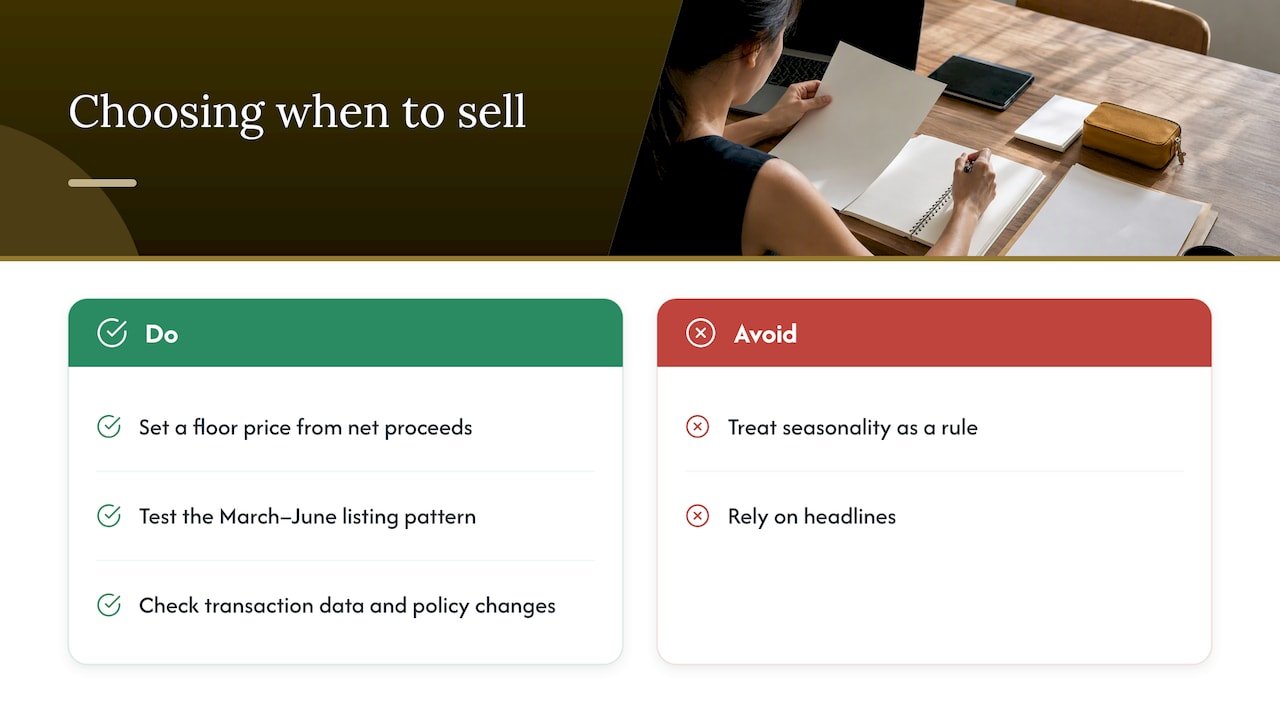
Your own numbers. If the net proceeds after all deductions meet the floor price you set at the start, selling is on the table. If they do not, holding is the default.
Seasonality in listings. We have found that listing between March and June, aiming for late May, tends to work well; the reasoning is in our guide to the best time to sell. Treat this as a pattern to test against your own property and not a rule.
The market cycle. Look at transaction data and policy changes rather than headlines. Our market outlook scenarios set out how different paths for prices and rates would affect buyers and sellers. Official figures on private home prices come from the Urban Redevelopment Authority and policy announcements from MAS and the Ministry of National Development; check them for the latest release before acting.
If your block is part of a possible collective sale, the calculation changes again. Our en bloc guide explains the four-year SSD point and the consent thresholds owners must understand.
Sell or hold: comparing the numbers
A common mistake is to compare the rental yield with the sale price. Compare cash flows instead.
| Item | Sell now | Hold and rent |
|---|---|---|
| Cash received | Sale price minus loan, CPF refund, SSD if any, fees | Monthly rent |
| Ongoing costs | None after completion | Loan interest, property tax, maintenance, vacancy, agent fees |
| Exposure to price changes | Ends at sale | Continues |
| Use of capital | Free to redeploy | Tied up in the property |
| Main risk | Selling too early and paying SSD, or at a weak price | Rate rises, long vacancies, falling value |
To make it concrete, take these steps:
- Get a current valuation and estimate the net sale proceeds using the deductions above.
- Estimate annual rent, then subtract property tax, maintenance, vacancy allowance and interest.
- Divide the net rent by the net sale proceeds, not the original price. This is your real return on the capital you could free up.
- Compare it with what that capital could earn elsewhere, including repaying debt.
If the net figure from step 3 is lower than your alternatives, the case for selling gets stronger, provided SSD is no longer a factor. A yield that looks respectable on the purchase price, such as 3.5%, can look weak against the capital you could release today. Whether 3.5% is good depends on your loan cost and your alternatives, not on a universal benchmark.
Exit planning by type of owner
First-time buyers. Your home may also be your exit. Think about how easy the unit will be to resell, since you may upgrade. Our condos and apartments listings let you compare the layouts and locations that tend to hold buyer interest.
Investors with a second or later property. Additional Buyer’s Stamp Duty raises the cost of entry, so the exit matters more: you need a clear way to recover that cost. Foreign buyers face higher rates; see what foreign buyers must budget for ABSD.
Commercial investors. Lease length, tenant quality and the number of likely buyers shape your exit more than the headline price. Browse commercial and commercial office listings to see what is on the market, and plan for a longer sale period than with a residential unit.
Buying off the plan. If you buy a new launch, your exit window is partly fixed by construction. The progressive payment schedule shows when cash is due, which tells you how long you must carry costs before the unit can be rented or sold.
Our perspective
We handle purchases, sales and rentals, and one pattern repeats: owners who ask about exit at the start make better decisions at the end. The question we ask first is not “what will this sell for?” but “what will you keep, and when?”
We think three habits separate good exits from poor ones. The first is to value the property independently before you list and again before you accept an offer, so you negotiate from evidence. The second is to treat the valuation gap between the price paid and what a bank or valuer will support as a planning item, not an afterthought; our note on valuation shortfall explains how that gap is paid for. The third is to look for where a price sits against comparable transactions before buying at all; see how we screen for undervalued properties. A purchase made at a sound price starts with a better exit.
Our approach is to put the numbers on the table and let you choose. If selling does not make sense yet, we will say so.
— Anderson
Get a starting number for your exit
If you are weighing a sale, the first figure you need is what your property is worth today. Register Today offers a free property valuation, which carries no charge, and we can then walk through your net proceeds with you.

If you are ready to act, you can also start from our main page to sell, buy or rent, and our team negotiates on your behalf to get the terms you set in your exit plan.
Review your plan every year
An exit plan is not fixed. Put a date in your calendar each year and check:
- Which SSD band you are in, and when the next one begins.
- The current interest rate against your loan, and whether refinancing now pays back.
- The rent you could achieve against the rent you receive.
- Your own timetable: retirement, children’s education, other commitments.
- Whether policy or market changes affect your floor price.
Write down what would make you sell and what would make you hold. When the trigger arrives, you decide from a plan instead of a worry.
FAQ
What is an exit strategy in property investing?
It is your plan for how and when you will get out of a property investment, and what you expect to receive. In Singapore it usually means choosing between selling, refinancing and holding, and timing the move around Seller’s Stamp Duty, loan terms and CPF refunds.
When can I sell a Singapore property without paying SSD?
For residential property acquired on or after 4 July 2025, IRAS applies no SSD once you have held it for more than four years. Earlier sales attract rates from 16% down to 4%, depending on the year. Check the IRAS page for your own purchase date.
Do I get all the sale money in cash?
No. Proceeds first repay your outstanding housing loan, then refund the CPF you used plus accrued interest, and SSD and fees are deducted. What is left is your cash. The CPF portion returns to your CPF account.
Is refinancing a way to exit a property?
It is a way to change the loan, not to leave the asset. It can lower your monthly cost so you can hold longer. Weigh the interest saving against fees and any lock-in penalty, and ask your bank whether TDSR or LTV rules apply to your property type.
Is a 3.5% rental yield good?
It depends on your loan rate, costs and alternatives. Measure it against the net rent after property tax, maintenance and vacancy, divided by the capital you could release by selling. If that is below what you could earn or save elsewhere, selling may make more sense.
Sources
- MAS: Reply to Parliamentary Question on refinancing housing loans
- IRAS: Seller’s Stamp Duty (SSD) for Residential Property
- IRAS: Essential Property Tax Information for HDB Flat Owners
- CPF Board: CPF refund when selling or transferring property