
Singapore Shophouse Investment: Why 3% Yields Suit Private Wealth
Singapore shophouses remain a heritage, low-yield but capital-preserving asset best suited to patient private wealth rather than income-hungry buyers. Entry yields typically sit in the low single digits, often at modest rates. while conservation status in gazetted areas limits supply and protects long-term value. Regulatory and tax treatment under URA and IRAS rules can shift the maths materially, so returns depend on how a unit is zoned and used.
TL;DR:
- A S$8 million shophouse earning S$240,000 in annual gross rent yields 3% before vacancy, restoration costs, financing, and other expenses.
- Before bidding, verify the unit’s permitted use with URA; conservation rules may require approval for changes, and some precincts prohibit hotels.
- Purely commercial units generally avoid ABSD and SSD, but residential zoning can trigger both; mixed use sales and leases incur GST on the commercial portion.
- H1 2025 recorded S$462.9 million across 42 transactions as buyers retreated from F&B assets; hospitality and living conversions sustained activity.
Table of Contents
- Why investors buy shophouses: heritage, scarcity and strategic role
- Typical pricing and yields investors can expect
- Recent market activity and investor demand trends
- Conservation, zoning and permitted uses: what to check with URA
- Tax, stamp duty and GST implications for purchase and leasing
- Practical due-diligence and deal-structuring checklist for HNW investors
- Shophouse location analysis and neighbourhood trends
- Potential for rental income and tenant types
- Long-term capital appreciation prospects
- Impact of government policies on shophouse investment
- Exit strategies and market liquidity considerations
- Author perspective: positioning shophouses in a private-wealth portfolio
- How Register Today helps investors find and transact shophouses in Singapore
- FAQ
- Sources
Why investors buy shophouses: heritage, scarcity and strategic role
Shophouses form the bulk of Singapore’s gazetted conservation buildings, and that status is precisely what family offices and high-net-worth buyers are paying for. Supply is fixed by law, not by market cycles, which gives these assets a scarcity premium that ordinary commercial stock cannot match.
For many private-wealth investors, a shophouse functions less like a yield instrument and more like a legacy holding, something to pass down or anchor a portfolio against inflation. Others pursue adaptive reuse, converting units into boutique hotels or living-sector assets where tourism demand supports a different revenue profile.
- Conserved shophouses carry cultural and brand value that newer commercial buildings cannot replicate.
- Boutique hospitality and living-sector conversions are increasingly common adaptive reuse strategies.
- Capital preservation, not income maximisation, often drives the purchase decision.
Typical pricing and yields investors can expect
Tenure matters: freehold units in tightly held conservation precincts tend to command a premium over leasehold equivalents, which compresses yield further.
A worked illustration: say a shophouse is priced at S$8 million and generates S$240,000 in annual gross rent, that implies a gross yield of 3%, before accounting for restoration capex or vacancy.
- F&B tenancies often command higher headline rents but carry restoration and licensing overheads.
- Office or retail use tends to offer steadier occupancy with lower capex requirements.
- Vacancy risk rises in units pending conservation approval for a change of use.
Recent market activity and investor demand trends
The first half of 2025 saw shophouse transactions total S$462.9 million across 42 units, a slowdown attributed to macro volatility and investors pulling back from F&B-dependent assets. Market outlooks project full-year 2025 volumes lower than in 2024.
Despite the softer overall volume, living-sector assets and boutique hospitality conversions kept activity alive, supported by a recovering tourism sector. Buyer composition has stayed consistent: family offices and HNWIs dominate, with selective institutional interest in larger portfolios.
- H1 2025 transaction value fell year-on-year, driven largely by caution around F&B tenancies.
- Boutique hotel conversions and living-sector deals offset some of the broader slowdown.
- Interest-rate movements and tourism recovery remain the two biggest swing factors for demand.
Conservation, zoning and permitted uses: what to check with URA
Before committing capital, every investor needs to confirm what a specific shophouse can legally be used for. Buildings within a Historic Conservation Area require conservation permission for any change of use, and URA lists both allowable and restricted uses depending on the precinct, with some areas limiting hotels or backpacker hostels outright.
- Check URA’s conservation maps and URA SPACE to confirm the building’s conservation status and precinct boundaries.
- Identify the current permitted use and whether your intended operation (retail, office, F&B, hospitality) requires a fresh application.
- Submit a change-of-use application through GoBusiness Singapore where required, noting the published processing fee and turnaround time.
- Where restoration works are planned, request a Specific Restoration Guideline early to clarify what alterations URA will accept.
Pro Tip: Resolving permitted use before you bid can unlock a materially different revenue stream, so treat the URA check as step one, not a formality to confirm after signing.
Tax, stamp duty and GST implications for purchase and leasing
Stamp duty treatment for shophouses hinges on zoning and permitted use rather than the building’s heritage label. IRAS guidance confirms that Buyer’s Stamp Duty and related treatment depend on land zoning and permitted use), with worked examples for mixed-use properties. A purely commercial shophouse generally sits outside Additional Buyer’s Stamp Duty and Seller’s Stamp Duty, while any residential-zoned component within the same building can attract both.
For mixed-use buildings, GST applies only to the non-residential portion of a sale or rental, and an independent valuer’s apportionment is commonly required to separate the residential and commercial shares correctly.
- Confirm zoning and permitted use before assuming a shophouse is exempt from ABSD or SSD.
- Budget for GST on the commercial portion of mixed-use sales and leases.
- Build an independent valuation apportionment into the sale and purchase agreement to avoid disputes later.
On financing, banks typically exercise discretion on loan-to-value ratios for conservation and commercial properties, and margins are commonly linked to SORA, both of which deserve modelling before you set a bid price. Our guide to zoning checks that avoid ABSD surprises walks through this in more detail, and foreign buyers should also review what to budget for ABSD ahead of any offer.
Practical due-diligence and deal-structuring checklist for HNW investors
A disciplined sequence protects capital far more reliably than relying on a broker’s summary. Before any offer, we recommend working through the following in order.
- Verify title, tenure and any assignment conditions attached to existing leases.
- Confirm URA conservation status and permitted use for the specific unit, not just the street.
- Commission a structural and restoration survey to estimate capex exposure.
- Obtain an independent valuation apportionment for tax purposes ahead of exchange.
- Decide the operating model (F&B, office, hospitality) and confirm it is permitted before finalising price.
- Model rental sensitivity, restoration capex, and interest-rate scenarios across a base, upside and downside case.
- Plan an exit route and realistic holding horizon before committing.
Ask sellers directly about outstanding conservation works, undeclared restrictions, or pending URA notices, and verify their answers against URA’s own records rather than relying on representations alone. Escalate any gap between what is declared and what URA shows on file.
Pro Tip: Treat a seller’s silence on restoration history as a red flag worth investigating, not a minor gap to clarify after exchange.
Shophouse location analysis and neighbourhood trends
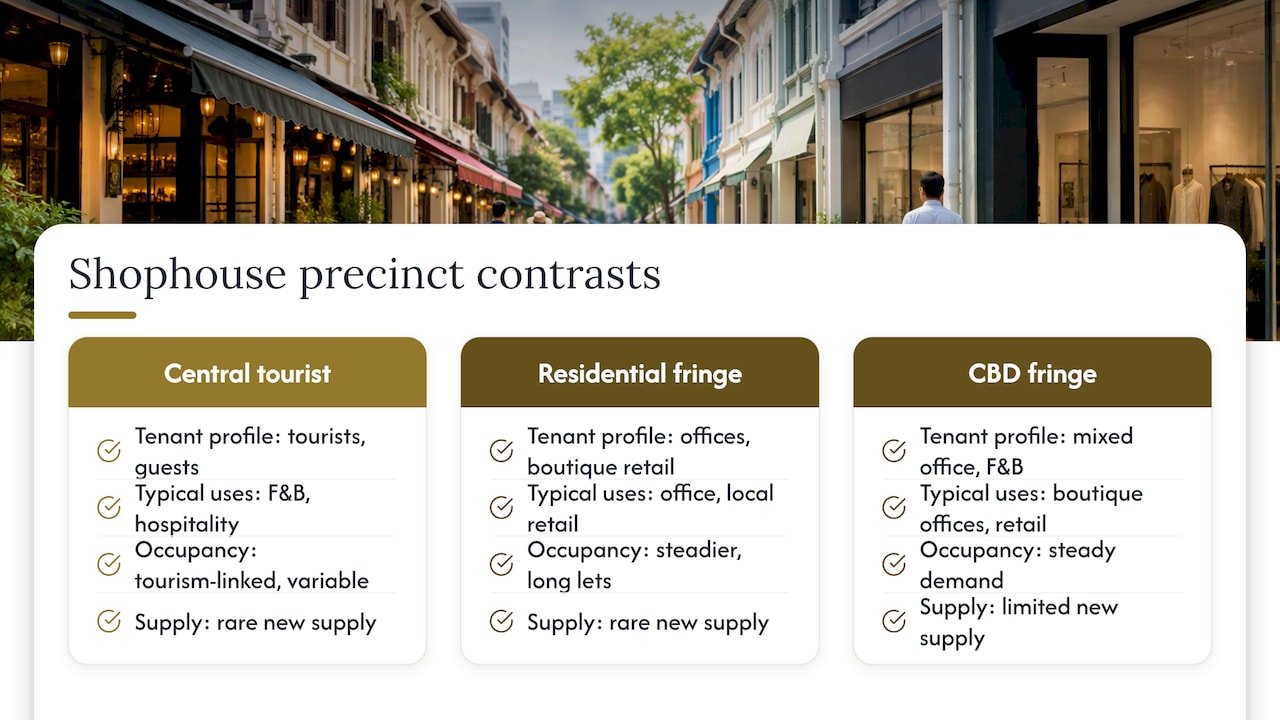
Location within Singapore’s conservation map drives value more than almost any other variable. Precincts such as Chinatown, Kampong Glam, Tiong Bahru and the Central Business District fringe each carry distinct tenant profiles and price bands, shaped by foot traffic, tourism exposure and the permitted uses URA allows in that specific precinct.
Central, tourist-facing precincts tend to support hospitality and F&B conversions, while quieter residential-fringe conservation areas lean toward office and boutique retail tenants with steadier occupancy. Neighbourhood regeneration, such as nearby transport upgrades or adjacent redevelopment, can shift a precinct’s appeal over a five to ten year horizon, so investors should look beyond the current streetscape to planned infrastructure nearby.
Proximity to MRT stations and established retail clusters generally supports stronger rental demand, though conservation precincts rarely see new supply, which means a well-located shophouse holds its relative position even when wider market sentiment softens. Checking the precinct’s specific use restrictions against your intended tenant mix, before comparing price per square foot across precincts, avoids comparing assets that cannot legally serve the same purpose.
Potential for rental income and tenant types
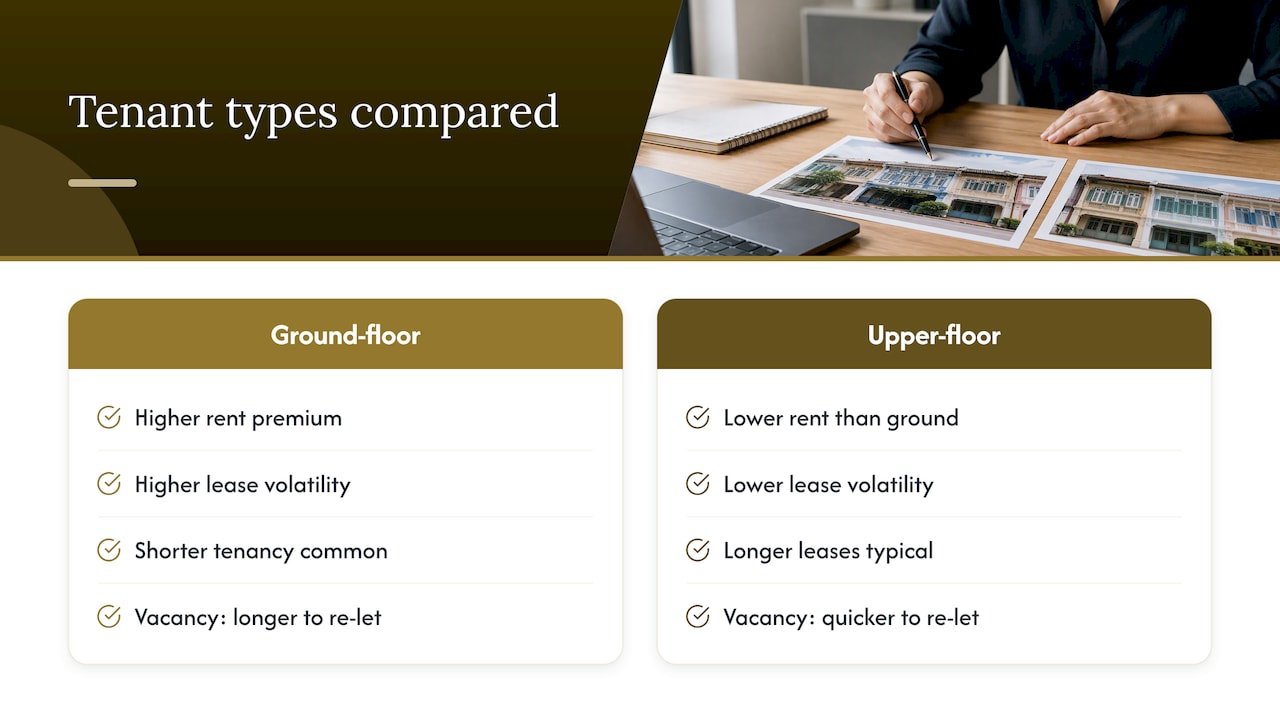
Rental income from a shophouse depends heavily on which tenant category occupies the ground floor versus the upper storeys, since conservation shophouses are often let across multiple uses within a single building. Ground-floor retail or F&B tenants typically pay a premium over upper-floor office or residential-style tenants, reflecting footfall value.
Tenant mix commonly includes specialty F&B operators, boutique retailers, professional services firms and, increasingly, hospitality operators running serviced accommodation or boutique hotel concepts where permitted. Each tenant type carries a different risk profile: F&B tenancies can command higher rent but face licensing and fit-out costs that increase turnover risk, while office or professional-services tenants tend to sign longer leases with lower volatility.
Investors modelling rental income should separate the ground floor and upper floors in their underwriting, since blending the two into a single average yield figure masks the real variance between tenancy types. Vacancy risk also differs by tenant category, with F&B space often taking longer to re-let given fit-out requirements, which should be factored into any income projection alongside a realistic restoration capex allowance.
Long-term capital appreciation prospects
Capital appreciation in the shophouse segment is underpinned by a structural feature unique to this asset class: supply cannot expand. Conservation status under URA guidelines fixes the stock of gazetted shophouses, so demand growth from family offices, HNWIs and selective institutional buyers presses against a ceiling that never moves.
That scarcity has historically supported price resilience even through periods of softer transaction volume, such as the slowdown observed in H1 2025. Appreciation is rarely driven by rental growth alone, given the modest yields typical of the segment, but rather by the combination of scarcity, precinct desirability and the building’s adaptive reuse potential.
Investors should treat capital appreciation as a medium to long-term outcome tied to holding discipline rather than short-term trading. A shophouse bought with a clear operating plan and a realistic restoration budget tends to appreciate more reliably than one bought purely on heritage sentiment without a defined use case.
Impact of government policies on shophouse investment
Government policy shapes shophouse economics on two fronts: conservation rules that protect supply, and tax policy that affects transaction cost. URA’s conservation framework is the reason shophouses retain scarcity value, but it also constrains what an owner can do with a unit, meaning policy changes to permitted-use lists directly affect which buyers will bid on a given property.
On the tax side, IRAS stamp duty guidance ties ABSD and SSD exposure to zoning and permitted use, so any future adjustment to those thresholds or definitions would change the relative appeal of purely commercial shophouses versus mixed-use ones. Cooling measures aimed at residential property have historically left purely commercial conservation shophouses largely outside their scope, which is part of why this segment attracts buyers seeking to reduce their ABSD exposure.
Investors should watch for changes to GoBusiness processing requirements, URA precinct masterplans, and any adjustment to GST apportionment rules for mixed-use buildings, since each can shift the relative cost of holding a given shophouse. Our breakdown of recent SSD rule changes covers one such adjustment worth factoring into exit timing.
Exit strategies and market liquidity considerations
Shophouses are not a liquid asset class, and exit planning deserves as much attention at purchase as the initial due diligence. The pool of qualified buyers is narrow, dominated by family offices, HNWIs and a handful of institutional players, which means a sale can take considerably longer than a typical residential or standard commercial transaction.
Liquidity tends to be stronger for units with clear, flexible permitted use and weaker for those tied to a single restrictive tenancy type or pending conservation approvals. Transaction volumes reported for 2025 suggest a market that rewards well-documented, use-flexible assets even when overall activity slows, as buyers shifted away from F&B-heavy stock toward living-sector and hospitality conversions.
Practical exit options include an outright sale to another private buyer, a sale to an operator seeking an established tenancy, or, in some cases, a long-term lease structure that preserves ownership while generating income until market conditions favour a sale. Whichever route is chosen, keeping documentation, permitted-use records and restoration history in order from day one materially shortens the time a future buyer needs to complete due diligence.
Author perspective: positioning shophouses in a private-wealth portfolio
We generally frame shophouses as a ten-year-plus holding, suited to capital preservation first and income second, since yield compression is the price of scarcity. Clients chasing cash flow are usually better served by standard commercial stock; those building a legacy portfolio tend to accept the lower yield for the scarcity premium. Our approach includes ABSD-aware structuring and independent valuation support, so the tax position is clear before an offer goes in.
— Anderson
How Register Today helps investors find and transact shophouses in Singapore
We offer a free property valuation service to help benchmark a shophouse against comparable conservation stock, alongside commercial listings including shophouse and mixed-use opportunities in Singapore’s conservation precincts. We provide negotiation support and conduct detailed market evaluations to identify gaps between asking price and underlying value.
We structure transactions with ABSD considerations in mind and provide information on how zoning and permitted use affect stamp duty exposure, helping investors understand total transaction costs before bidding. For financing context on loan-to-value limits that affect cash requirements, our partner’s breakdown of Singapore loan-to-value rules is a useful companion read. Start with a free property valuation or browse current commercial listings to see what fits your mandate.
FAQ
What is a typical rental yield for a Singapore shophouse?
The exact figure depends on tenure, permitted use and tenancy mix, so each unit needs individual modelling rather than a blanket assumption.
Do shophouses attract ABSD in Singapore?
Purely commercial shophouses generally sit outside Additional Buyer’s Stamp Duty, but IRAS guidance confirms that any residential-zoned component within the same building can still attract it. Confirming the building’s zoning and permitted use before purchase is essential to knowing your actual exposure.
Do I need URA permission to change how a shophouse is used?
Yes, buildings within a Historic Conservation Area require conservation permission for a change of use, and some uses such as hotels or backpacker hostels are restricted in specific precincts. Applications are typically submitted through GoBusiness Singapore ahead of any change in operation.
Is GST charged on shophouse sales and rentals?
For mixed-use shophouses, GST applies only to the non-residential portion of a sale or lease, and an independent valuer’s apportionment is commonly required to separate the residential and commercial shares. Purely commercial units follow standard GST treatment for the non-residential portion.
How can Register Today help with a shophouse purchase?
We provide a free property valuation and commercial listings covering shophouse and mixed-use opportunities, alongside personalised negotiation support and ABSD-aware structuring guidance. Investors can start with a valuation request to establish a realistic price benchmark before making an offer.
Sources
- Understanding the Shophouse | Urban Redevelopment Authority (URA)
- Shophouse sales slow in H1 amid macro volatility; investors shift away from F&B assets — The Business Times


